
«Drop-and-Go» Automation: How RFID UHF Self-Checkout Systems Work
Classic barcode-based self-checkout terminals are hitting a technological ceiling. Shoppers still hunt for barcodes on every item, rotate products in front of the scanner, and any weight-platform error triggers a tedious wait for the store assistant. RFID UHF technology rewrites this experience under the «Drop-and-Go» concept: the customer pours the basket into the checkout bin, and the system reads every tag in fractions of a second.
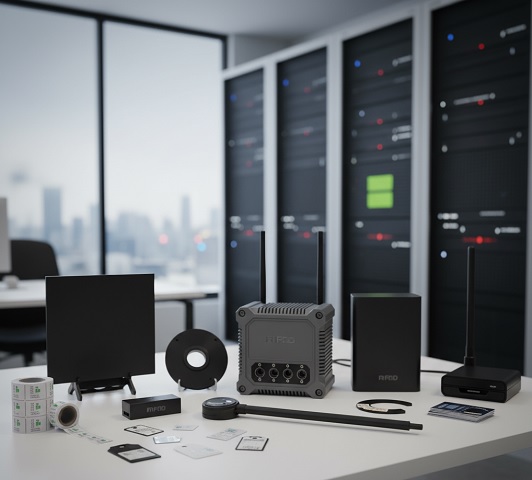
Anatomy of an RFID Self-Checkout Terminal
An RFID checkout is not a terminal with a single scanner — it is a sophisticated radio-engineering structure with four core modules.
Shielded Enclosure
The walls of the cabinet or read chamber are made of metal or lined with radar-absorbent materials (RAM). This is critical for isolation: the antenna must read tags only inside the bin and ignore goods in neighbouring trolleys.
High-Performance UHF Reader
The heart of the system is typically a module based on a modern chipset: Impinj E710 or the proven Impinj R2000. Sensitivity down to −92 dBm and stable Bulk Reading of 50–100 tags per second in a confined space.
Near-Field Antennas
Directional antennas with a tightly controlled radiation pattern. Their job is to keep the reliable read zone strictly inside the bin and minimise false reads.
Hybrid Data Capture Module
RFID does not eliminate the classic 2D barcode or QR scanner. It is still needed for loyalty cards on smartphone screens, coupons, and items that cannot carry RFID tags.
The Physics: Overcoming the Limitations
Metals and Liquids
If the basket contains items with water or metal (foil, hardware, cans), a standard UHF tag may fail to read due to antenna mismatch. The solution: hybrid on-metal tags, strict zoning of product placement, and software algorithms that cross-check basket weight against the number of captured EPC codes.
Signal Overlap (Anti-Collision)
When dozens of items with crumpled tags enter the field simultaneously, their signals overlap. The EPC Gen2 protocol (ISO 18000-6C) with Q-selection sequentially puts read tags into «sleep» (Session 1/2/3), identifying every unique chip in a pile of clothes within milliseconds.
Global Experience: Three Integration Approaches
Uniqlo: Full-Cycle on Fast Fashion
Tags are sewn directly into paper price labels at the factory. The customer drops a pile of clothing into the plastic recess of the checkout — reading takes less than a second. The system instantly displays the specification: sizes, colours, models, and the total amount.
Decathlon: Enclosed Automatic Bins
To minimise external noise, Decathlon in many countries uses checkouts with a deep niche, where the antenna faces strictly downward. This allows a stronger reader signal to reliably penetrate dense winter garments, footwear, and sports gear without the risk of reading a neighbour's cart.
Zara (Inditex): Reusable Hard Tags
The RFID chip is integrated directly into a hard plastic acoustic-magnetic tag (hard tag). The self-checkout is equipped with a dedicated slot: the customer presents the item, the checkout reads the code, and after payment the lock automatically releases — the customer drops the tag into a collector for reuse. A closed loop: the tag returns to the factory, is attached to a new garment, and comes back to the store. Exit gates (EAS) are linked to a cloud database: if the EPC code is marked as paid, the alarm does not trigger.
Economics: Where the Technology Pays Off
The main barrier to deployment is the cost of the tag itself. Applying an RFID tag to a carton of milk or a loaf of bread in small-format grocery remains economically unviable. However, in segments with a high average basket value and margin — fashion, footwear, sporting goods, electronics, perfumery — a payback in the 12–18 month range is achieved through three factors.
| Factor | Effect |
|---|---|
| Queue reduction | Checkout throughput increases 3–4 times |
| Inventory accuracy | A unique EPC per item → stock updates in real time |
| Shrinkage reduction | Integration of POS software with EAS systems removes cashier errors |
Frequently Asked Questions
«Drop-and-Go» is an approach where a customer pours items into the self-checkout bin, and the system automatically reads all RFID tags in fractions of a second and calculates the total — no manual barcode scanning required.
The UHF band (860–960 MHz) provides read ranges of several meters and high-speed Bulk Reading of 50–100 tags per second. HF and NFC operate within centimeters, which is not viable for identifying dozens of items in a basket simultaneously.
It uses the EPC Gen2 (ISO 18000-6C) protocol with the Q-selection anti-collision algorithm. The reader sequentially puts tags into «sleep» mode after a successful response, enabling identification of every unique chip in a pile of clothes within milliseconds.
A 12–18 month payback is achieved in segments with high average basket value and margin: fashion, footwear, sporting goods, electronics, and perfumery. In small-format grocery, tag cost still makes deployment economically unviable.
- Impinj E710 Endpoint IC — official documentation
- Impinj R2000 Reader Chip — datasheet
- EPC Gen2 UHF RFID standard (ISO/IEC 18000-6C) — GS1
- Fast Retailing (Uniqlo) — Sustainability Reports
- Decathlon — self-checkout technology and innovation
- Inditex (Zara) — RFID and retail innovation
- RAIN RFID Alliance — UHF RFID standards and case studies
© RFID Ukraine — international expertise in RFID automation