



Drones after the war: where will the machines that learned to survive go?
An engineering perspective on the future of technology
There is a certain irony in the fact that the biggest technological leap in the civilian drone industry occurred precisely during the destruction. Long before any startup had time to write a pitch deck about "autonomous monitoring," thousands of operators in real-world conditions learned to fly in the face of radio interference, without GPS, in the dark, in the rain — and return with data.
This is not abstract knowledge. It is a well-practiced skill that will transform into a competency after the end of hostilities. And this competency will seek application.
A drone that has learned to navigate without GPS in active interference conditions has no difficulty operating over a construction material warehouse on a cloudy day. The only question is — where exactly will it fly, and will it truly be useful there?
Construction: an industry where chaos is the norm
▸ real situation
Seven in the morning. The crane is already working on the construction site, the concrete mixer is waiting its turn, and three people have been looking for a pallet of rebar for twenty minutes, which, as it turns out later, was standing behind a container the whole time. We can 3D-print houses, but we still look for materials by phone.
A construction site is one of the least digitized working environments in the modern economy. An industry that builds skyscrapers and digs tunnels still records materials in a paper logbook with a person walking the perimeter with a clipboard.
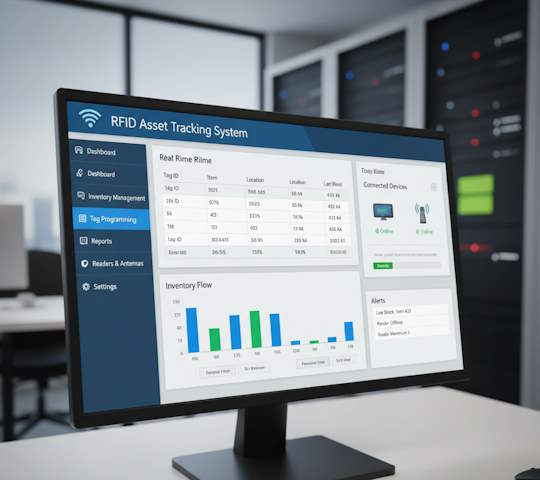
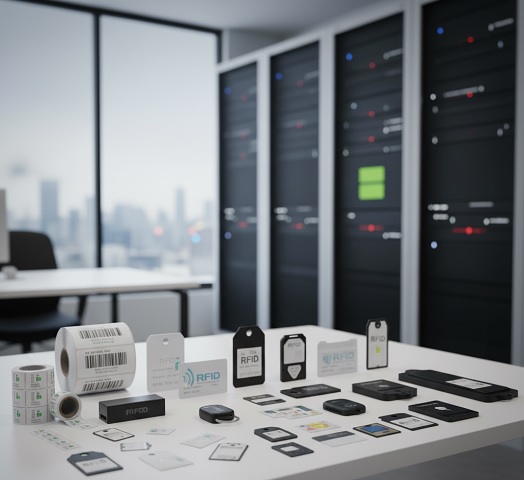
A passive UHF RFID tag costs less than a cup of coffee. Attached to a pallet of rebar, a pipe, or a bag of cement at the checkpoint, it turns the material into a digital object — with an identifier, arrival time, and unloading point.
A drone with an attached UHF reader flies over the site on a schedule or on demand. In one minute of flight, it reads up to a thousand tags — what a person with a handheld scanner would do for several hours. After landing, the system automatically generates a report: what is available, where exactly, what is missing, and what is in the wrong place.
No need for expensive stationary cameras around the perimeter. One mobile system replaces infrastructure that would cost many times more.
Concrete pouring is one of the most manipulation-prone processes on a construction site. Volumes, mixer arrival time, mix grade — all this is traditionally recorded by a person with a pen, who can make a mistake or "not notice" a discrepancy.
An RFID tag on a vehicle triggers at the checkpoint. The system automatically activates a drone. It accompanies the process: records arrival time, geolocation of the pouring point, and duration of the operation. The video recording is rigidly tied to the digital log and cannot be altered retroactively.
The result is not just convenience, but the elimination of an entire class of abuses that cost the construction industry millions each year.
What is already happening in the world
While active hostilities continue in Ukraine, other countries are quietly undergoing the same reassessment — only from the civilian side. A few examples worth knowing, not for citation, but to understand the scale.
Safety at height: where a drone saves not money, but lives
There is one scenario rarely discussed in the context of ROI and payback tables — but it is perhaps the most important.
▸ real situation
A weld on a structure at a height of twenty-eight meters.
To inspect it, you need to put on safety gear, climb the scaffolding, find the right viewing angle — and possibly realize that there is nothing critical.
Or launch a drone. Three minutes. The same result.
This is not about laziness. It's about the fact that a person at height is always a risk, even if the safety gear is on and the weather is good.
The daily reality of a construction worker or power engineer — climbing towers, cranes, scaffolding for visual inspection that could in principle be done remotely. A drone with a good camera does the same in minutes, risking nothing.
If a tool falls from a height — a drone will find it in minutes, instead of hours of searching over a large area. This is not automation for automation's sake — it's the elimination of a risk that always existed but was accepted as normal.
The most expensive resource on a construction site is not rebar or concrete. It is a qualified specialist whom there is no point in sending to height just to look at something.
Post-war Ukraine: a specific context
When discussing the peaceful use of drones in Ukraine, it is impossible not to consider the specifics of what will happen after the end of active hostilities.
Rebuilding destroyed infrastructure means thousands of sites simultaneously, limited resources, and the need to control costs and quality in conditions where physical presence of an inspector is impossible or too slow.
Weekly drone flyovers capturing progress, linking to project documentation, and automatically generating reports — this is a technology that already exists and can be deployed across hundreds of sites simultaneously. For international organizations funding reconstruction, this solves a key problem: how to track the targeted use of funds without constant physical presence at each site.
Humanitarian logistics has a chronic problem: cargo has arrived, but where is it — unknown. RFID marking combined with drone inventory allows real-time visibility of where each pallet is — from a warehouse in Poland to a temporary storage site in a frontline city.
For systems working under pressure and with incomplete information, the absence of «blind spots» in logistics is a matter of efficient resource allocation, where every hour of delay has a cost.
What to be honest about
Any technology requires a sober assessment of limitations, and drones are no exception.
Regulatory uncertainty. In Ukraine, as in most countries, rules for commercial flights in populated areas are still being formed. What is technologically possible today may be legally blocked in a specific location.
Limited flight time. Most commercial drones stay aloft for 25–35 minutes. Large sites require either multiple machines or charging stations on site.
Weather dependency. Strong wind, rain, snow limit or prevent flights. A drone is not a 24/7 tool.
Reading tags on metal. UHF RFID and metal — a difficult combination. A tag attached directly to a metal surface without a special backing reads inconsistently. This can be solved technically, but requires careful selection of the tag type for each surface.
Brief summary
- Drones are a ready-made tool. Machines that have been through extreme conditions have a competitive advantage over laboratory samples.
- Construction is the primary beneficiary. An industry with chronic chaos gains transparency of inventory and quality control without unnecessary costs.
- Occupational safety is not marketing. Replacing a person at height is not about saving money — it's about saving lives.
- Ukraine has unique experience. Operators who flew in interference conditions can scale solutions faster than any competitor.
- Limitations are real. Regulatory, weather, and technical barriers do not disappear; they must be considered at the design stage.
- Automation does not take away jobs. It redistributes attention — from routine patrol to data analysis.
- Ready for reconstruction. Drone solutions can be deployed across hundreds of sites simultaneously — saving time and resources.
Instead of a conclusion
Drones will not replace engineers, site managers, or warehouse workers. They will replace specific routine operations — those that require a person to be in an inconvenient place at an inconvenient time to collect data that will then be manually entered into a spreadsheet anyway.
By freeing people from this, we get not unemployment, but a redistribution of attention. An engineer who does not walk around the site for three hours with a scanner has three hours to analyze the data the drone just collected.
Ukraine is entering this transition with a unique set of competencies: thousands of people who know how drones behave in extreme conditions and understand their real capabilities without illusions. This is no small advantage.
Machines that learned to survive in the harshest conditions
are ready for peaceful work better
than any laboratory development.
Sources and regulatory framework
The following publicly available standards and recommendations were used in preparing this material:
- ISO — International Organization for Standardization
- ASTM — American Society for Testing and Materials
- FAA — Federal Aviation Administration
- EASA — European Union Aviation Safety Agency
- BuildingSMART — International Alliance for Building Information Modeling (BIM)
Specific links to technical documents are not provided as they are frequently updated. We recommend referring to the current versions on the official websites of the organizations.