



Automating Construction Equipment and Surveying Asset Tracking: Traceability in Tunnel and Railway Projects
Case study update date:
Tunnel and railway construction involves managing thousands of high‑value assets in extreme conditions. UHF RFID with rugged IP68/IP69K tags ensures accurate inventory, reduces equipment loss by up to 60%, and improves inventory accuracy to 99.2%.
Introduction: The Cost of Loss
Tunnel and railway construction is not just an engineering challenge—it is a logistical operation involving high‑value assets. Every hour of equipment downtime can cost tens of thousands of dollars, and losing a single unit can delay schedules for weeks. Traditional methods—paper logs, spreadsheets, QR codes—fail at scale: large sites involve thousands of machines, tools, and surveying instruments scattered across kilometres of underground workings.
RFID technology provides a systematic solution: passive tags attached to each asset, combined with fixed and handheld readers, enable real‑time tracking without contact or on‑tag power sources.
Why UHF RFID is the Construction Site Standard
Unlike QR codes (which require line‑of‑sight and manual scanning) or Bluetooth beacons (with limited battery life), UHF RFID operates in the 860‑960 MHz band and offers:
- Read range up to 12 meters – ideal for entry/exit checkpoints and crane‑mounted antennas.
- Simultaneous reading of hundreds of tags – one fixed reader identifies over 200 objects per second.
- No battery dependency – passive tags last for decades.
- Operation on metal surfaces – when using specialized on‑metal tags.
The Specifics of Tunnel and Railway Construction
Tunnel sites present extreme conditions for any equipment:
- Metal surfaces – all machinery, from drill rigs to rail carts, is made of metal, which can shield radio signals.
- High humidity and water – water is ever‑present, and equipment is regularly washed with high‑pressure jets.
- Shock and vibration – drilling, heavy movement, and blasting generate massive mechanical stress.
- Chemical exposure – lubricants, fuels, concrete mixes, and chemical additives aggressively attack materials.
Standard RFID tags fail within days under these conditions.
Rugged IP68/IP69K Tags: Technical Requirements
For tunnel and railway construction, tags must meet IP68 and IP69K standards:
| Characteristic | IP68 | IP69K |
|---|---|---|
| Dust protection | Total (6) | Total (6) |
| Water protection | Immersion >1 m for 24+ hours | High‑pressure water jets (100 bar, 80°C) |
| Mechanical strength | Shock, vibration | Shock, vibration, compression up to 13,000 psi |
| Temperature range | –40°C to +85°C (up to +250°C for special versions) | –40°C to +85°C |
Examples of industrial tags:
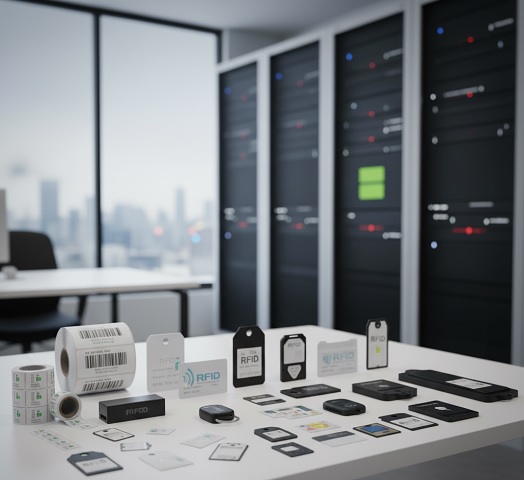
- Xerafy XPLORER Surface – IP68/IP69K, withstands compression up to 13,000 psi (89 MPa), resistant to drilling and hydraulic fluids.
- Xerafy ROSWELL – patented IP69K design, withstands heavy impacts, vibration, and sandblasting.
- HID InLine Tag – IP68/IP69K protection, designed for trucks, wagons, and trains.
- X03A0 Series (Xerafy) – specially designed for construction equipment, vehicle chassis, and containers.
- S‑Tag 3D Multilock 2.5 – combines RFID read range up to 5 m with a locking mechanism on a steel cable.
- GAORFID Hi‑Temp UHF Tag – IP68/IP69K, resistant to high pressure, vibration, and chemicals.
System Architecture
A typical configuration for a construction site:
| Component | Function |
|---|---|
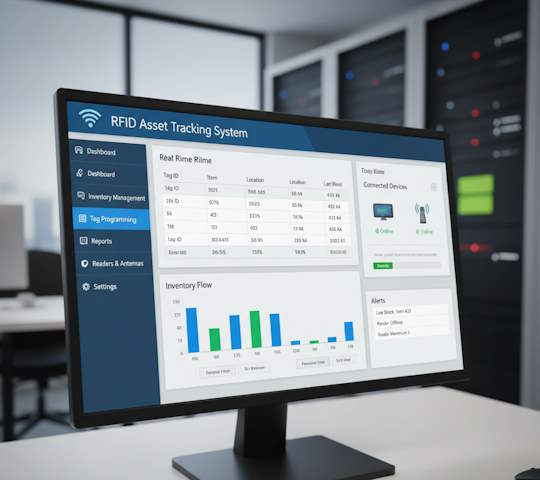
| Fixed readers | Installed at entry/exit points, staging areas, warehouses – automatic asset movement tracking |
| Handheld scanners | For inventory, inspections, and handover to subcontractors |
| Asset tags | On excavators, drill rigs, surveying instruments, welding machines, fall‑protection systems |
| Cloud platform | Centralized storage for location, status, and maintenance history |
Key use cases:
- Entry control – equipment is automatically logged when crossing checkpoints.
- Warehouse inventory – handheld scanners verify all assets in minutes.
- Tunnel traceability – readers along the tunnel track equipment and personnel movement.
- Maintenance scheduling – the system alerts for planned servicing based on actual usage data.
Real‑World Case Studies
1. Brisbane Tunnel Project (Australia, 2008–2010)
During the construction of two 4.8‑km tunnels, an active RFID system tracked 1,700 workers and all construction equipment. Tags were read at entry/exit points and emergency assembly areas.
2. Qatar Mega‑Projects (Lusail, Doha Metro, Ras Bufontas)
Simultaneous management of 15,000 assets across three sites using UHF RFID. IP68/IP69K tags on excavators, welding machines, and fall‑protection systems.
3. Wattro GmbH (Germany)
The German tool management solutions provider implemented Xerafy OUTDOOR series tags to automate tool issuance and return on construction sites.
Results and Benefits
- Reduction in equipment loss – up to 60% (according to GAO RFID data).
- Inventory accuracy – up to 99.2%.
- Time saved searching for equipment – 35% or more.
- Full asset traceability even in challenging terrain, tunnels, and high‑load conditions.
- The technology has proven its effectiveness on major infrastructure projects worldwide and continues to scale as standards evolve and costs decrease.
Economic Impact
- Downtime reduction – rapid equipment location cuts unplanned downtime by 30–50%.
- Inventory optimization – accurate tracking prevents over‑procurement and unnecessary rental.
- Planned maintenance improvement – automatic usage tracking prevents unexpected breakdowns.
- ROI on RFID systems for large construction projects typically ranges from 12 to 24 months due to loss prevention and efficiency gains.
Sources
| Source | Description |
|---|---|
| GAO RFID Inc. | IoT & M2M Solutions for Civil Engineering Industries |
| RFID Journal | Brisbane Tunnel Construction |
| RFIDHY | RFID for Qatar Construction Sites |
| Xerafy | Wattro Construction Tool Tracking; XPLORER Surface / ROSWELL series |
| GAO RFID | Construction and Mining UHF RFID |
Frequently Asked Questions (FAQ)
Why is UHF RFID preferable over QR codes or Bluetooth beacons for construction sites?
UHF RFID provides read ranges up to 12 meters, simultaneous reading of hundreds of tags, no battery dependency (passive tags last for decades), and works on metal surfaces when using specialized on‑metal tags—all critical for construction equipment tracking.
What protection standards are required for RFID tags in tunnel construction?
In high‑pressure, humid, impact‑prone, and chemically aggressive environments, tags must meet IP68 (total dust protection, prolonged immersion) and IP69K (protection against high‑pressure water jets up to 80°C). Mechanical shock and vibration resistance are also essential.
Which real‑world projects demonstrate the effectiveness of RFID for construction asset tracking?
Notable examples include the Brisbane Tunnel Project (Australia) – tracking 1,700 workers and equipment; Qatar Mega‑Projects – managing 15,000 assets across three sites; and Wattro GmbH (Germany) – automating tool issuance and return using Xerafy rugged tags.
Legal & SEO Note
This information is for reference purposes only and is based on public sources. References to trademarks (Xerafy, HID, GAO RFID, etc.) do not imply affiliation. Professional consultation is recommended for adaptation to specific business needs.