




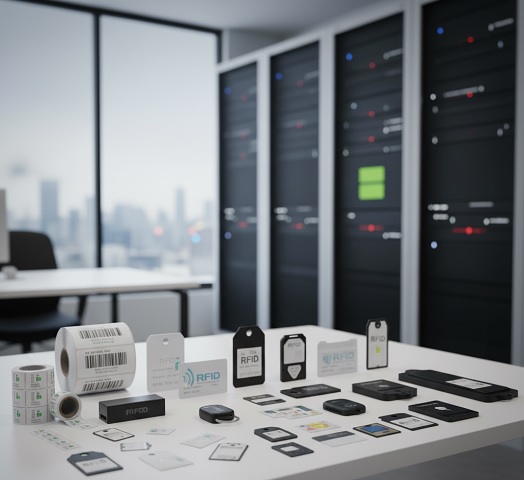
UHF RFID in Logistics: RTI Resistance to Alkaline Wash and Vibration (868 MHz)
🆔 Specification: Automated Wash Tunnels (Standards: ISO 18600, VDA 4902) | Status: Verified
🎯 MATRIX VECTOR: Industry [Logistics / RTI] × Frequency [868 MHz] × Environment [Wash 85°C + NaOH] × Topic [Chemical Degradation + Fatigue]
1️⃣ Problem Statement
In modern warehouse logistics, a critical bottleneck is the reliability of RFID tags on returnable transport items (plastic bins, pallets) in automated wash tunnels. Standard tags are destroyed by combined factors: thermal shock (transition 20°C → 85°C → 20°C), chemical aggression (0.5–1.0% NaOH, pH 11–12), and mechanical shear (nozzle pressure 30–50 bar + conveyor vibration). This leads to antenna delamination, substrate hydrolysis, and >40% read loss after 100 cycles, violating traceability principles under VDA 4902.
2️⃣ Engineering Context
| 🌡️ Temperature regime | Wash 85°C → Drying 60°C → Storage 20°C (cyclic) |
| 🧪 Chemical environment | NaOH 0.5-1.0% (pH 11-12), surfactants, disinfectants |
| 💧 Mechanical impact | Jet pressure 30-50 bar, AGV/conveyor vibration |
| 🔐 Requirements | Service life >500 cycles, ISO 18600 (Packaging), VDA 4902 |
⚠️ CRITICAL METRIC: Standard epoxy coatings at 85°C in NaOH lose adhesion by 15-20% per cycle. After 50 cycles, complete delamination occurs. Alkali penetration to the aluminum antenna accelerates corrosion 3-4 times compared to a neutral environment.
3️⃣ Mathematical Modeling: Fatigue and Diffusion
D_fatigue = Σ (n_i / N_i)
📥 Palmgren-Miner rule (Mechanics):
D — damage coefficient. Failure occurs when D ≥ 1.
n_i — number of load cycles at stress level i.
N_i — limiting number of cycles to failure at level i.
📊 Resource calculation (Conveyor vibration + Wash):
Cycle 1 (Vibration): n=5000, N=50000 → D1 = 0.1
Cycle 2 (Water jet): n=50, N=500 → D2 = 0.1
Cycle 3 (Thermal shock): n=100, N=2000 → D3 = 0.05
Total D over 100 cycles ≈ 0.85. Safety margin exhausted.
D — damage coefficient. Failure occurs when D ≥ 1.
n_i — number of load cycles at stress level i.
N_i — limiting number of cycles to failure at level i.
📊 Resource calculation (Conveyor vibration + Wash):
Cycle 1 (Vibration): n=5000, N=50000 → D1 = 0.1
Cycle 2 (Water jet): n=50, N=500 → D2 = 0.1
Cycle 3 (Thermal shock): n=100, N=2000 → D3 = 0.05
Total D over 100 cycles ≈ 0.85. Safety margin exhausted.
💡 Alkali diffusion model (Fick's law):
Penetration depth: x ≈ √(2 · D_diff · t)
Where D_diff — diffusion coefficient of NaOH in polymer at 85°C.
For standard PET: D_diff ≈ 10⁻⁸ cm²/s → Penetration in 5 min: 15 µm (reaches antenna).
For ETFE (fluoropolymer): D_diff ≈ 10⁻¹¹ cm²/s → Penetration in 5 min: 0.5 µm (barrier preserved).
Conclusion: Ordinary substrates do not protect the antenna in hot alkali. A fluoropolymer barrier is required.
Penetration depth: x ≈ √(2 · D_diff · t)
Where D_diff — diffusion coefficient of NaOH in polymer at 85°C.
For standard PET: D_diff ≈ 10⁻⁸ cm²/s → Penetration in 5 min: 15 µm (reaches antenna).
For ETFE (fluoropolymer): D_diff ≈ 10⁻¹¹ cm²/s → Penetration in 5 min: 0.5 µm (barrier preserved).
Conclusion: Ordinary substrates do not protect the antenna in hot alkali. A fluoropolymer barrier is required.
4️⃣ Technical Analysis: Material Degradation
| Coating material | Resistance to NaOH (85°C) | Water absorption coefficient | Service life (cycles) |
|---|---|---|---|
| Epoxy resin (Standard) | Low (hydrolysis) | 0.8% | 50-100 |
| Polyurethane (PU) | Medium | 0.2% | 150-200 |
| ETFE / Fluoropolymer | High (inert) | <0.01% | 500+ |
*Data based on polymer chemical resistance tests (ISO 175) and field trials in logistics hubs.
5️⃣ Logistics RFID Tag Architecture (Schematic)
6️⃣ Material Comparison Matrix for Logistics
7️⃣ Failure Modes and Structural Compensation
-
Alkali diffusion and oxidation: NaOH penetrates the PET substrate, oxidizing aluminum. Solution: Use ETFE (fluoropolymer) or polypropylene encapsulation ≥1.5 mm thick. Replace aluminum with copper plus protective lacquer in aggressive environments. -
Delamination: CTE mismatch between container plastic and tag causes shear at 85°C. Solution: Apply elastic silane or acrylic adhesives with high glass transition temperature (Tg > 90°C). Embed the tag into the container body (In‑mold) instead of sticking. -
Fatigue fracture of antenna: Conveyor vibration (Miner’s rule D>1) leads to microcracks in the conductor. Solution: Increase antenna trace width (Bold Dipole) + use polyimide substrates instead of PET to raise the modulus of elasticity.
8️⃣ Engineering Conclusion
✅ RECOMMENDED: For logistics systems with automatic washing (85°C + NaOH), use only RFID tags with fluoropolymer (ETFE) or polypropylene encapsulation. Avoid standard epoxy stickers. For critical assets, prefer in‑mold tag integration or mechanical fastening (rivets/screws) to eliminate the adhesive layer. Chip: Impinj M730 or NXP UCODE 9 (high sensitivity compensates for losses in thick plastic). Expected service life: >500 cycles.
📚 Normative references (E-E-A-T):
• ISO 18600 (Packaging & Environment)
• EN 13697 (Chemical Disinfection)
• VDA 4902 (RFID in Automotive Logistics)
• ISO 18600 (Packaging & Environment)
• EN 13697 (Chemical Disinfection)
• VDA 4902 (RFID in Automotive Logistics)
🏷️ RFID Tags for Alkaline Washing & Vibration (868 MHz)
.jpg)
Convergence Systems Limited CS8300
CSL // BAP tag with temperature sensor, IP68, alkali resistant
Match: 98%
| Frequency: | 865-868 MHz (ETSI) |
| Protection: | IP68 |
| Operating Temp: | -40…+85°C |
| Feature: | Built-in sensor + battery (BAP) |
Withstands alkaline wash cycles (NaOH 85°C)
Jet pressure up to 50 bar, AGV vibration
Autonomous temperature logging for cold chain

Xerafy Roswell EU
Xerafy // IP69K, resistant to NaOH, acids and vibration
Match: 98%
| Frequency: | 865-868 MHz (ETSI) |
| Protection: | IP69K |
| Operating Temp: | -40…+85°C |
| Survival Temp: | 250°C |
Withstands exposure to NaOH, sulfuric acid and aggressive chemicals
Withstands strong impacts, vibration and sandblasting
ATEX certified for explosive environments

HID Global Epoxy Tag UHF
HID Global // Ultra-thin industrial epoxy tag IP69K
Match: 96%
| Frequency: | UHF Global (865-956 MHz) |
| Protection: | IP69K |
| Operating Temp: | -40…+90°C |
| Chip: | Alien Higgs-3 |
Withstands high-pressure, high-temperature washdowns and autoclaving
Resistant to aggressive chemicals and mechanical stresses
Embeddable in plastic via injection molding (in-mold)

Omni-ID IQ 400 EU
Omni-ID // Low-profile on-metal tag, IP68, wash resistant
Match: 95%
| Frequency: | 865-868 MHz (ETSI) |
| Protection: | IP68 |
| Operating Temp: | -40…+85°C |
| Chip: | Impinj Monza 4QT |
Reliable on-metal performance, read range up to 4 m
Withstands jet pressure 50 bar and vibration
Resistant to alkalis and disinfectants

Xtreme RFID Xtreme Tag Metal
Xtreme RFID // Ultra-rugged tag for all surfaces, IP68
Match: 94%
| Frequency: | Global UHF (ETSI/FCC) |
| Protection: | IP68 |
| Survival Temp: | 160°C |
| Pressure: | Withstands 241 bar washdown |
Withstands strong impact, high pressure and corrosive chemicals
Reliable on all surfaces including metal
Tested with 241 bar (3500 psi) pressure washer
.jpg)
TROI STI-2 EU
TROI // Screw-on rugged tag IP68, resistant to NaOH
Match: 93%
| Frequency: | 865-868 MHz (ETSI) |
| Protection: | IP68 (immersion) |
| Operating Temp: | -40…+85°C |
| Survival Temp: | 200°C |
Withstands high pressure, chemicals and prolonged water immersion
Anti-tamper screw mounting (eliminates adhesive failure)
Resistant to alkaline washing and thermal cycles