




Industrial RFID Tag Directory
| 🛠️ |
Anti‑Marketing HandbookEngineering RFID breakdown: why the datasheet’s “4×4” fails in the mud |
💡 Engineer’s analogy: Imagine you buy an off‑road vehicle. The salesperson cheerfully reports: “4×4, 250 mm ground clearance, it will take any terrain!” You happily drive, but as soon as you get into a deep puddle (water) and high‑centre on a stump (metal), the vehicle ends up in a “diagonal hang‑up”. Now only two wheels are gripping, and you call the service guy to pull you out.
The exact same thing happens with RFID tags. On paper they have “15 metres range and all‑weather capability”, but on the real site, physics is relentless. Below is an honest breakdown of how to avoid getting into a diagonal hang‑up.
INTERACTIVE “Real Range” Calculator
Enter the datasheet range and check the real‑world conditions. The script applies physical attenuation coefficients (based on the Friis equation and empirical data). The calculator does not give centimetre accuracy — it shows how much real operating conditions differ from datasheet values.
Datasheet range (m):
● Fixed reader (4W EIRP)
○ Handheld terminal (0.5–1W ERP)
Operating conditions:
☐ Mounted on metal (without proper stand‑off)
☐ Near water / liquids / high humidity
☒ Using a “global” tag (not ETSI)
|
Expected real range 15.0 m Ideal anechoic chamber conditions
|
WARNING Common RFID Datasheet Myths
| What marketing says | What physics says |
|---|---|
| 📊 Range up to 15 metres | Only in an anechoic chamber. In reality: divide by 2–3. |
| 🌡️ Temperature up to +250°C | That’s survival temp. Operating is typically up to +85…105°C. |
| 🌍 Global frequency | Lower peak gain. ETSI‑optimised tags give +15–20% more range. |
| 🔩 Metal‑compatible | Stand‑off distance is critical. Wrong gap = 80% range loss. |
| ❄️ Operates at -40°C | Electronics work, but ABS plastic will shatter on impact like glass. |
🔥 Temperature: survival vs operation
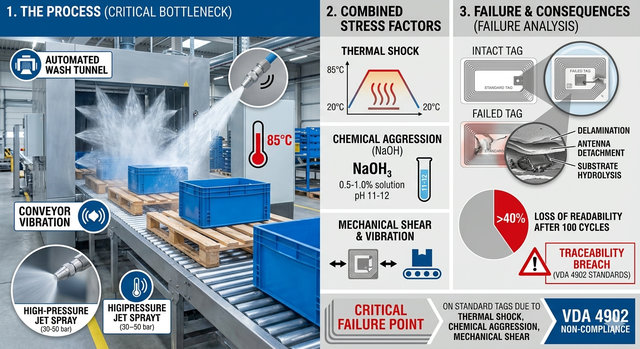
Survival Temp is short‑term heating without permanent damage. Operating Temp is limited by different coefficients of thermal expansion (CTE) of the chip and substrate, leading to antenna detachment. The real limit for most passive UHF tags is +85°C…+105°C.
📏 Range: inverse‑square law
By the Friis equation: to double the range, you must quadruple the power. A handheld terminal physically cannot deliver 15 metres. Considering antenna detuning due to the surface dielectric constant, the handheld scanner range rarely exceeds 3–6 metres.
🛡️ Metal: critical importance of stand‑off distance
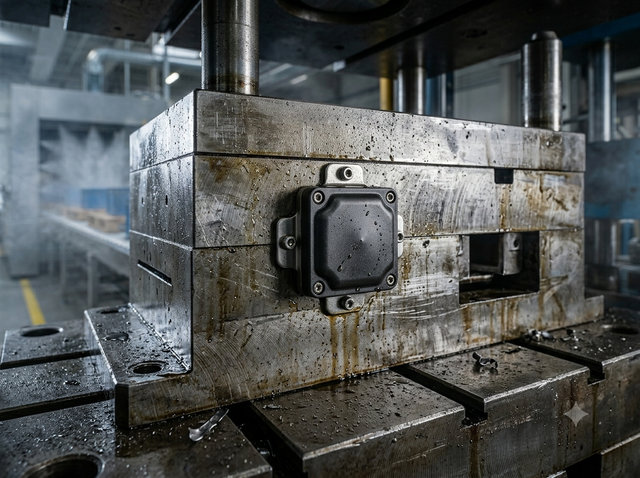
On‑metal tags use the object as a reflector. But if a tag designed for a 3–5 mm gap is glued flush to the metal, the electromagnetic field is suppressed and range drops by 80–90%. This is the main cause of field failures.
FAQ Technical Q&A
❓ Why does RFID range drop on metal?
Metal changes the antenna impedance, causing detuning and destructive electromagnetic interference. Special on‑metal tags solve this with a dielectric spacer (stand‑off distance).
❓ Why does range decrease near water?
Water has a high dielectric constant (ε ≈ 80) and absorbs RF energy at UHF frequencies, reducing effective read range by 30–70%.
❓ What is the difference between Survival and Operating Temperature?
Survival is short‑term heating without housing damage. Operating is the stable working range. Most UHF tags have Operating up to +85…+105°C, even if the brochure states +250°C.
❓ Why does a global tag perform worse in Europe?
Global tags are optimised for the wide 860‑960 MHz band. In the European ETSI band (865‑868 MHz), ETSI‑optimised tags provide 15–20% more range due to better antenna matching.
💡 Engineering checklist when selecting tags:
|
Save these rules to avoid arguments with suppliers and contractors. |