

Brady HH83 Handheld Reader for Asset Management
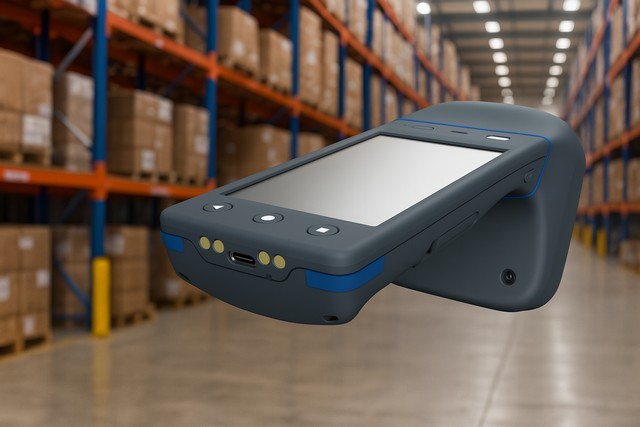
The Brady HH83 mobile RFID reader (formerly known under the Nordic ID brand) is a universal solution for enterprise data collection automation. The device combines high-performance UHF RFID scanning, reading of all popular barcode types, and operation on the modern Android OS, making it a key tool for logistics, inventory management, and asset tracking. This review examines the technical features, capabilities, and practical applications of this reader.
Author: RFID UKRAINE Experts
Last Updated: December 05, 2025
Technical Specifications and Design
The Brady HH83 is a rugged industrial handheld computer, engineered in Finland for operation in demanding environments. Its build ensures reliability and ease of use throughout an entire work shift.
Key Device Specifications
| Parameter | Specification | Note |
|---|---|---|
| Operating System | Android 10 | Standard environment for application development |
| Processor & Memory | 8-core ARM 1.8 GHz, 2 GB RAM, 16 GB Flash | Available MicroSDXC card slot |
| Display | 4.69" HD (1280x720), Capacitive, Gorilla Glass 3 | Sunlight-readable, supports gloved operation |
| Ruggedness | IP65, drop-tested from 1.6 m (5 ft) | Dust and water jet protection, shock-resistant |
| Battery | Removable Li-Ion 6700 mAh | Up to 18 hours of operation, hot-swap support |
| Dimensions & Weight | 211x84x132 mm, ~515 g (1.13 lb) | Ergonomic design for prolonged use |
Interfaces and Connectivity
The reader features a comprehensive set of wireless and wired interfaces for corporate IT integration: dual-band Wi-Fi 802.11 a/b/g/n/ac, Bluetooth 4.2, and USB-C for charging and PC connection. The device is also equipped with a 5-megapixel autofocus camera and flash, expanding its capabilities for documentation purposes.
Scanning Functionality: RFID and Barcodes
The core strength of the HH83 is its hybrid data capture engine, enabling a single device to work with both RFID tags and visual codes.
- UHF RFID: Supports the ISO 18000-63 standard (EPC Class 1 Gen 2). Read speeds reach up to 1000 tags per second. The software-controlled adaptive antenna with circular polarization ensures stable reading at distances of up to 15 meters (50 feet), depending on conditions and tag type.
- Barcodes (1D/2D): The built-in 2D imager reads all common linear and matrix codes, including Data Matrix, QR, PDF417, as well as all types of product codes like EAN/UPC, Code 128, Code 39, and others.
- Additional Technologies: The device also supports NFC tag scanning, opening possibilities for access control applications or interactive engagement.
Applications and Business Use Cases
Thanks to its versatility and reliability, the Brady HH83 finds application across various industrial and logistics sectors where accurate and rapid data collection is required.
Typical Usage Scenarios
| Application Area | Tasks Solved | HH83 Advantages |
|---|---|---|
| Warehouse Inventory Management | Stocktaking, goods receipt/dispatch, item location | Speed of RFID scanning for pallets and cases, drop protection |
| Asset Tracking | Equipment, IT asset, tool, and vehicle management | UHF read range, ability to read tags without direct line-of-sight |
| Manufacturing (Work in Process) | Tracking workpieces on the shop floor, operation time logging | Resistance to industrial environments (dust, moisture), gloved operation |
| Logistics & Distribution | Sorting, cross-docking, order fulfillment verification | Combined scanning of RFID on pallets and barcodes on cartons |
The manufacturer also notes the device’s application for item labeling, security control, and working with temperature indicators. Programmable keys and haptic feedback (vibration) simplify the operator’s work.
Software and Ecosystem
Operating on the open Android 10 platform provides maximum flexibility for businesses. Companies can develop custom applications or use ready-made industry solutions.
- Unified API (NUR API): Brady provides a single software interface for managing RFID and barcode scanning functions, significantly reducing integration and development time.
- Accessories: A wide range of additional equipment is available for the device: spare batteries (3350 or 6700 mAh), holsters, 4-bay charging stations, which is convenient for managing a fleet of readers.
- Support: The official equipment warranty is 2 years. The manufacturer supplies detailed user manuals for quick start-up.
Economic Efficiency and Total Cost of Ownership (TCO)
Investing in equipment of this class requires a return-on-investment analysis. When assessing the total cost of ownership, it’s important to consider not only the price of the reader itself but the overall economic impact of process automation.
Cost-Benefit Analysis
| Cost/Benefit Item | Description | Business Impact |
|---|---|---|
| Initial Investment (CAPEX) | Cost of reader, charging station, spare batteries, software | One-time capital expenditure. For a medium enterprise: significant but justified automation cost. |
| Operational Expenses (OPEX) | Maintenance, potential repairs, software updates | Low due to high degree of casing protection (IP65, drop-proof) and long manufacturer warranty. |
| Productivity Increase | Inventory and auditing speed increases 5-10x compared to manual methods or laser scanning | Reduction in labor costs and downtime, ability to conduct inventory more frequently without stopping core operations. |
| Error & Loss Reduction | Automation eliminates human error in data entry and accounting | Decrease in financial losses due to accounting inaccuracies, theft, or asset loss. Data accuracy approaches 99.9%. |
| Versatility & Flexibility | One device replaces several (RFID reader, barcode terminal, mobile computer) | Reduction in heterogeneous equipment fleet, simplified staff training, process consolidation. |
Conclusion: Implementation experience shows that the payback period for a solution based on the Brady HH83, under conditions of active use (e.g., in a large warehouse or logistics center), typically ranges from 6 to 18 months. The main sources of savings are the significant increase in operation speed and error reduction, leading to decreased losses.
Frequently Asked Questions (FAQ)
What standard does the UHF RFID module in the Brady HH83 operate on?
The reader complies with the international ISO 18000-63 standard, also known as EPCglobal UHF Class 1 Gen 2 (version 2). This is the world’s most common standard for passive UHF RFID, ensuring compatibility with the vast majority of tags on the market.
Can the device be used outdoors or in dusty conditions?
Yes, thanks to the IP65 enclosure rating, the reader is protected against dust ingress and water jets from any direction. This allows its use in warehouses, industrial workshops, and for temporary outdoor work. However, it is not intended for permanent operation in heavy rain or complete water immersion.
What is the battery life of the reader?
With the standard 6700 mAh battery, the device can operate for up to 18 hours in continuous active scanning mode. The hot-swap battery function is a key feature—it allows an operator to replace a depleted battery with a charged one without powering down the reader, which is critically important for ensuring 24/7 operation in multi-shift environments.
Is it difficult to develop applications for it?
Development is standard for Android devices, opening access to a large pool of developers. Brady additionally provides the NUR API—a unified interface for accessing all scanning functions (RFID and barcodes). This significantly simplifies and speeds up the creation of specialized software, freeing programmers from the need to work with low-level commands.
What is included in the standard package?
The standard package typically includes: the device itself with a pre-installed battery, a wrist strap, documentation, and a USB-C cable. The charger, docking stations, additional batteries, and specialized holsters are purchased separately, allowing for flexible workstation configuration for specific tasks.
Sources and References
- Official HH83 Product Page on Brady Website — detailed technical specifications.
- User Manual for HH8x Series — official documentation.
- https://rfid.org.ua — RFID UKRAINE Homepage
- https://rfid.org.ua/blog — RFID Technology Blog
© 2025 RFID UKRAINE. All rights reserved. Go to blog: https://rfid.org.ua/blog
Purchase and delivery terms
Recently viewed products