
RAIN RFID System for Tracking Medical Uniforms at Nordland Hospital
Case study update date:
Implementation of a RAIN RFID System for Tracking Medical Uniforms and Textiles at Nordland Regional Hospital (Norway)
This case study demonstrates the digitalization of reusable textile management (gowns, sheets, towels) in a major Norwegian hospital using UHF RFID. The solution enabled a radical reduction in losses, inventory optimization, and compliance with strict Norwegian healthcare hygiene standards.
Pre-Implementation Problems
Before RFID system implementation, managing thousands of textile items at Nordland Hospital was inefficient and costly:
- High Losses: Up to 3,500–4,000 uniform and linen items were lost annually due to a lack of precise tracking.
- Excess Inventory: To compensate for losses and invisible flow, overstocking was necessary, tying up working capital.
- Lack of Visibility: It was impossible to determine in real-time where a specific textile batch was (in laundry, in storage, in a department) and its status.
- Manual Labor: Significant labor costs for manual distribution, collection, inventory, and search for missing items.
- Hygiene Risks: Potential use of textiles that had not undergone proper sanitization due to accounting errors.
- High Replacement Costs: Constant purchases of new textiles to replenish losses cost hundreds of thousands of euros per cycle.
Solution and RFID System Architecture
A RAIN RFID (passive UHF) standard with a focus on tag durability and full process automation was selected and implemented to comprehensively address these issues.
Hardware
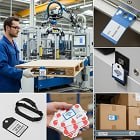
- Tags: Specialized passive UHF RFID tags compliant with EPC Gen2 standard using Impinj Monza chips. Tags are designed for industrial laundry conditions (durable laundry tags), withstanding more than 200 cycles of washing, drying, and chemical cleaning. Both sewn-in and heat-seal application methods were used on uniforms, bed linen, and towels.
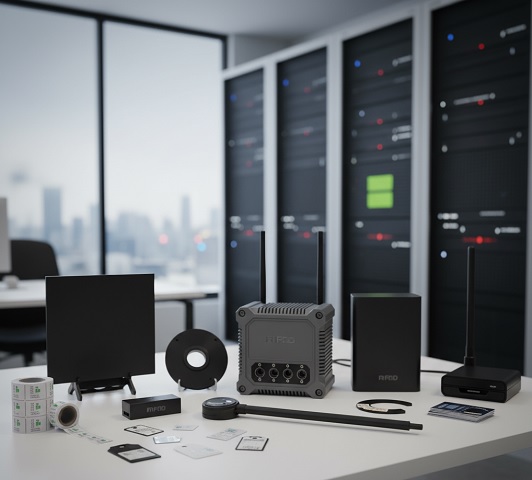
- Readers: Fixed Impinj Speedway readers installed at entry/exit portals of laundries, warehouses, and vending machines (dispensers) for uniform distribution. Mobile handheld readers for conducting inventories in departments and storage areas.
Software and Integration
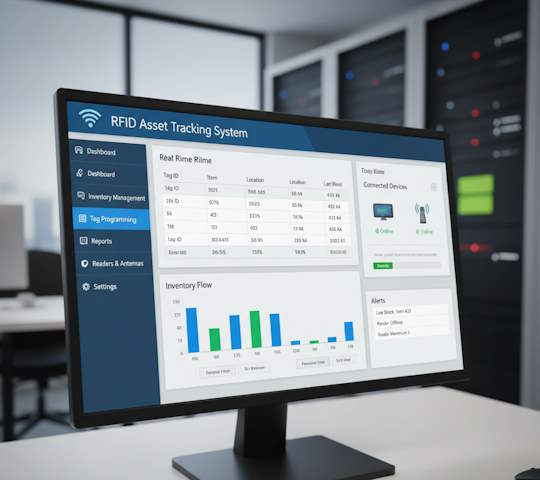
- Management Platform: Software based on Deister Electronic and Impinj solutions for data management, inventory, and analytics. The system is integrated with existing hospital laundry and logistics management systems.
- Functionality: Bulk reading of up to 200–500 tags simultaneously at distances of up to 5–8 meters. Automatic registration of issuance, return, and dispatch to laundry. Generation of alerts for loss, wear, or maintenance needs.
Post-Implementation Process: As-is vs. To-be
| Process Aspect | As-is (Before Implementation) | To-be (After RFID Implementation) |
|---|---|---|
| Distribution & Collection | Manual distribution to staff, paper or verbal logging. Accidental losses and unauthorized removal. | Automatic distribution via vending machines (dispensers) using ID cards. Automatic registration of return when textiles pass through RFID portals. |
| Accounting & Inventory | Periodic manual counts taking days and yielding inaccurate results. No real-time picture. | Instant inventory of an entire warehouse or batch using a handheld reader. Accounting accuracy of 98–99.9%. Real-time visibility of each item's location and status (clean/dirty, in use, in repair). |
| Laundry & Logistics | Manual tracking of batches, risk of mix-ups and loss. | Automatic registration of batch entry into the laundry and its exit after processing. Control over the number of wash cycles for each item. |
| Hygiene & Control | Risk of using improperly processed textiles due to human error. | The system prevents the distribution of textiles that have not completed a full sanitization cycle. Automatic alerts for replacement of worn items. |
| Inventory Management | Purchasing based on guesswork, large safety stocks, frozen capital. | Accurate data on movement and wear enables optimized purchasing, reduces overall inventory volume, and frees up funds. |
Implementation Results (12–36 months)
The RFID system implementation brought significant operational improvements to Nordland Hospital:
- Inventory Accuracy: Achieved a level of 98–99.9% compared to previous approximate data.
- Loss Reduction: Reduced from 3,500–4,000 to less than 1,000 items per year, representing a 70% reduction.
- Inventory Optimization: The total number of textile items in circulation was reduced by 20,000 without compromising availability.
- Efficiency Increase: Distribution and accounting processes became 30–50% more efficient.
- Hygiene & Compliance: Full control over the textile lifecycle ensured compliance with strict Norwegian healthcare standards.
- Tag Durability: Tags proved resistant to more than 200 cycles of industrial washing.
Economic Effect / ROI
Investments in RFID infrastructure paid off through direct cost reduction and savings:
- Procurement Cost Reduction: Expenses for purchasing new textiles and replacing lost items decreased by 40–60%.
- Direct Savings: According to project calculations, cumulative savings over 10 years are estimated at approximately €175,000.
- Labor Optimization: Labor costs for routine accounting and distribution operations decreased by 30–50%.
- Payback Period: Ranged from 24–48 months, considering the system's scale (thousands of tracked items).
- Return on Investment (ROI): Over 3–5 years, ROI is estimated in the range of 200–400%, depending on laundry volumes and the level of vending automation.
Sources Card and Realistic Estimates
| Category | Source / Confirmation | Data Type / Note |
|---|---|---|
| Real Implementations | Impinj customer story (2018–2023), RFID Journal, Deister Electronic reports | Uniform tracking, vending dispensers, 70% loss reduction |
| Technical Specifications | Impinj Monza laundry tags datasheets, Deister platform | EPC Gen2 durable tags (200+ cycles), fixed/handheld readers |
| Integration | Deister/Impinj inventory system, hospital laundry integration | Automated dispensers, real-time visibility |
| Process Metrics | Impinj benchmarks, healthcare textile studies | Inventory reduction 20k units, losses –70%, efficiency +30–50% |
| Economic Metrics | Impinj case estimates (~175k EUR savings over 10 years), Nordic healthcare benchmarks | Procurement/labor savings 40–60%, ROI 200–400% estimates |
| Calculation Methodology | Synthesis of cases (Nordland + similar Nordic hospitals like Oslo University), averaging benchmarks | Ranges based on laundry volume and vending automation level |
Legal-SEO Note: This information is for reference purposes only and is based on public sources. References to trademarks (Impinj, Deister Electronic, etc.) do not imply affiliation. Professional consultation is recommended for adaptation to specific business needs.
Frequently Asked Questions (FAQ)
What textile management problems did Nordland Hospital face before RFID implementation?
Manual inventory and distribution led to high uniform losses (up to 3,500–4,000 items annually), excess stock, lack of visibility into textile location/status, high labor costs for search and accounting, hygiene risks (unserviced textiles), and significant replacement costs (hundreds of thousands of euros per cycle).
What RFID solution was implemented for textile tracking?
Passive UHF RAIN RFID tags compliant with EPC Gen2 standard using Impinj Monza chips (durable laundry tags, withstanding 200+ industrial wash cycles). Tags were sewn-in or heat-sealed onto uniforms and linen. Fixed readers (Impinj Speedway) were installed at laundry/warehouse portals and vending machines; handheld readers were used for mobile inventory. The system ran on the Deister Electronic/Impinj platform.
What economic results were achieved?
Reduction in textile procurement/replacement costs by 40–60%; savings of approximately €175,000 over 10 years; optimization of labor costs for accounting/distribution by 30–50%. Payback period was 24–48 months, with ROI estimated at 200–400% over 3–5 years.