


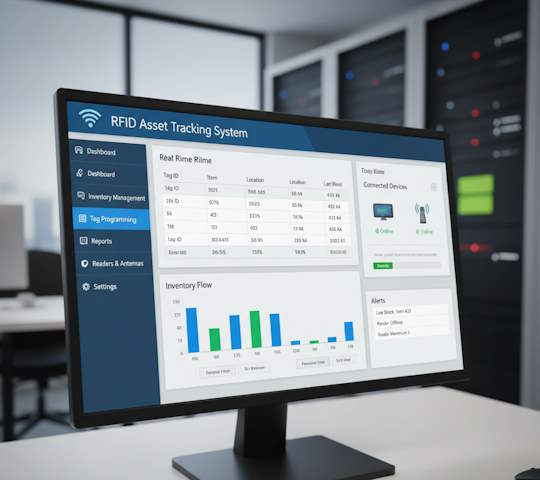


Full-Scale Implementation of RFID Systems in the International Fashion Retailer C&A: From Inventory Challenges to End-to-End Supply Chain Visibility
Full-Scale Implementation of RFID Systems in the International Fashion Retailer C&A: From Inventory Challenges to End-to-End Supply Chain Visibility
This case study examines how the global apparel retailer C&A standardized processes and significantly increased operational efficiency by implementing an end-to-end RFID item-level tagging system across over 1,220 stores. The award-winning project demonstrates an investment payback period of 18–36 months and serves as a benchmark for the industry.
Company and Production Context
C&A is an international fashion retailer with a private-label model, operating over 1,220 stores in 17 countries (key markets are Europe and Brazil). The company offers clothing, accessories, and footwear for the whole family, handling billions of items per year. The business focuses on fast fashion cycles, omnichannel sales, and end-to-end visibility of the supply chain from production to the store shelf. The full implementation of UHF RFID in stores and distribution centers was completed by 2025 and received the prestigious RFID Journal Award for Best Retail Implementation.
Problems Before Implementation
Before RFID implementation, C&A faced a number of critical operational challenges typical for large-scale retail with high turnover:
- Low Inventory Accuracy: Discrepancies between physical stock and system data reached 15–30% due to manual operations and rapid collection turnover.
- Lost Sales and Overstocks: Frequent out-of-stock and overstock situations on shelves.
- Labor-Intensive Processes: Inventory counts for a single store took days, and shelf replenishment and omnichannel order picking required high labor input.
- Lack of Visibility: Limited control over item movement from the distribution center (DC) to the store shelf.
- Standardization Complexity: Difficulty managing processes uniformly across a multi-country network with different teams.
Solution and Architecture
C&A implemented a comprehensive end-to-end RFID system based on industry standards:
Tags and Standards
100% of items were equipped with passive UHF RFID tags compliant with the GS1 EPC Gen2 standard. Source-tagging was applied at the manufacturing stage. Chips used included Impinj Monza and equivalents, with inlays from partners such as Avery Dennison and Nedap.
Hardware Infrastructure
The system included a multi-layered reader network:
- Fixed portals (Impinj, Zebra, Nedap) at DC entrances/exits and warehouse doorways.
- Overhead readers in store sales areas for automatic inventory counting.
- Handheld scanners for conducting inventory counts and finding items.
The technology enabled bulk reading of up to 1000+ tags per second at distances of up to 8–10 meters.
Integration and Software
The RFID system was deeply integrated with corporate WMS, ERP, and POS systems. This provided real-time data flow and created a single digital item model for all countries of operation.
Process After Implementation (As-is / To-be)
| Process | As-is (Before Implementation) | To-be (After Implementation) |
|---|---|---|
| Counting and Inventory | Manual barcode scanning, periodic checks taking days. | Automatic registration at DC portals and in stores. Daily/weekly inventory using handheld or overhead readers in hours. |
| Visibility and Localization | Limited visibility in DCs and stores, visual item search. | Accurate real-time localization of every item at all stages of the chain. |
| Replenishment | Manual, based on approximate data, leading to out-of-stocks. | Automated, based on precise stock data, standardized for all countries. |
| Customer Service | Difficulties finding sizes/colors, limited omnichannel service capabilities. | Accurate online and in-store availability information, streamlined fulfillment for BOPIS (Buy Online, Pick Up In-Store) and ship-from-store orders. |
Results (12–36 Months)
Measurable results 12–36 months after full system deployment:
- Inventory Accuracy: Increased from 70–85% to 98–99%.
- Inventory Speed: Time reduced by a factor of 10–20x.
- Check Frequency: Increased from quarterly/semi-annual to daily/weekly without cost increase.
- Product Availability: Reduction in out-of-stock situations by 20–40%.
- Operation Productivity: Productivity growth in replenishment and order processing by 30–50%.
- Loss Reduction: Reduction in losses from theft, accounting errors, and markdowns by 20–40%.
- End-to-End Visibility: Achieved full supply chain visibility from DC to the customer.
Economic Effect / ROI
The comprehensive economic effect of the large-scale implementation confirms the high profitability of RFID investment for large retailers:
- Operational Cost Reduction: Labor cost reduction for inventory, replenishment, and search processes by 30–60%.
- Revenue Growth: Sales increase of 5–15% due to significantly improved product availability on shelves.
- Loss Reduction: Direct reduction in losses from theft and markdowns of unsold goods by 20–40%.
- Payback Period: 18–36 months due to the scale effect (1,220+ stores) and process standardization.
- Overall ROI: Expected aggregate return on investment over a 3–5 year period is estimated in the range of 200–500%.
Source Card and Realistic Estimates
| Category | Source / Confirmation | Data Type / Note |
|---|---|---|
| Real Implementations | RFID Journal Awards 2025, ECR Shrink Group report | Public case studies and reports. Confirm full coverage of 1220+ stores in 17 countries and the Best Retail Implementation Award 2025. |
| Technical Specifications | GS1 Standards, manufacturer datasheets (Impinj, Avery Dennison, Nedap) | Industry EPC Gen2 standards and technical specifications of equipment used in the project. |
| Process and Economic Metrics | ECR Shrink Group Reports, RFID Journal industry benchmarks | Aggregated data on RFID effectiveness in retail: accuracy, out-of-stock reduction, sales uplift, ROI. Figures extrapolated to the scale of the C&A project. |
Legal and SEO Note
This information is for reference purposes only and is based on public sources. References to trademarks (Impinj, Avery Dennison, Nedap, GS1, etc.) do not imply affiliation. Professional consultation is recommended for adaptation to specific business needs.
Frequently Asked Questions (FAQ)
What inventory accuracy results did C&A achieve after implementing RFID?
Following the full implementation of the RFID system, inventory accuracy in C&A's stores and distribution centers increased to 98–99%. This is a radical improvement compared to the previous discrepancy level of 15–30% with manual counting.
What was the economic effect and ROI achieved in the project?
The large-scale implementation across over 1,220 stores led to significant savings: a 30–60% reduction in labor costs, a 5–15% increase in sales due to better product availability, and a 20–40% reduction in losses. The expected Return on Investment (ROI) is 200–500% over a 3–5 year period, with a project payback period of 18–36 months.
How large-scale was the RFID implementation at C&A?
The implementation was comprehensive and global. By 2025, C&A completed tagging 100% of its merchandise and deployed the infrastructure across all its distribution centers and over 1,220 stores in 17 countries. This project received the RFID Journal Award 2025 in the Best Retail Implementation category.