



RFID Implementation at Ford Assembly Plants: From Manual Body Routing to Fully Automated Vehicle-in-Process Tracking
Case study update date:
RFID Implementation at Ford Assembly Plants: From Manual Body Routing to Fully Automated Vehicle-in-Process Tracking
This case study describes how one of the world's largest automakers implemented RFID systems at plants in Germany and the USA to accurately track thousands of vehicle bodies on their journey from the welding shop to final assembly. The solution eliminated downtime, guaranteed correct configuration, and significantly improved conveyor efficiency.
Company and Production Context
Ford Motor Company is one of the world's largest automakers with multiple assembly plants (including Cologne, Germany, and facilities in the USA), producing millions of vehicles annually (Focus, Fiesta, F-150, etc.). The process involves sequential assembly from body stamping and painting to final trim, with a focus on just-in-time (JIT) deliveries, sequence control, and minimizing line errors. Implementation of UHF RFID for vehicle-in-process tracking, especially for body-in-white and painted bodies, has been rolled out at several plants (Cologne Plant since the 2000s, with expansions in the USA).
Problems Before Implementation
Prior to implementing an automated tracking system, Ford faced typical mass-production problems leading to losses and downtime:
- Routing Errors: Manual counting and barcode scanning led to errors in directing bodies along the process route (10–20% discrepancies).
- Line Delays: Disruption of the correct build sequence due to routing errors caused conveyor stoppages.
- Inefficient Search: Lengthy manual searches for specific vehicles in extensive buffer zones for modifications or checks.
- Quality Risks: High labor costs for configuration verification and the risk of building a vehicle with the wrong option set.
- Lack of WIP Visibility: Limited visibility of work-in-process (WIP) hindered operational management.
Solution and Architecture
Ford implemented an end-to-end RFID tracking system deeply integrated into manufacturing processes:
Tags and Standards
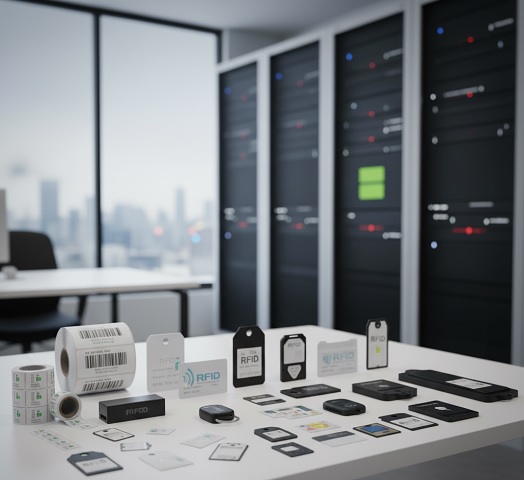
Passive UHF RFID tags compliant with the EPC Gen2 standard are used. Special rugged on-metal tags based on Impinj Monza or NXP UCODE chips are used for harsh conditions (welding, paint shops). Tags can be either reusable (bolt-on) or disposable and are attached directly to the body or chassis at early production stages (body shop or after painting).
Hardware Infrastructure
- Dense Reader Network: Fixed portals and readers (Impinj Speedway, Zebra FX9600) are installed at key conveyor transitions, between shops, and at inspection stations (up to 50+ read points per plant).
- Mobile Scanners: Handheld readers for selective verification and search.
The system provides bulk reading of 500–1000 tags per second at distances up to 8–10 meters. The tag encodes VIN, model, options list, and build sequence number.
Integration with Manufacturing Systems
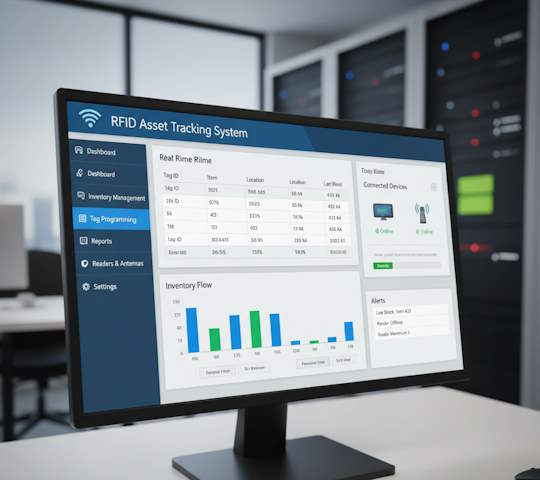
The RFID system is deeply integrated with the MES (Manufacturing Execution System), Andon signaling system, and Ford's proprietary Vehicle Tracking system. This provides real-time data flow for production control.
Process After Implementation (As-is / To-be)
| Process | As-is (Before Implementation) | To-be (After Implementation) |
|---|---|---|
| Identification and Routing | Manual barcode scanning at several key points. Visual sequence check. Paper or electronic logs for routing. | Automatic body registration at every transition between zones (paint → assembly → quality). Real-time status and sequence update in MES. |
| Sequence Management (Sequencing) | Risk of violating the strict model and option sequence, leading to downtime. | Automatic routing and instant alerts for any deviation from the planned sequence. |
| Search and Verification | Lengthy manual search for a specific vehicle in buffer zones for inspection or modification. | Accurate real-time location knowledge of any body. Automatic verification of completeness before final assembly. |
| Supply (JIT) | Just-in-time component deliveries were based on a planned schedule, not the actual body status. | Components are fed to the line tied to the real location and status of a specific body, improving JIT accuracy. |
Results (12–36 Months)
Key measurable improvements following full-scale deployment on assembly lines:
- Tracking Accuracy: Achieved body tracking accuracy of 98–99.9%.
- Search Speed: Time to locate specific vehicles in buffer zones reduced by 50–80%.
- Process Quality: Assembly and routing errors decreased by 30–70%.
- Productivity Growth: Assembly line productivity increased by 20–40% by eliminating downtime due to sequencing issues.
- Logistics Optimization: Improved efficiency of JIT component deliveries based on real body status.
Economic Effect / ROI
Investment in RFID infrastructure brought significant economic benefit, especially considering the high cost of conveyor downtime:
- Labor Cost Reduction: Costs for verification, search, and manual counting reduced by 40–60%.
- Working Capital Optimization: Reduction in work-in-process (WIP) inventory in buffer zones and associated costs by 20–40%.
- Reduced Downtime Losses: Minimization of costly conveyor downtime and rework expenses.
- Payback Period: 24–48 months due to plant scale and the high cost of each hour of assembly line stoppage.
- Overall ROI: Aggregate return on investment over a 3–5 year period is estimated at 200–400%, depending on line coverage and depth of integration with MES/Andon.
Source Card and Realistic Estimates
| Category | Source / Confirmation | Data Type / Note |
|---|---|---|
| Real Implementations | RFID Journal (2005–2018), GAO RFID case studies, Cologne Plant reports | Public case studies and industry reports. Confirm implementation at the Ford Cologne plant since the 2000s, use of reusable tags, and expansion in the USA. |
| Technical Specifications | Impinj/Zebra datasheets, Auburn RFID Lab automotive studies | Technical data on on-metal tags, fixed portals, and bulk reading on the conveyor. |
| Process and Economic Metrics | RFID Journal industry benchmarks, automotive downtime cost studies | Effectiveness estimates based on similar implementations: search time reduction, assembly error reduction, line efficiency increase. ROI calculation for high-volume production. |
Legal and SEO Note
This information is for reference purposes only and is based on public sources. References to trademarks (Impinj, Zebra, NXP, etc.) do not imply affiliation. Professional consultation is recommended for adaptation to specific business needs.
Frequently Asked Questions (FAQ)
What accuracy of vehicle tracking in production did RFID provide?
The RFID system implementation enabled tracking accuracy for vehicle bodies on the assembly line at a level of 98–99.9%. This eliminated routing errors and ensured the correct build sequence.
What key operational improvements were achieved on the conveyor?
The system reduced the time to locate specific bodies in buffer zones by 50–80%, decreased assembly and routing errors by 30–70%, and increased overall assembly line productivity by 20–40% by minimizing downtime.
What is special about the RFID tags used in automotive production conditions?
For harsh production conditions (welding, painting), special rugged on-metal tags were used. They could be either reusable (bolt-on) or disposable, attached directly to the body or chassis. The tags encoded VIN, model, options list, and sequence number.