




RFID Implementation in Boeings Global Aerospace Manufacturing: From Manual Part Search to End-to-End Digital Lifecycle Traceability
Case study update date:
RFID Implementation in Boeing's Global Aerospace Manufacturing: From Manual Part Search to End-to-End Digital Lifecycle Traceability
This case study describes how the world's aerospace leader Boeing has been implementing RFID systems since 2005 to automate the tracking of thousands of critical aircraft components, from suppliers through to maintenance. The project has ensured unprecedented accuracy, FAA compliance, and significant operational savings.
Company and Production Context
Boeing is a global leader in the production of commercial and military aircraft, including the 787 Dreamliner and 737 programs. The manufacturing process involves an incredibly complex supply chain with thousands of suppliers and the assembly of millions of components (up to 7,000–10,000 critical parts per aircraft). The industry imposes the strictest FAA requirements for tracking the lifecycle of parts (LRU, life-limited parts). UHF RFID implementation began in 2005–2006 for the 787 program (supplier tagging of ~2,000 parts), was expanded to internal assembly (from 2016, 4+ plants), and maintenance (RFID Integrated Solutions for airlines).
Problems Before Implementation
Before RFID implementation, the company faced fundamental problems of manual management in a high-precision and safety-critical industry:
- Low Operational Efficiency: Manual counting and visual verification led to lengthy searches for needed parts—from hours to days per component.
- Errors and Safety Risks: High rate of configuration errors (10–20% discrepancies), risks of foreign object debris (FOD), and non-compliance with FAA requirements.
- Labor-Intensive Documentation: High labor costs for inventory and recording the history of each part required for compliance.
- Lack of End-to-End Visibility: Inability to quickly trace a part from the supplier through the assembly plant to operation by an airline, causing delays in production and maintenance.
Solution and Architecture
Boeing implemented a multi-layered RFID system that meets stringent industry standards:
Tags and Standards
Passive UHF RFID tags compliant with the EPC Gen2 standard and the aerospace standard SAE AS5678 are used. High-memory chips (up to 64 Kbit) from Intelleflex, Fujitsu, Impinj Monza are used to store part history data. Tags are ruggedized/encapsulated, designed for harsh production environments and a service life of 12+ years.
Tagging Strategy
Source-tagging: Suppliers tag flyable parts (LRU, emergency equipment) at the manufacturing stage.
Internal tagging: Boeing plants tag parts and tools directly on the production floor (Fujitsu Integrated Labels).
Hardware Infrastructure and Integration
- Fixed readers at receiving portals and assembly stations.
- Mobile terminals (Zebra MC9190/MC3300R) for inventory and search in workshops and warehouses.
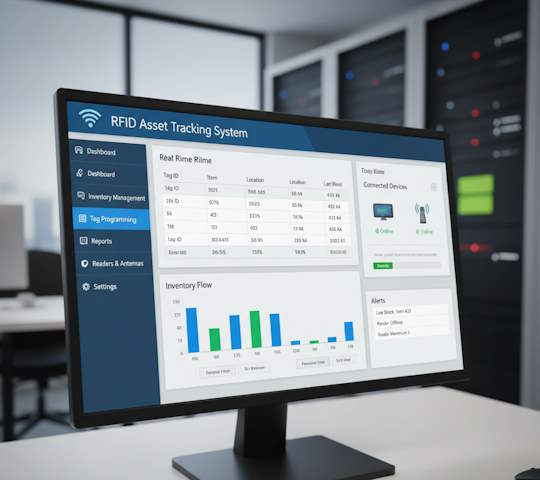
- Deep integration with MES/ERP systems and specialized Boeing RFID Integrated Solutions software for airlines.
The system enables bulk reading of up to 1000+ tags per second at distances of up to 10–12 m and encoding of data (serial number, inspection history) directly onto the tag.
Process After Implementation (As-is / To-be)
| Process | As-is (Before Implementation) | To-be (After Implementation) |
|---|---|---|
| Counting and Identification | Manual data entry, scanning barcodes one by one, visual verification. | Automatic registration of parts as they pass through portals. Instant bulk identification of kits. |
| Traceability and Search | Paper-based part pedigrees, lengthy searches through documents and warehouses. | Real-time localization of any part on the shop floor or in the warehouse. Lifecycle data (inspection, repair) is written to the tag itself. |
| Compliance | Labor-intensive manual report preparation for the FAA. | Automatic generation of ARL (Aircraft Readiness Log) and other reports for regulators. |
| Tool Management | Manual tracking, frequent tool loss (FOD risk). | End-to-end tool tracking, bulk inventory with handheld readers. |
Results (12–36 Months)
Results of implementation across various areas (assembly, maintenance, tool tracking):
- Traceability Accuracy: Achieved part tracking accuracy of 98–99.9%.
- Search Speed: Time to locate specific parts reduced by 50–80%.
- Assembly Quality: Configuration and assembly errors decreased by 30–70%.
- Productivity: Assembly line productivity increased by 20–40%.
- Compliance: Automated reporting for the FAA, minimized risk of downtime due to non-compliance.
- Tool Tracking: In pilot projects on 737/787 lines, tool loss was reduced by 85%.
Economic Effect / ROI
Investment in RFID brought significant economic benefits across the product lifecycle:
- Labor Cost Reduction: Reduced costs for counting, searching, and inventorying parts by 40–70%.
- Inventory Optimization: Minimization of excess parts and losses, saving 20–50%.
- Operational Cost Reduction: Reduction in downtime and maintenance costs through quick access to part history.
- Payback Period: 24–48 months due to the scale of implementation and end-to-end benefits (including savings for airline customers).
- Overall ROI: Aggregate return on investment over 3–5 years is estimated at 200–400%, depending on coverage (flyable vs. internal parts).
Source Card and Realistic Estimates
| Category | Source / Confirmation | Data Type / Note |
|---|---|---|
| Real Implementations | RFID Journal (2006–2024), Boeing press (2005–2017) | Public announcements and industry reports. Confirm implementation since 2005, supplier tagging for the 787, expansion to assembly plants from 2016. |
| Technical Specifications | SAE AS5678 Standard, FAA Policy, Fujitsu/Impinj datasheets | Industry standards for passive UHF RFID in aviation. Requirements for tag durability (12+ years), memory, read range. |
| Process and Economic Metrics | RFID Journal Benchmarks, Boeing internal studies, industry reports | Effectiveness estimates based on pilot projects and phased rollout: search time reduction, accuracy increase, tool loss reduction, ROI calculation. |
Legal and SEO Note
This information is for reference purposes only and is based on public sources. References to trademarks (Fujitsu, Impinj, Zebra, SAE, etc.) do not imply affiliation. Professional consultation is recommended for adaptation to specific business needs.
Frequently Asked Questions (FAQ)
What was the key result achieved in part traceability accuracy?
The RFID implementation enabled end-to-end part traceability accuracy of 98–99.9%. This is critical for compliance with stringent FAA requirements for lifecycle traceability of flyable parts (LRU).
How did RFID impact operational efficiency on assembly lines?
The technology reduced the time to locate specific parts by 50–80%, decreased configuration and assembly errors by 30–70%, and increased overall assembly line productivity by 20–40% through automation of tracking and localization.
What was the particular complexity of implementing RFID at Boeing?
The main complexity lay in the scale and stringent requirements of the aerospace industry. The solution had to operate in harsh industrial environments, provide a tag lifespan of over 12 years, store part history (inspection, repair), and be integrated into a global supply chain of thousands of manufacturers.