


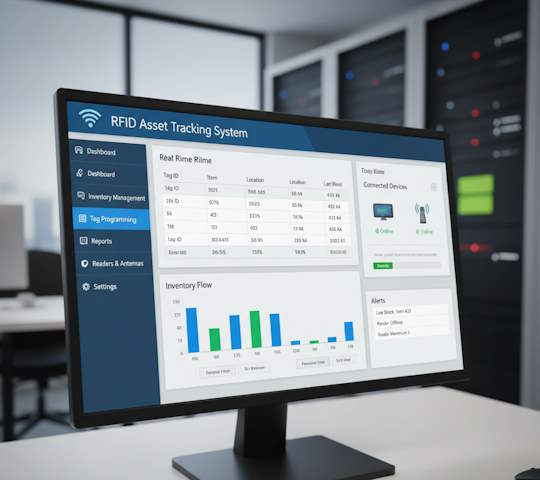


RFID as Airbus Business Radar: From Manual Container Search to Full Digital Visibility of the Global Supply Chain
Case study update date:
RFID as Airbus' Business Radar: From Manual Container Search to Full Digital Visibility of the Global Supply Chain
This case study explores how the world's leading aircraft manufacturer Airbus has been using RFID technology since the 2000s to create end-to-end visibility (business radar) of thousands of parts, returnable containers, and tools. Solutions deployed across assembly lines and suppliers ensure traceability accuracy up to 99.9%, significant logistics optimization, and compliance with stringent industry standards.
Company and Production Context
Airbus is a leading global manufacturer of commercial aircraft (A320, A330, A350, A380 families), with an extensive network of Final Assembly Lines (FAL) in Europe (Toulouse, Hamburg, Filton) and a global supply chain involving thousands of companies. The manufacturing process requires end-to-end tracking of both flyable parts and tooling, returnable containers (jigs), tools, and work-in-progress (WIP) under strict EASA and FAA requirements for lifecycle traceability and Foreign Object Debris (FOD) prevention. Large-scale UHF RFID implementation has been ongoing since the 2000s as part of the strategy to create a "business radar" for visibility across the supply chain, manufacturing, and maintenance.
Problems Before Implementation
Prior to process digitalization, Airbus faced high operational costs and risks typical of complex, distributed manufacturing:
- Lack of Asset Visibility: Low accuracy of data on container and part locations (10–25% discrepancies), leading to lengthy searches taking hours or days.
- Inefficient Container Logistics: Imbalance between surplus and shortage of specialized returnable containers across different sites, necessitating an oversized container fleet.
- High Labor Costs and Risks: Manual inventories, configuration checks, and paper-based part history records, increasing the risk of human error and regulatory non-compliance.
- Production Delays: Assembly line downtime due to untimely arrival of needed components or searches for tooling.
Solution and Architecture
Airbus implemented a comprehensive, multi-purpose RFID ecosystem integrated into the production infrastructure:
Tags and Standards
Primarily passive (and in some cases active) UHF RFID tags compliant with the EPC Gen2 standard and industry standards SAE AS5678/ATA Spec 2000 are used. Impinj Monza chips and equivalents with high memory for lifecycle data are utilized. Special rugged tags and so-called "hybrid nameplates" from partners (Fujitsu, MAINtag, Brady/Tego) are applied for use on metal surfaces and in harsh environments.
Tagging Strategy
Source-tagging: Critical flyable parts (seats, life vests, LRU) are tagged directly at manufacturer sites.
Internal tagging: Containers, jigs, tools, and work-in-progress are tagged at Airbus plants.
Hardware Infrastructure and Software
- Large-Scale Reader Network: Fixed portals (Impinj, Zebra) at receiving docks and assembly stations (over 100 points in Hamburg for the A380 program). Mobile handheld readers for operational search and inventory.
- Specialized Software: The Airbus Tag Check (ATC) platform for data validation and integration with corporate MES/ERP systems as part of the "Smart Factory" concept.
The system enables bulk reading of up to 1000+ tags per second at distances up to 10 meters.
Process After Implementation (As-is / To-be)
| Process | As-is (Before Implementation) | To-be (After Implementation) |
|---|---|---|
| Asset Tracking and Identification | Manual barcode scanning, paper-based pedigrees, periodic physical inventories. | Automatic registration as items pass through portals. Real-time localization of any container, part, or tool in the system. |
| Returnable Container Management | Visual search, inventory imbalance, need for an oversized container fleet. | Logistics and container fleet optimization based on accurate data. Reduction in total units through increased turnover. |
| Configuration and Compliance | Manual verification of kits, labor-intensive report preparation for EASA/FAA. | Automated configuration checking (ATC) and report generation for regulators, minimized FOD risk. |
| Operational Production Support | Delays due to searching for missing components or tooling. | Instant search for necessary resources for line replenishment, reduced downtime. |
Results (12–36 Months)
Key measurable improvements following full-scale deployment across various areas:
- Traceability Accuracy: Achieved asset tracking accuracy of 98–99.9%.
- Search Speed: Time to locate containers, parts, and tools reduced by 50–80%.
- Logistics Optimization: Reduction in specialized returnable container fleet by 8–15% within pilot projects by eliminating "dead" stock.
- Productivity Growth: Assembly line efficiency increased by 20–40% through reduced downtime and accelerated processes.
- Tool Control: Reduction in tool loss and misplacement by 50–85%.
- Full Visibility: Creation of end-to-end visibility for continuous process improvement.
Economic Effect / ROI
Investment in RFID infrastructure brought Airbus significant financial returns across several dimensions:
- Operational Cost Reduction: Labor cost reduction for counting, searching, and inventory by 40–70%.
- Capital Optimization: Reduced need for working capital tied up in excess part and container inventory by 20–40%.
- Reduced Downtime and Compliance Costs: Minimized losses from downtime and expenses for ensuring regulatory compliance.
- Payback Period: 24–48 months due to the scale of implementation across multiple sites and lifecycle benefits (including savings for airlines and MRO centers).
- Overall ROI: Aggregate return on investment over a 3–5 year period is estimated in the range of 200–400%, depending on the scope of coverage (parts vs. containers/tools).
Source Card and Realistic Estimates
| Category | Source / Confirmation | Data Type / Note |
|---|---|---|
| Real Implementations | RFID Journal (2007–2024), Airbus announcements | Public case studies and industry presentations. Confirm deployment across multiple sites (A380 assembly lines, A350 parts, container and tool management). |
| Technical Specifications | SAE AS5678/ATA Spec 2000 Standards, Fujitsu/Impinj datasheets, Airbus Tag Check description | Technical requirements for aviation tags, characteristics of environment-resistant (rugged) tags and validation software. |
| Process and Economic Metrics | RFID Journal Benchmarks, Airbus case studies, aerospace industry reports | Effectiveness estimates based on phased rollout across multiple sites: search time reduction, container fleet optimization, ROI calculation considering regulatory requirements. |
Legal and SEO Note
This information is for reference purposes only and is based on public sources. References to trademarks (Impinj, Fujitsu, MAINtag, SAE, etc.) do not imply affiliation. Professional consultation is recommended for adaptation to specific business needs.
Frequently Asked Questions (FAQ)
What traceability accuracy did the RFID implementation at Airbus achieve?
The RFID system implementation enabled Airbus to achieve end-to-end traceability accuracy for parts, containers, and tools at a level of 98–99.9%, which is a critical requirement for compliance with EASA and FAA standards.
How did RFID help optimize returnable container logistics?
The system provided full real-time visibility into the location of thousands of specialized containers and jigs. This enabled a reduction in the total returnable container fleet by 8–15% within pilot projects by eliminating excess inventory and accelerating turnover.
How extensive was the RFID deployment across Airbus production?
The deployment was global and multi-layered. It covered key Final Assembly Lines (FAL) in Europe (e.g., over 100 read points in Hamburg for the A380), tagging of supplied parts (seats, life vests), and internal assets. The project is part of the Airbus "Smart Factory" strategy.