



Case Study: Implementation of a UHF RFID-based Medical Equipment Tracking System at Hull University Teaching Hospitals NHS Trust
Case study update date:
Case Study: Implementation of a UHF RFID-based Medical Equipment Tracking System at Hull University Teaching Hospitals NHS Trust
The deployment of end-to-end visibility for mobile assets across two major hospitals reduced operational costs, improved patient flow, and optimized the use of high-value equipment within the constraints of the NHS budget.
Company and Production Context
Hull University Teaching Hospitals NHS Trust is a large UK National Health Service organization managing two main hospitals: Hull Royal Infirmary and Castle Hill Hospital. Together, they provide over 1,200 beds, with intensive care, oncology, cardiology, and trauma departments. Annually, the Trust serves hundreds of thousands of patients and manages thousands of mobile assets: infusion pumps, defibrillators, wheelchairs, monitors, beds. The UHF RFID implementation was carried out in partnership with Harland Simon and Zebra Technologies, focusing on minimizing delays in patient care and optimizing equipment utilization within the constrained NHS budget.
Problems Before Implementation
Prior to RFID implementation, the Trust faced serious asset management challenges typical of large healthcare institutions:
- Time Loss: Medical staff spent up to 25–35% of their working time searching for necessary equipment.
- Care Delays: Frequent delays in procedures and patient care due to device unavailability.
- Asset Losses: Annual equipment losses and theft accounted for 10–20% of the total fleet.
- Inventory Imbalance: Overstock in some departments and acute shortages in others.
- Inefficient Procurement: Unnecessary purchases and rentals due to lack of accurate availability data.
- Safety Risks: Risks of using faulty or overdue maintenance equipment.
Solution and Architecture
A comprehensive tracking system based on passive UHF RFID technologies was implemented:
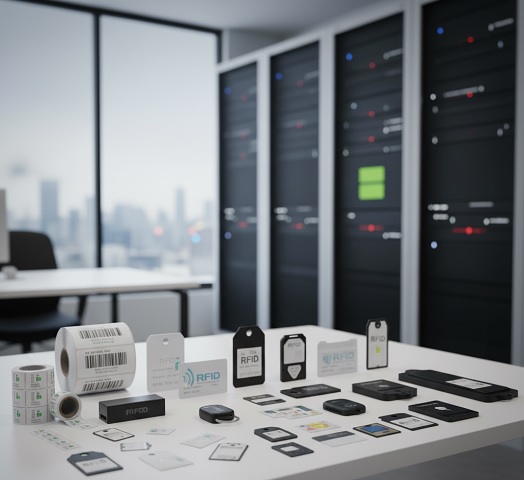
- Tags: Thousands of mobile assets (infusion pumps, wheelchairs, vital signs monitors) were equipped with durable passive UHF RFID tags (EPC Gen2 standard, Zebra/Impinj chips), including specialized tags for metal and textile surfaces.
- Equipment: Fixed Zebra FX9600 readers (based on Impinj) are installed at key control points (choke points): department entrances/exits, elevators. For room-level inventory, Zebra MC3300R handheld readers are used.
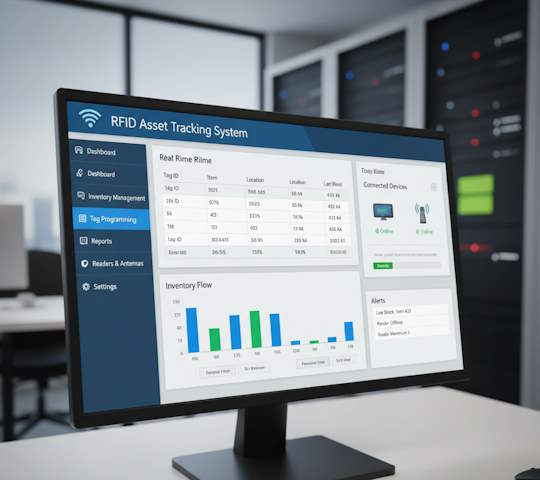
- Software and Integration: The Harland Simon platform (approved for NHS use) provides real-time data management. The system is integrated with the hospital's asset management systems.
- Process: Bulk reading without line-of-sight at distances up to 6–10 meters is ensured, along with automatic movement registration and precise localization.
Process After Implementation (As-is / To-be)
| As-is (Before) | To-be (After) |
|---|---|
| Manual equipment search through departments with visual inspection | Automatic registration when moving through checkpoints |
| Periodic inventory with barcodes or manually | Instant bulk scanning of rooms with handheld readers for quick verification |
| Lack of automated notifications | Real-time alerts for low stock, maintenance due, movement between Trust hospitals |
| Random equipment distribution | Directed, optimized asset distribution between the two hospitals based on data |
Results (12–36 months)
- Inventory Accuracy: Achieved 95–99%.
- Equipment Search Time: Reduced by 50–80%.
- Equipment Utilization: Increased by 20–40%.
- Asset Losses: Decreased by 15–30%.
- Patient Flow: Improved by 10–25% due to minimized procedure delays.
- Planning: More efficient maintenance and procurement planning.
- Redistribution: Underutilized items identified and redistributed.
Economic Effect / ROI
- Labor Cost Reduction: Medical staff time spent searching reduced by 30–60%.
- Procurement Optimization: Minimization of unnecessary purchases and rentals saved 15–30%.
- Loss Reduction: Direct savings from reduced asset loss and theft.
- Payback Period (PP): 18–48 months due to optimized asset lifecycle and operational efficiency in the large Trust.
- ROI (over 3–5 years): Expected in the range of 200–400%, depending on the number of tagged assets and depth of integration with NHS procurement systems.
Source Card and Realistic Estimates
| Category | Source / Confirmation | Data Type / Note |
|---|---|---|
| Real Implementations | Zebra Technologies case studies, RFID Journal (2018–2023), Harland Simon NHS references | Mobile equipment tracking at Hull Royal Infirmary/Castle Hill, multi-site Trust |
| Technical Specifications | Zebra FX9600/MC3300R datasheets, Impinj platform | EPC Gen2 tags, fixed/handheld readers, choke point coverage |
| Integration | Harland Simon/Zebra asset management solutions | Real-time visibility, NHS inventory integration |
| Process Metrics | Zebra/Harland Simon benchmarks, NHS RFID studies | Search time –50–80%, utilization +20–40%, accuracy 95–99% |
| Economic Metrics | Industry benchmarks (UK NHS asset tracking), Zebra case estimates | Procurement/loss reduction 15–30%, labor 30–60%, ROI 200–400% |
Legal-SEO Note
This information is for reference purposes only and is based on public sources. References to trademarks (Zebra, Impinj, Harland Simon, etc.) do not imply affiliation. Professional consultation is recommended for adaptation to specific business needs.
FAQ
What problems did the RFID implementation solve at Hull University Teaching Hospitals?
The implementation solved the problem of medical staff time loss searching for equipment (up to 35% of working time), delays in procedures, asset losses (10–20% annually), inventory imbalance between departments, and risks of using faulty equipment.
What equipment and tags are used in the system?
Passive UHF RFID tags EPC Gen2 (Zebra/Impinj) are used for thousands of assets: infusion pumps, defibrillators, wheelchairs. Zebra FX9600 readers are installed at key points, Zebra MC3300R handheld readers are used for inventory. The Harland Simon platform provides data management.
What economic effect was achieved?
Reduction in search labor costs by 30–60%, savings on purchases and rentals of 15–30%, reduction in asset losses. Payback period 18–48 months, ROI 200–400% over 3–5 years.