




RFID Implementation for Reusable Packaging Tracking in Aviation MRO: KLM Engineering & Maintenance and Nefab Case Study
Case study update date:
RFID Implementation for Reusable Packaging Tracking in Aviation MRO: KLM Engineering & Maintenance and Nefab Case Study
This case demonstrates how a joint project between an aviation giant and a packaging supplier enabled the transition of high-value component logistics to fully automated tracking, reducing costs and increasing supply chain reliability for a mission-critical industry.
Company and Production Context
KLM Engineering & Maintenance (AFI KLM E&M) is the global Maintenance, Repair, and Overhaul (MRO) division of the Air France-KLM group. It services approximately 1,500 aircraft for over 150 airlines worldwide. A key challenge is managing the logistics of high-value aviation components (engines, avionics, airframe parts), which are transported in specialized reusable packaging (cases/boxes) from suppliers like Nefab. The RFID tracking project for this reusable packaging is in an active implementation and scaling phase for the 2024–2025 period.
Pre-Implementation Problems
Manual processes for managing reusable packaging created significant operational and financial risks:
- Inventory Errors (10–25% discrepancies): Manual registration of incoming and outgoing shipments led to database inaccuracies.
- Time-Consuming Searches: Employees spent hours visually searching for a specific container suitable for a given component.
- Packaging Inventory Imbalance: Lack of visibility into container locations caused overstock in some sites and shortages in others.
- High Costs: The company was forced to purchase new packaging instead of returning and reusing existing assets.
- Paperwork and Delays: Manual Advance Shipping Notices (ASN) and documentation slowed the entire MRO chain, potentially impacting aircraft readiness time (AOG — Aircraft On Ground).
Solution and Architecture
A comprehensive RFID identification and tracking system based on industry standards was deployed:
- Tags: Passive UHF RFID tags compliant with the EPC Gen2 standard, including Battery-Assisted Passive (BAP) models like the Omni-ID Power 50, to guarantee 100% read rates in challenging conditions (metal, liquids). Tags with serial numbers are permanently affixed to containers and linked to content information.
- Hardware:
- Fixed Intellifi readers at building ingress/egress portals, on trucks, and at key warehouse and shop floor points.
- Handheld Nordic ID Morphic terminals for exception handling and work in areas without fixed coverage.
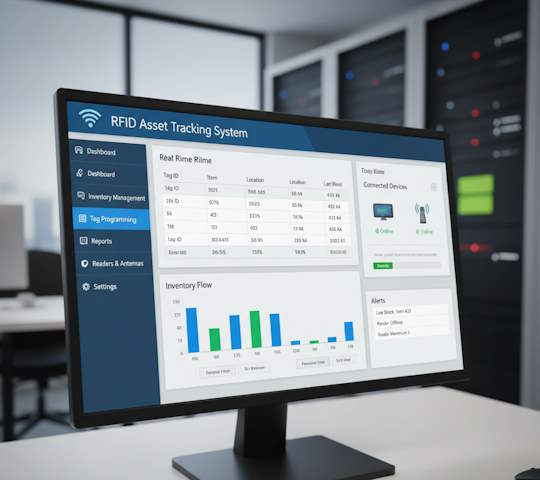
- Software: The web-based APIS (Aviation Packaging Information System) platform from ScoreTrace for centralized data management, automatic ASN generation, and end-to-end visibility.
- Process: Bulk reading of tags from a distance of up to 8–10 meters as containers move, enabling a fully automatic, paperless process.
Post-Implementation Process (As-is / To-be)
| Process Aspect | As-is (Before RFID) | To-be (After RFID Implementation) |
|---|---|---|
| Registration | Manual recording of arrival/shipment, high error probability. | Automatic registration upon passing through RFID portals. Real-time data update. |
| Container Search | Visual warehouse search, taking hours. | Instant search in the APIS system with precise location and container specifications. |
| Notification (ASN) | Paper or email notifications requiring manual processing. | Automatic electronic ASNs from Nefab, integrated into APIS without operator intervention. |
| Chain Visibility | Limited, fragmented, and outdated data. | Full end-to-end visibility (Nefab → KLM → customer) in real time. |
| Container Return | Ad-hoc, with losses and delays. | Managed and optimized process, initiated by the system. |
Results (12–36 Months)
- Inventory Accuracy: Achieved at 98–100%.
- Tag Read Rates: 100% through the use of BAP tags.
- Reduced Operation Time: Container search and registration became 50–80% faster.
- Automation: The process became hands-free, eliminating manual data entry.
- Global Visibility: Improved supply chain transparency among all partners.
- Scalability: Successful expansion of the system to facilities at Schiphol Airport (Amsterdam) and other global sites.
Economic Effect / ROI
- Reduction in Total Packaging Costs: by 30–50% through minimized loss, optimized rotation, and reduced new purchases.
- Packaging Inventory Optimization: reduction of excess stock by 20–40%.
- Labor Cost Reduction: freeing personnel from routine accounting tasks.
- Investment Payback Period: 24–48 months for large-scale projects with thousands of containers.
- Overall ROI: Expected return on investment over 3–5 years is estimated in the range of 200–400%, depending on MRO volumes and the onboarding of additional suppliers.
Source Card and Realistic Estimates
| Category | Source / Confirmation | Data Type / Note |
|---|---|---|
| Real Implementations | RFID Journal (2015–2024), Nefab/KLM case studies, Intellifi reports | Phased rollout since the 2010s, APIS system, reusable packaging tracking. |
| Technical Specifications | RFID Journal articles, Omni-ID Power 50/Intellifi datasheets | EPC Gen2 standard (incl. BAP tags), fixed & handheld readers, 100% read rates. |
| Integration | ScoreTrace APIS software, Nefab logistics reports | Web-based visibility, ASN automation, hands-free process. |
| Process Metrics | RFID Journal/Cisper benchmarks, aviation MRO studies | Search/registration time reduced by 50–80%, accuracy 98–100%. |
| Economic Metrics | RFID Journal (packaging cost savings up to 50%), Nefab estimates | Overall savings 30–50%, estimated ROI 200–400%. |
Legal & SEO Note
This information is for reference purposes only and is based on public sources. References to trademarks (Nefab, Impinj, Intellifi, Omni-ID, etc.) do not imply affiliation. Professional consultation is recommended for adaptation to specific business needs.
FAQ
How did RFID tags improve the accuracy of reusable packaging tracking?
Automatic registration of inbound and outbound shipments via RFID portals completely eliminated manual data entry, removing human error and increasing inventory accuracy to 98-100%.
What RFID hardware was key in this project?
The solution utilized passive and battery-assisted passive (BAP) UHF EPC Gen2 tags, fixed readers on portals and in trucks, and handheld scanners for exception handling, achieving 100% read rates.
What economic effect was achieved?
The implementation reduced overall packaging costs by 30-50% through optimized container rotation, reduced loss, and fewer new purchases, with an investment payback period of 24-48 months.