




RFID Implementation for Tool Control in Aviation MRO: HAECO and Xerafy Case Study
Case study update date:
RFID Implementation for Tool Control in Aviation MRO: HAECO and Xerafy Case Study
This case demonstrates how a leading Asian MRO provider fully automated the tracking and control of thousands of calibrated tools, eliminating FOD risks and reducing inventory time by 85% using specialized on-metal RFID tags.
Company and Production Context
HAECO (Hong Kong Aircraft Engineering Company) is one of Asia's leading independent Maintenance, Repair, and Overhaul (MRO) providers, part of the Swire Group. Major bases are in Hong Kong (HKIA) and Xiamen (China). It serves over 100 airlines (including Cathay Pacific, Emirates), performing line/base maintenance, component overhaul, and cabin modifications for hundreds of aircraft annually. HAECO manages thousands of calibrated tools (torque wrenches, borescopes, measuring devices) under strict FOD (Foreign Object Debris) prevention requirements per FAA/EASA standards. Since the 2010s, a UHF RFID tool control system has been implemented with partner Xerafy (on-metal tags), scaled to 3200+ tools.
Pre-Implementation Problems
Manual tool control processes created operational and regulatory risks:
- Lengthy Inventory: Pre- and post-work tool checks took 20–30 minutes per toolbox.
- High FOD Risks: Potential multi-million dollar losses from tools left inside aircraft.
- Inventory Errors (5–15% discrepancies): Manual verification against lists and shadow boards led to inaccuracies.
- High Labor Costs: Need for paper/electronic logs and manual checks.
- Delays and Regulatory Risks: Increased turnaround time and risk of audit failures.
Solution and Architecture
A specialized RFID identification system for metal tools was deployed:
- Tags: Passive UHF RFID tags compliant with the EPC Gen2 standard, Xerafy Pico/XII on-metal series (Impinj Monza chips). Ultra-small size (<10 mm), resistant to autoclave and chemical cleaning. Permanently attached to over 3200 calibrated tools.
- Hardware:
- Handheld readers (Nordic ID with Xerafy integration) for toolbox check-in/out.
- Fixed readers at some workstations.
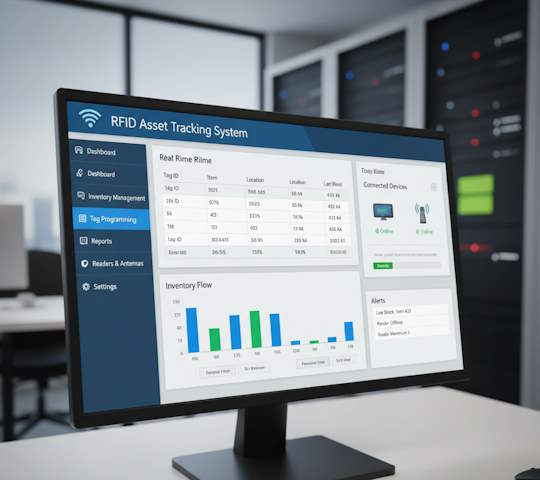
- Software: Xerafy Dashboard platform and HAECO's custom tool management system for real-time tracking, reporting, and integration with the calibration database.
- Process: Bulk reading of up to 100–200 tools simultaneously from a distance of 1–2 meters, full integration with calibration processes.
Post-Implementation Process (As-is / To-be)
| Process Aspect | As-is (Before RFID) | To-be (After RFID Implementation) |
|---|---|---|
| Inventory | Manual verification against lists and shadow boards, visual inspection. | Automatic bulk scanning with a handheld reader in 3–5 minutes for a full check. |
| FOD Control | High risk of tool loss, paper-based reports. | Real-time alerts for missing tools, automatic FOD reports. |
| Calibration | Separate manual tracking of calibration schedules. | Integration with the calibration database, automatic reminders. |
| Audit & Compliance | Lengthy checks (hours), paper trail. | Digital audit trail, instant reports (seconds). |
| Record Keeping | Paper/electronic logs, manual entry. | Centralized tool management system in real time. |
Results (12–36 Months)
- Inventory Accuracy: Achieved ≈99–100% tool control accuracy.
- Reduced Inventory Time: From 20 minutes to 3 minutes (85% time savings).
- FOD Prevention: Virtual elimination of tool-related FOD incidents.
- Productivity Increase: Technicians became 20–40% more efficient due to reduced non-productive time.
- Simplified Audits: Inspections reduced from hours to seconds.
- Scalability: Successful system expansion to Xiamen and other global sites.
Economic Effect / ROI
- Reduction in Tool Control Labor Costs: by 50–80%.
- Minimized FOD Risks: Potential savings of millions of dollars from prevented incidents.
- Reduced Tool Loss/Duplication: by 10–30%.
- Investment Payback Period: 18–36 months for a project with 3200+ tools.
- Overall ROI: Expected return on investment over 3–5 years is estimated in the range of 300–500%, depending on maintenance volumes and regulatory benefits.
Source Card and Realistic Estimates
| Category | Source / Confirmation | Data Type / Note |
|---|---|---|
| Real Implementations | Xerafy Case Study (2015–2024), RFID Journal (2018–2023), HAECO references | >3200 tools, 85% time savings, FOD prevention. |
| Technical Specifications | Xerafy Pico/XII Datasheets, Impinj Monza chip specs | EPC Gen2 on-metal tags, bulk read of 100–200 tools. |
| Integration | Xerafy Dashboard Software, HAECO tool management system | Calibration integration, real-time FOD reporting. |
| Process Metrics | Xerafy/HAECO Benchmarks, aviation MRO studies | Inventory time 20→3 min (85%), accuracy ≈99–100%. |
| Economic Metrics | RFID Journal Tool Control Cases, Xerafy estimates | Labor reduction 50–80%, FOD risk savings, ROI 300–500%. |
Legal & SEO Note
This information is for reference purposes only and is based on public sources. References to trademarks (Xerafy, Impinj, Nordic ID, etc.) do not imply affiliation. Professional consultation is recommended for adaptation to specific business needs.
FAQ
What RFID tags were used for metal tool control?
Ultra-small passive UHF EPC Gen2 tags from the Xerafy Pico/XII series, specifically engineered for on-metal performance. They withstand autoclave sterilization and chemical cleaning, ensuring reliable identification of each tool.
How did RFID reduce tool inventory time?
Bulk scanning with a handheld reader can read up to 200 tools simultaneously in 3-5 minutes, which is 85% faster than the 20-30 minutes required for manual checks against lists and shadow boards.
What economic impact did the RFID tool control implementation have?
Reduced labor costs by 50-80%, minimized FOD risks (preventing multi-million dollar losses), cut tool loss/duplication by 10-30%. Investment payback was 18-36 months with an ROI of 300-500% over 3-5 years.