



Standard UHF RFID Project in Pharmaceuticals: Tracking and Tracing Medicines in the Supply Chain
Case study update:
Standard UHF RFID Project in Pharmaceuticals: Tracking and Tracing Medicines in the Supply Chain
Implementation of passive UHF RFID tags at the item-level for large manufacturers and distributors. This case study demonstrates full automation of drug movement control from the packaging line to the hospital pharmacy, ensuring 100% traceability, compliance with stringent regulatory requirements (DSCSA, FMD), and significant cost savings through loss reduction.
Company and Production Context
Typical clients are international pharmaceutical manufacturers (such as Hanmi, Fresenius Kabi) and major distributors producing or handling millions of packages of drugs sensitive to counterfeiting and expiration annually. Key process stages include primary packaging, serialization, warehousing, shipping, and distribution to endpoints—pharmacies and hospitals. The key driver for implementation is not only operational efficiency but also compliance with increasing global regulatory pressure.
Challenges Before RFID Implementation
Manual Labor and Errors
Manual barcode scanning at each stage led to human errors (up to 10-20% data discrepancies), high labor costs, and slowed logistics processes.
Supply Chain Opacity
Lack of real item-level visibility after factory shipment created "blind spots," facilitating diversions, counterfeiting, and complicating the urgent recall of unsafe batches.
Compliance and Loss Risks
Difficulty managing expiration dates led to write-offs, and manual inventories did not provide the accuracy required by regulators (e.g., under DSCSA in the USA or FMD in the EU).
Solution and System Architecture
Tags and Application
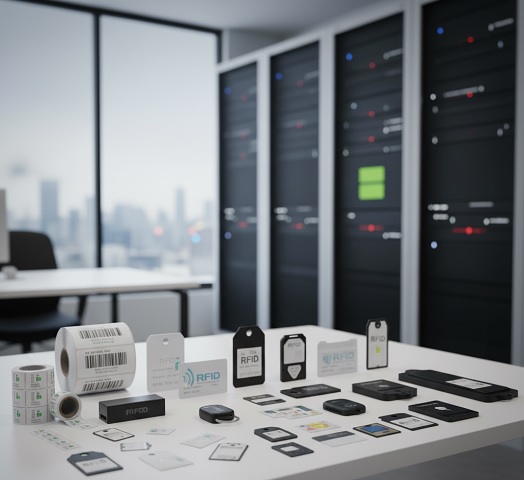
Passive UHF RFID tags (RAIN RFID standard, EPC Gen2) with Impinj Monza or NXP UCODE chips. Tags (Avery Dennison Smartrac inlays) are integrated into the label or packaging of each unit (bottle, syringe, blister) on high-speed packaging lines.
Reading Equipment
Fixed readers (Impinj Speedway or Zebra) are installed on conveyors, warehouse door portals, and in shipping/receiving areas. Handheld Zebra terminals are used for cycle counts in distribution centers and hospitals.
Integration and Software
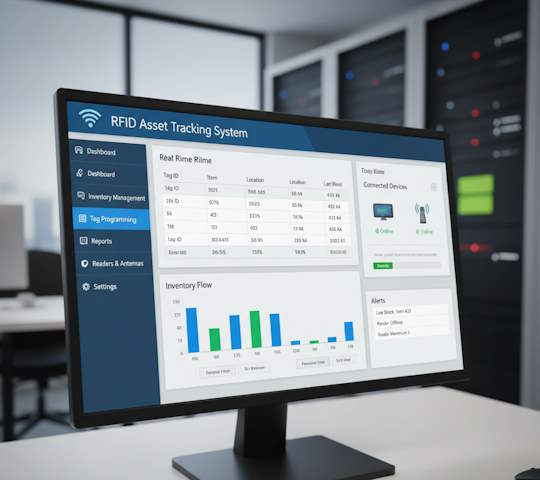
The system backend aggregates data on the movement of each serial number and integrates with corporate ERP (SAP) and WMS. For hospital operations, integration with cloud services like Kit Check is used to automate medical kit verification.
Process After Implementation (As-is / To-be)
| Process | Before (As-is) | After (To-be) |
|---|---|---|
| Serialization & Packaging | Printing and visual verification of 2D DataMatrix codes. Manual spot-check scanning. | Automatic encoding and writing of a unique EPC code to the RFID tag at line speed. Guaranteed 100% serialization. |
| Consolidation & Shipping | Scanning barcodes of each box to confirm shipment. Risk of missing units. | Instant bulk-reading of all packages on a pallet passing through an RFID portal. Automatic reconciliation with the shipping manifest. |
| Warehouse Inventory | Quarterly manual inventories requiring work stoppage, taking days. Accuracy ~95%. | Daily or weekly inventory by a single employee with a handheld reader in hours. Accuracy >99.9%. |
| Traceability & Recall | Manual database search, batch-level tracking. Recall took weeks. | Instant identification of the exact location of any suspect batch in the supply chain. Recall within hours. |
Implementation Results (12–36 months)
- Data Accuracy: End-to-end traceability level increased to 96–100%.
- Identification Reliability: Tag read rates in real-world conditions reached 98–99.9%.
- Operational Efficiency: Time required for inventory counts reduced by 5–10x.
- Safety & Compliance: Errors related to mis-shipment and counterfeits reduced by 30–80%. Full compliance with DSCSA, FMD requirements.
- Inventory Management: Sharp reduction in losses from drug expiration.
Economic Impact and ROI Calculation
The payback period for a typical project is 24–48 months. Primary sources of savings:
- Reduction of Direct Losses: Preventing losses from counterfeit drugs and expired stock write-offs saves 20–50% of previously lost amounts.
- Labor Cost Optimization: Automating accounting and inventory frees up to 80% of logistics personnel's time.
- Avoidance of Regulatory Fines: Guaranteed compliance eliminates the risk of multi-million dollar fines.
Overall ROI over 3–5 years ranges between 200–500%, significantly depending on the implementation scale and the value of the protected product portfolio.
Sources and Ranges Card
| Category / Company | Source / Confirmation | Data Type / Note |
|---|---|---|
| Hanmi Pharmaceutical | RFID Journal, Avery Dennison case study | Large-scale item-level tagging, 60 million units/year |
| Axia Institute Pilot | RFID Journal, Healthcare IT News | End-to-end pilot 2023–2024, 100% traceability |
| Fresenius Kabi | RFID Journal, Kit Check reports | Syringe tagging for hospitals |
| Genixus | RFID Journal LIVE! presentations | Unit-dose tracking of propofol |
| Purdue Pharma | RFID Journal, Impinj historical case | Anti-counterfeiting for Oxycontin (early case study) |
Legal and SEO Note
Information is based on public sources and is for informational purposes only. Not a commercial offer. Consultation with specialists is recommended for adaptation to a specific business.
Frequently Asked Questions (FAQ)
How does RFID help combat drug counterfeiting?
Passive UHF RFID tags applied at the item-level provide unique digital identification and cryptographic security, making it virtually impossible to unnoticeably copy or substitute a product within the supply chain.
What is the economic impact of RFID implementation in pharma?
Project ROI reaches 200-500% over 3-5 years due to reduced losses from counterfeits and expiring stock (by 20-50%), drastic cuts in labor costs for inventory, and process automation, which also minimizes operational risks.
What RFID standards are used in pharmaceutical traceability?
The industry relies on global RAIN RFID (EPC Gen2) standards and GS1 guidelines for data encoding. This ensures cross-vendor hardware compatibility and end-to-end traceability among various market participants, from manufacturer to hospital.