



Warehouse Logistics Optimization with UHF RFID: Cost Reduction and Inventory Accuracy Improvement
Strategic Context: Why RFID Became a Must-Have for Warehouses
If you manage a warehouse, your biggest pain point is not knowing where everything is right now. Traditional inventory systems provide 85-92% accuracy, meaning: out of every 100 orders, 8-15 are processed with errors. UHF RFID changes the game, raising accuracy to 99.5%+ and turning the warehouse from a cost center into a competitive advantage.
Why Now: The cost of RFID tags has fallen below $0.10, and hardware has become more reliable. Over the past 3 years, implementation ROI has decreased from 24-36 to 12-18 months. For management, this means: investments pay off within one financial year, and operational metrics improve immediately after launch.
Operational Losses of a Traditional Warehouse: Where Millions "Leak"
In our practice, we see the same problems in 90% of warehouses without RFID. These are systemic flaws that cannot be solved by "trying harder" – technology is required.
- Inventory Blind Spots: Manual counting of 50,000 SKUs takes 120-200 man-hours with 87-92% accuracy. In monetary terms: with a $10 million turnover, annual losses from inaccuracies amount to $800,000 - $1.2 million.
- Picking Errors: Even with barcode scanners, the error rate is 3-5%. Each error means costs for returns, reshipment, and customer loss ($150-300 per incident).
- Equipment and Personnel Downtime: Searching for "lost" pallets takes up 15-25% of forklift operators' working time. Annually, this translates to $45,000-75,000 for equipment and $60,000-100,000 in wages.
- Suboptimal Space Utilization: Without precise pallet positioning, a warehouse loses 18-22% of usable volume. For a 10,000 m² warehouse, this is $120,000-180,000 in annual rental payments for air.
Technical Implementation: How RFID Works in Real Conditions
UHF RFID (860-960 MHz) is not "magic" but an engineering solution. Proper implementation requires understanding three components: tags, readers, and integration with WMS.
System Architecture for a 10,000 m² Warehouse
| Component | Quantity | Function | Cost (Example) | Vendors |
|---|---|---|---|---|
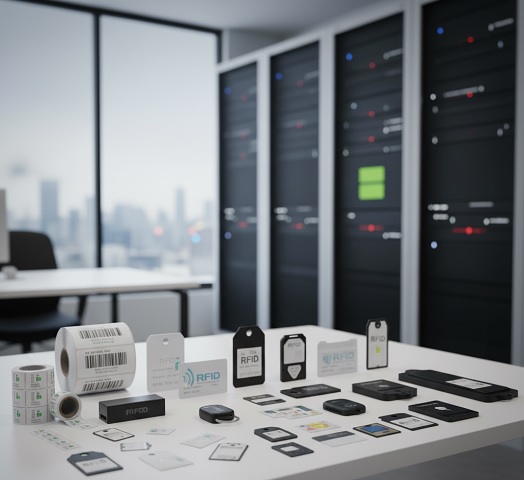
| UHF RFID Tags | 50,000 – 200,000 | Identification of pallets, cartons, equipment | $0.08 – $0.15 per unit | Impinj, Avery Dennison, Alien |
| Fixed Gate Readers | 8-12 points | Control of inbound/outbound traffic, receiving/shipping | $2,500 – $4,000 per point | Impinj, Zebra, ThingMagic |
| Mobile Handheld Terminals | 15-25 units | Inventory, search, movement | $1,200 – $2,000 per unit | Zebra, Honeywell |
| Antennas & Cables | 30-40 antennas | Ensuring coverage | $150 – $300 per antenna | Laird, MTI |
| Software & Integration | 1 system | Connection with WMS, reporting, analytics | $40,000 – $80,000 | Custom development or ShipBob, Deposco |
Critical Success Factors
- Tags for Metal: 40% of racking is metal. Use tags with a protective layer (ferrite) or isolator overlays. The price is 30-40% higher, but without this, read rates will be 50-60%.
- Zonal Coverage: Divide the warehouse into zones with different reader densities. Receiving/shipping area – 100% coverage, storage area – pinpoint antennas on main aisles.
- Integration "Layer by Layer": Do not replace the WMS, but supplement it with an RFID module. Phased launch: first receiving, then inventory, then picking.
Financial Justification: ROI for the Board of Directors
Implementing RFID is a capital expenditure (CAPEX). Management needs clear numbers, not "technological prospects." Let's provide a calculation for a typical 10,000 m² warehouse with a turnover of 50,000 pallets per month.
| Savings/Revenue Item | Before Implementation | After Implementation | Savings/Growth | Annual Benefit ($) |
|---|---|---|---|---|
| Reduction in losses from inventory inaccuracy | 2.8% of turnover | 0.5% of turnover | 2.3% | 345,000 (at $15M turnover) |
| Savings on inventory counting | 240 man-hours per month | 40 man-hours per month | 200 hours/month | 72,000 (at $30/hour) |
| Increase in order processing speed | 85 orders/person/day | 120 orders/person/day | 35 orders | 210,000 (additional capacity) |
| Reduction in search costs | 18% of working time | 4% of working time | 14% of time | 84,000 (20 employees) |
| Optimization of space utilization | 82% efficiency | 94% efficiency | 12% of volume | 96,000 (rental) |
| TOTAL Annual Benefit | 807,000 | |||
Investments and Payback Period
Capital Expenditure (CAPEX):
- Equipment (readers, terminals, server): $180,000
- Tags (100,000 units): $12,000
- Software & Integration: $65,000
- Training & Launch: $25,000
- Total CAPEX: $282,000
Operational Expenditure (OPEX): $18,000/year (support, tag replacement).
ROI Calculation: $282,000 / $807,000 = 0.35 years (~4 months) by pure math. In practice, considering staff adaptation and fine-tuning – 7-9 months. After that, the system generates $650,000+ in net savings annually.
Practical Case Studies: How Competitors Are Already Gaining Advantage
Case 1: European E-commerce Fulfillment Center (Netherlands)
Problem: The center processed 25,000 orders per day with 91% accuracy. During peak periods (Black Friday), errors reached 9%, leading to penalties from marketplaces and loss of ranking.
Solution: Full-scale UHF RFID implementation across 75,000 items. Every rack, every pallet, and every picking zone received tags. Integration with the existing WMS via API.
Results (after 10 months):
- Inventory Accuracy: 99.6% (was 91%)
- Order Processing Speed: +47% (from 3.5 to 2.2 minutes)
- Picking Errors: Reduction from 9% to 0.4%
- Savings on Inventory Counting: 2,200 man-hours per month ($66,000)
- ROI: 8 months with €320,000 investment
- Additionally: Contract with a new major marketplace due to supply chain transparency
Case 2: US Pharmaceutical Distributor (Texas)
Problem: 15,000 m² warehouse with $40 million in inventory. Regulator (FDA) requirements for traceability of every product. Manual accounting was non-compliant, with an annual penalty risk of $2-5 million.
Solution: RFID for 100% temperature and movement tracking. Special tags with temperature sensors, specialized readers for cold zones.
Results (after 14 months):
- Full compliance with FDA 21 CFR Part 11 requirements
- Automatic creation of an audit trail for each product
- Reduction in losses from temperature excursions: from 1.2% to 0.2% ($480,000 per year)
- Reduction in documentation time: from 160 to 25 hours per week
- ROI: 11 months with $580,000 investment
- Additionally: Ability to enter EU markets thanks to compliance with EU GDP
Limitations and Risks: When RFID May Not Meet Expectations
As technology partners, we often advise against implementation if we see "red flags." RFID is not a panacea but a tool that works under certain conditions.
Technical Limitations (Which Can Be Overcome, but for Additional $)
- Metal Environment: Warehouses with 80%+ metal racking require tags with isolation. Increases tag cost by 200-300% and requires professional installation.
- Liquids and Organic Materials: Meat, beverages, chemicals absorb radio waves. Need high-power tags and special antennas, increasing system cost by 40-60%.
- High Density of RFID Tags: Warehouses with 500,000+ tags experience collisions. The solution is zoning and special protocols, but this is a complex engineering task.
Economic and Organizational Limitations
- Small Volumes: For warehouses with a turnover of less than 5,000 pallets per month, ROI exceeds 24 months. Often, it's cheaper to optimize processes without RFID.
- Staff Resistance: 30% of implementations "fail" due to employee sabotage. An adaptation and engagement program is mandatory.
- Unprepared IT Infrastructure: Wi-Fi networks 5+ years old, weak servers, outdated WMS without API – all this increases cost and timelines 2-3 times.
Our "Readiness" Checklist: Before starting a project, we assess: 1) Metal density in the warehouse (<60%), 2) Wi-Fi speed (>200 Mbps), 3) In-house IT specialist, 4) Training budget (>5% of CAPEX), 5) Turnover (>10,000 pallets/month). If 4 out of 5 points are "yes," the implementation will be successful.
Practical Questions from Decision-Makers (FAQ)
What ROI can be expected from RFID implementation in a warehouse?
Average ROI for a 10,000 m² warehouse is 12-18 months. Specific figures depend on scale: inventory automation saves 70-85% of time, reduces shrinkage by 60-75%, and increases inventory accuracy to 99.5%.
What are the main risks of implementing RFID in an existing warehouse?
Key risks: interference from metal racking (solved with specialized tags), integration with legacy WMS (requires API adapters), process change management (requires staff training). A proper pilot project reduces risks by 80%.
How does RFID affect operational KPIs of a warehouse?
RFID improves key metrics: order processing time is reduced by 35-50%, inventory accuracy rises to 99.5%, goods receiving speed increases by 60%, and warehouse space utilization is optimized by 15-20%.
Can RFID be integrated with our current WMS?
Yes, in 95% of cases. Modern WMS (SAP WM, Manhattan, Oracle) have APIs for RFID data. Average integration time is 3-5 weeks. For custom systems, we write adapters, adding 2-3 weeks to the project.
What to choose: full implementation or a pilot project?
We recommend a pilot on 10-15% of the warehouse area (usually the receiving/shipping zone). This allows: 1) Assessing real effectiveness, 2) Preparing staff, 3) Adjusting technical parameters. The pilot pays off in 2-4 months and reduces the risks of a full-scale project.
Next Steps for Management:
- Audit Current Processes: Determine exact accuracy and speed metrics (not "approximately," but in numbers).
- Technical Site Visit: Invite specialists to assess RFID coverage at your facility.
- Pilot Project: Launch a test in a limited area with clear success metrics.
- Financial Modeling: Calculate ROI specifically for your volumes and specifics.
Sources for Further Study:
- GS1 RFID Standards for Warehousing – International logistics standards
- MHI Annual Industry Report – Warehouse automation trends
- Zebra: RFID in Warehousing (PDF) – Practical guide
- Impinj Case Studies – Implementation cases in logistics
© 2025 RFID UKRAINE. Material prepared for decision-makers in technology adoption. All calculations are based on real projects but require adaptation to a specific business context.
Consultation on RFID implementation in warehousing: rfid.org.ua