


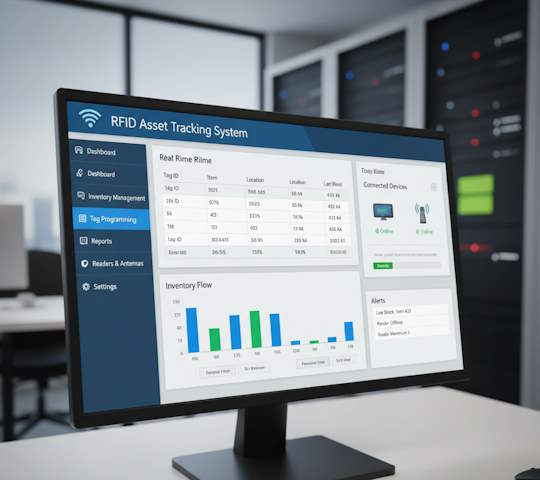

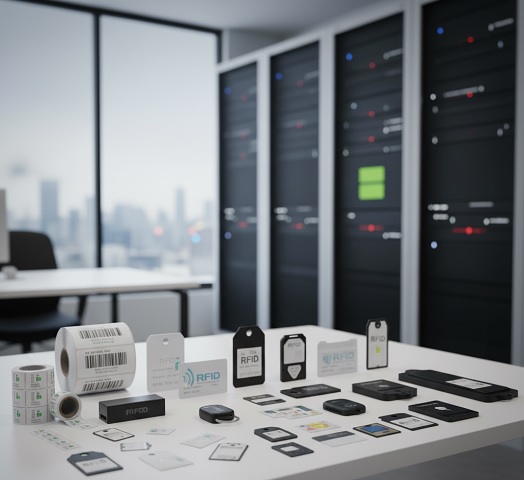
IT Equipment Asset Management with UHF RFID: ROI, Case Studies, and Strategy for Executives
Authors: Material prepared by experts from RFID UKRAINE, with over 10 years of international implementation experience.
Last Updated:
Digital Transformation of IT Asset Management: From Manual Tracking to Intelligent Automation
For middle and senior management, managing an IT equipment portfolio is a strategic task that directly impacts efficiency, budget, and security. Traditional tracking methods using Excel and barcodes cannot keep pace with modern business demands, leading to asset loss, budget overruns, and data leakage risks. The solution is automation based on UHF RFID, which has proven its effectiveness in international corporations, reducing losses by 40% and paying back within 12–18 months.
Key Challenges of Manual Management
Executives face three core problems:
- Financial Losses. 5–10% of equipment is lost or incorrectly written off annually. For a fleet of 10,000 units, this translates to hundreds of thousands of dollars in losses.
- Operational Inefficiency. Auditing 1000 assets with two specialists takes up to 80 hours monthly.
- Security Risks. Uncontrolled movement of equipment creates data leakage threats and non-compliance with ISO 27001, GDPR, HIPAA standards.
UHF RFID Technology for IT Assets
UHF RFID (860–960 MHz) enables contactless identification from distances up to 12 m.
- On-Metal Tags. Impinj, Zebra — for servers, laptops, network equipment.
- Readers. Honeywell, Alien Technology — fixed and mobile for control and inventory.
- Software. Integration with ITSM (ServiceNow, Jira), accounting, and CMDB.
EPCglobal Gen2v2 and ISO/IEC 18000-63 standards ensure compatibility and global applicability.
International Case Studies
European Financial Holding
Challenge: Reduce losses of laptops and tablets across 15 offices.
Solution: 120 Impinj readers, NXP tags on 8,500 devices.
Results:
- Losses reduced by 42% (~€280,000).
- Audit time cut from 3 weeks to 2 days.
- 720 personnel hours freed up.
- ROI — 14 months.
Asian Technology Giant
Challenge: Optimize server equipment tracking.
Solution: Zebra tags on 25,000 units, Honeywell scanners integrated with DCIM.
Results:
- Tracking accuracy — 99.8%.
- Inventory costs reduced by 35% (~$150,000/year).
- Equipment search and replacement accelerated by 65%.
- ROI — 16 months.
Financial Justification: Example for 5,000 Assets
For strategic decision-making, executives need a clear financial model. Consider a company with a fleet of 5,000 IT assets.
| Item | Amount (USD) | Comment |
|---|---|---|
| CAPEX | 85,000 | Tags, 20 readers, software, integration, training |
| Savings from reduced losses (annual) | 70,000 | 7% of fleet value |
| Audit cost savings (annual) | 80,000 | Freeing up 2 FTE |
| Reduced fines (annual) | 15,000 | Regulatory compliance |
| Total Annual Savings | 165,000 |
Note: The calculated payback period (CAPEX / Annual Savings) is approximately 6 months. In some optimized configurations, payback can be achieved in 6–9 months, but for strategic planning and accounting for all indirect costs and risks, the 12–18 month ROI range is recommended.
Limitations
RFID is not advisable when:
- Asset portfolio <500 items.
- Lack of readiness for change.
- Extreme operating conditions.
- Stringent CAPEX constraints.
A pilot on 500–1,000 assets is recommended to evaluate benefits.
Implementation Roadmap
- Pilot (3 months): Tag 500–1,000 assets, testing.
- Expansion (6–9 months): Integration with ITSM and accounting, staff training.
- Full Deployment: Connect all sites, predictive analytics.
A key success factor is appointing a Project Sponsor from top management.
FAQ
What is the payback period (ROI) for an RFID system managing IT assets?
With proper implementation, ROI is achieved within 12–18 months. In some optimized configurations, payback can be 6–9 months, but for strategic planning and accounting for all factors, the 12–18 month range is recommended.
What are the main risks when implementing RFID in IT infrastructure?
Key risks: metal server racks, integration with ITSM, CAPEX.
Can equipment be tracked outside the office?
Standard passive UHF RFID tags do not have a built-in power source. For tracking outside premises, active tags or hybrid solutions (BLE + RFID) are needed.
Sources
© RFID UKRAINE, 2025. All rights reserved.