


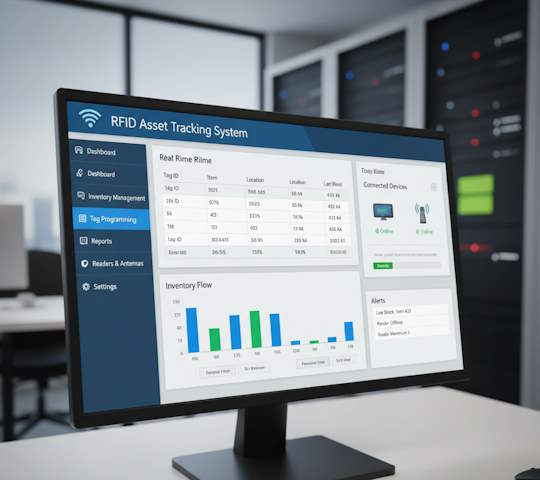


Archive and Document Management with UHF RFID Technologies
Authors: Material prepared by experts from RFID UKRAINE, with over twelve years of experience in international document and archive management projects.
Last Updated:
Digital Transformation of Document Management: From Paper Chaos to Intelligent Archives
The global document management market exceeds $70 billion and grows by 12–15% annually. Organizations spend 5–7% of their turnover on handling paper documents, with about 7.5% lost irretrievably. Implementing UHF RFID transforms document management, turning archives into manageable digital assets with a 12–18 month payback period and up to a 65% reduction in operational costs.
Key Challenges of Traditional Document Management
Executives face systemic challenges:
- Losses: 7–15% of business documents are lost annually, leading to legal costs of about $180,000 per company.
- Time: Employees spend 25–30% of work time searching (18–24 days per year per person).
- Non-compliance: 60% of companies receive fines for violating storage regulations (GDPR, SOX, HIPAA).
- High Costs: Maintaining an archive costs $15–25 per storage location per year.
- Inefficient Space Utilization: 30–40% of premises are occupied by improperly stored documents.
UHF RFID Technology for Intelligent Management
Modern systems use the ISO 28560-3 standard with passive tags.
Solution Architecture
- Tags: Thin Impinj Monza R6 labels, 0.3 mm thick, range up to 8 m, integrated into covers.
- Fixed Readers: Zebra AN720 at archive entrances/exits, 99.9% accuracy.
- Mobile Terminals: Honeywell ScanPal for inventorying 2,000–3,000 documents per hour.
- Software: Integration with ECM (OpenText, IBM FileNet) and DMS (SharePoint, DocuWare).
International Standards
Solutions comply with ISO 15489, ISO 16175, ISO 23081, ensuring legal validity and long-term preservation.
Benefits for Management
Efficiency
- Document search reduced from 45–60 minutes to 30–60 seconds (98–99% acceleration).
- Inventory: 100,000 documents in 2–3 hours instead of 2–3 weeks.
- Accounting accuracy: 99.9% vs. 85–90% with manual systems.
- Labor costs reduced by 60–70%.
Risk Management
Complete audit trail: who, when, and where a document was moved. Automatic notifications of violations. Full readiness for regulatory inspections.
Financial Analysis
| Metric | Before RFID | After RFID | Effect |
|---|---|---|---|
| Document Losses | $85,000 (8%) | $4,250 (0.4%) | –95% |
| Search | $240,000/year (3 FTE) | $72,000/year (0.9 FTE) | –70% |
| Inventory | $65,000/year | $6,500/year | –90% |
| Fines | $120,000/year | $12,000/year | –90% |
ROI for a 200,000 Document Archive
- CAPEX: $350,000 (tags, readers, software, integration)
- Annual Savings: $437,250 (OPEX + prevented losses)
- Payback Period: 9.6 months
- 3-Year ROI: 275% (NPV $962,000)
- Space Savings: 30% ($45,000/year)
International Case Studies
European Financial Conglomerate
Challenge: Managing 850,000 documents across 8 countries, complying with GDPR and MiFID II.
Solution: RFID Impinj + IBM FileNet, 900,000 Alien tags, 124 Zebra readers.
Results (24 months):
- Search time reduced from 52 to 0.9 minutes (€420,000/year)
- Costs reduced by 68% (€310,000/year)
- Full GDPR compliance
- 1,200 m² freed up (€180,000/year)
- ROI — 11 months
North American Medical Corporation
Challenge: Managing 1.2 million medical records, complying with HIPAA, quick access for 300+ physicians.
Solution: RFID Honeywell with NXP encryption, integration with Epic Systems.
Results (18 months):
- Record access time reduced from 22 to 1.2 minutes
- Audit costs reduced by 85% ($240,000/year)
- Record losses decreased from 3.2% to 0.08% ($175,000)
- Productivity increased by 18% (12 FTE)
- ROI — 14 months with CAPEX $480,000
Limitations
Technical:
- Metal staples require special tags (+$0.8–1.2)
- High storage density (>500 documents/m²) causes collisions
- Thick bindings (>8 cm) shield the signal
- Metallic paper or conductive ink
Economic:
- Small archives (<10,000 documents): ROI over 3 years
- Low document value (<$5): tag cost exceeds benefit
- Short-term storage (<1 year)
- Digitized processes (95%+ documents in digital form)
Alternatives: barcodes ($0.02–0.05), digital archives, hybrid solutions for critical documents.
FAQ
What is the payback period?
On average 12–18 months. For an archive of 100,000+ documents — 14–16 months.
Which ROI metrics are important?
Reduction in search time, lower personnel costs, decreased losses, increased productivity, regulatory compliance. ROI of 20–30% per annum with CAPEX of $200,000–500,000.
When is RFID not feasible?
For small archives (<10,000 documents), with metallic elements without preparation, with high rotation frequency (>50% per month), if the main problem is digital indexing, or with a budget < $100,000.
Conclusion: Strategic Transformation of Knowledge Management
For management, RFID is a tool to transform a costly archive into a value-creating asset.
- Financial Efficiency: ROI 12–18 months with 60–70% cost reduction
- Risk Management: 99.9% preservation and full regulatory compliance
- Operational Excellence: Access speed as a competitive advantage
- Strategic Flexibility: Scalable infrastructure for growth
The next step is an audit of current costs and a pilot implementation on 10,000–20,000 documents.
Sources and References
- ISO 28560-3:2014 — RFID for document management
- ISO 15489-1:2016 — Records management
- ISO 16175-2:2020 — Functional requirements
- Impinj Library & Asset Management — Industry solutions
- Zebra Location Solutions — Tracking technologies
- Honeywell Asset Tracking — Industrial solutions
- Research on RFID in Document Management — Academic research