


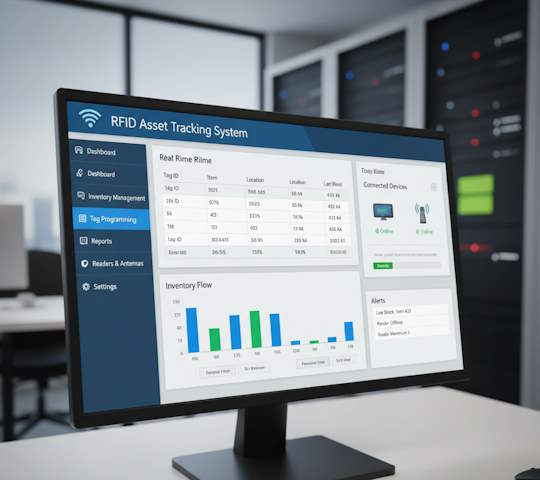


Enterprise Asset Management: Implementing UHF RFID for Fixed Asset Control
Authors: Material prepared by experts from RFID UKRAINE, with over ten years of experience implementing international projects.
Last updated:
For top management and mid-level executives, controlling fixed assets is not just routine accounting but a matter of strategic development. A lack of up-to-date data on property status leads to direct financial losses, audit risks, and inefficient resource allocation. Using passive UHF RFID technology shifts the paradigm from rare inventories to a mode of continuous automated control. This transforms material values from static accounting entries into an active and transparent company resource. This work provides an analysis of global practices, financial model calculations, and key nuances of solution implementation.
Strategic Challenges in Fixed Asset Management
The traditional approach to property accounting through paper registries and periodic reconciliations creates a range of systemic threats to business stability:
- Capital losses: On average, organizations lose 10% to 15% of property due to unaccounted write-offs, theft, or chaotic movements. If assets worth $50 million are on the balance sheet, annual damage reaches $5-7.5 million.
- Low process efficiency: Searching for necessary tools or equipment at large facilities can consume up to one-fifth of engineering personnel's productive time.
- Audit and taxation risks: Discrepancies between registry data and actual item availability trigger scrutiny from regulatory bodies, leading to penalties and errors in depreciation calculations.
- Planning obstacles: Lack of operational information about asset location and wear hinders proper allocation of capital expenditure (CAPEX) budgets and implementation of structural transformations.
Technological Architecture of the Solution
A modern complex for remote asset monitoring is based on three fundamental elements:
1. Identification and Tags
Specialized UHF RFID identifiers adapted for operation in harsh conditions are used to equip assets:
- Solutions for metal: The Impinj H47 series provides read ranges up to 8 meters when mounted on metal surfaces. Price ranges from $2.5-4 per unit.
- Multi-purpose identifiers: NXP UCODE 9 with IP68 protection class (resistant to moisture and chemicals). Cost is $1.5-2.5.
- Options for extreme temperatures: Alien Technology Higgs-EC, maintaining functionality from -40°C to +85°C.
2. Reading Infrastructure
- Fixed readers: Zebra FX9600, installed at checkpoints and inter-departmental transfer zones.
- Portable terminals: Honeywell CT60, equipped with RFID modules for scheduled audits.
- Local antennas: Placed directly in storage areas for high-value items.
3. Software Platform and Integration
The digital environment for asset control operates according to ISO/IEC 24791 standards. It connects with corporate systems (SAP, Oracle) via APIs. Key features include: automatic balance confirmation, maintenance schedules, and monitoring of asset utilization intensity.
International Case Studies and Financial Results
Case Study 1: Major Industrial Holding in Asia (Chemical Industry)
Goal: Establish control over 25,000 equipment units across seven plants in Malaysia, Thailand, and Indonesia. Previous annual losses were $3.2 million, and reconciliation procedures took 45 days.
Implementation: Deployment of infrastructure based on Impinj H47 components and Zebra equipment. Integration with SAP PM module. Staff training (120 specialists).
Results after two years of operation:
- 94% reduction in property losses (annual savings reached $3 million).
- Inventory time reduced from 45 to 3 working days.
- 11% increase in OEE (Overall Equipment Effectiveness) due to timely repairs.
- Elimination of tax risks through complete data transparency.
Economic impact: Initial investment (CAPEX) — $850,000. Reduction in operating expenses (OPEX) — $3.8 million annually. Return on investment (ROI) achieved in 22 months.
Case Study 2: Network of Medical Centers in Europe
Goal: Control over 8,000 inventory items (from functional beds to ventilators) across 12 branches. Up to 30% of equipment was idle due to search problems. One hour of downtime cost $280.
Implementation: Use of sterilizable NXP UCODE 9 tags and Honeywell mobile devices. Integration with surgery planning software.
Results after 18 months:
- Finding needed equipment now takes 3 minutes instead of 45.
- Utilization of high-value equipment increased from 62% to 89%.
- Expenses for renting external equipment decreased by $420,000 annually.
- Wear and disposal accounting fully automated.
Economic impact: CAPEX — $320,000. Annual profit — $580,000. Payback period (ROI): 17 months.
Typical Financial Calculation for a Medium-Scale Enterprise
Calculation for an industrial enterprise with 10,000 fixed asset units and annual turnover of $200 million.
| Metric | Value | Comment |
|---|---|---|
| Capital Expenditure (CAPEX) | ||
| • RFID tags (10,000 units at $2.5 each) | $25,000 | Impinj or NXP series chips |
| • Readers, antenna field, software | $85,000 | Zebra, Alien Technology brands |
| • Configuration, launch, and training | $40,000 | |
| Total CAPEX | $150,000 | |
| Operational Benefit (annual, OPEX) | ||
| • Asset retention (10%) | $80,000 | With average item price of $8,000 |
| • Reduced accounting costs | $45,000 | 80% labor resource savings |
| • Increased asset turnover | $120,000 | Less downtime, no need for rentals |
| • Minimized tax losses | $25,000 | Accurate depreciation, no penalties |
| Total Annual Savings | $270,000 |
ROI Analysis: The payback period will be approximately 6-7 months. After this stage, the project provides a net income of about $270,000 annually, which equals 0.135% of the organization's revenue.
Key Benefits for Management
- Strategic clarity: Reliable information about asset structure and productivity to justify capital investments.
- Financial discipline: Prevention of unauthorized asset disappearance, improved reporting quality.
- Process optimization: Freed-up personnel time previously spent on routine searches and reconciliations.
- Risk reduction: Protection from regulatory, auditor, and insurance company claims.
- Growth readiness: Simplified procedures during mergers and acquisitions, quick integration of new units into the overall system.
Limitations and When RFID Is Not Advisable
Despite high efficiency, the technology has its limitations. Management should consider factors that reduce returns:
- Small scale: If the asset portfolio contains fewer than 500-1000 items, system costs may outweigh benefits. Entry threshold starts from $50,000-80,000.
- Harsh environmental conditions: Operation above 120°C, in environments with strong radio interference, or inside shielded enclosures requires expensive modifications, increasing the budget by 40-60%.
- Object specificity: Storing liquids or tagging very small parts (under 5 cm) is technically challenging.
- Human factor: The project requires restructuring of internal regulations. Without top management involvement, implementation risks becoming a formality.
- When implementation is not justified:
- Organizations with a small number of stationary objects (e.g., furniture in a single office).
- Assets cheaper than $100, where the tag price and installation costs are comparable to the item's value.
- Companies on the verge of complete business sale or liquidation within the next year and a half.
Advice for executives: Before full-scale launch, it's recommended to run a pilot project on 5-10% of the asset base. This allows evaluation of real KPIs and calculation of Total Cost of Ownership (TCO) over a five-year horizon.
Frequently Asked Questions (FAQ)
What is the payback period (ROI) for an RFID solution for fixed asset accounting?
Typically, the return on investment period ranges from 18 to 24 months. This is influenced by the volume of assets, type of tags selected, level of automation, and initial scale of losses. In heavy industry with high loss percentages, payback can occur within 6-12 months.
Which standards regulate the use of UHF RFID in this field?
The foundational standards are ISO/IEC 18000-63 (radio interface), ISO/IEC 29143 (operating modes), and ISO/IEC 24791 (data processing). For identification purposes, ISO/IEC 15459 is often used. Compliance with these protocols ensures interoperability of equipment from different brands and protects future investments.
In which situations is RFID accounting economically impractical?
When there is a small number of units (up to 500 pieces), a high tag price relative to the asset itself, or if property remains in one place for years. Also, the project is unlikely to succeed if the company is not ready to change established business processes.
Sources and References
The following materials were used in preparing this review:
- ISO/IEC 18000-63:2015 — regulation for UHF RFID systems
- Impinj documentation on Asset Tracking solutions
- Zebra comprehensive reviews on fixed asset management
- GS1 EPC/RFID standards in asset management
© 2025 RFID UKRAINE. Copying is protected. Information is provided for educational purposes. For expert support, contact our specialists.