



Smart Clothing Manufacturing: How UHF RFID Optimizes the Textile Industry
Strategic Context: Industry 4.0 in Textiles
The textile industry is undergoing its fourth industrial revolution. UHF RFID today is not merely an accounting tool, but the foundation for creating digital production twins, predictive analytics, and full traceability from cotton to finished product.
For Executive Leadership: Modern RFID systems provide 99.7% real-time inventory accuracy, reduce production cycles by 22-30%, and enable mass customization—a key retail trend for 2025-2030.
Operational Problems in Traditional Manufacturing
Textile enterprise managers face systemic issues that reduce profitability by 15-25%:
Financial Losses of a Typical Factory (500 employees):
- Material Waste: 8-12% of fabric and trim cost ($180,000-$300,000/year)
- Work-in-Progress (WIP): Excess inventory worth $400,000-$700,000
- Equipment Downtime: Due to lack of needed materials or instructions (15-20% of time)
- Order Fulfillment Errors: Wrong specifications, sizes, colors (3-5% of total volume)
- Reputational Risks: Inability to confirm ethical and sustainable supply chain practices
Technological Architecture: RFID for Textiles
The textile environment requires specialized solutions: tags must withstand humidity, high temperatures, mechanical stress, and chemical processes.
Key Technical Parameters:
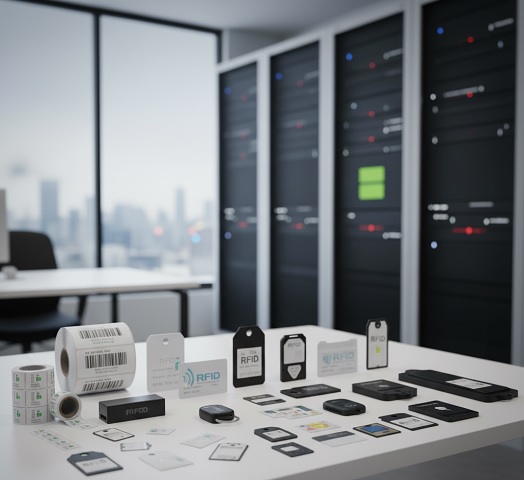
- Tag Types: Fabric (sew-in), paper (for packaging), plastic (for boxes)
- Durability: Washing at 95°C, dry cleaning, ironing up to 200°C, bleaching
- Read Range: Up to 8 meters for fabric rolls, up to 12 meters for packed pallets
- Integration: Direct connection to ERP (SAP, Oracle), MES, WMS systems
- Standards: EPC Gen2 (ISO/IEC 18000-63), GS1 for end-to-end traceability
Implementation Points in the Production Cycle
| Production Stage | Traditional Approach | With RFID | Effect |
|---|---|---|---|
| Fabric Cutting | Manual marking, 5-8% errors | Automatic roll identification | 12-18% waste reduction |
| Sewing Lines | Paper job cards, part search | Auto-feeding of needed parts to workstations | 25-35% productivity increase |
| Quality Control | Sampling inspection (10-20%) | 100% automatic inspection of each item | Defect reduction from 3% to 0.3% |
| Finished Goods Warehouse | Manual monthly inventory | Real-time, 99.9% accuracy | 95% reduction in inventory time |
International Case Studies: Implementation Impact
Case 1: European Premium Apparel Manufacturer (Portugal)
A factory with 800 employees implemented a full RFID cycle on the Impinj platform. Each fabric roll, each part kit, and each finished product received a UHF tag.
Results after 24 months: Material waste reduced by 22%, sewing line productivity increased by 31%, order lead time decreased from 21 to 14 days. Enabled mass customization—customers can order individual sizes and details without cost increase.
ROI: Achieved in 14 months with an investment of €1.3 million. Annual savings—€950,000.
Case 2: Asian Contract Manufacturer (Vietnam)
A factory producing clothing for 7 international brands implemented a Zebra Technologies system for 12,000 equipment units and 2,000 workstations.
Results after 18 months: Work-in-Progress reduced by 42%, equipment downtime decreased from 18% to 6%, production planning accuracy reached 97%. Full traceability enabled obtaining sustainable production certificates (GOTS, Oeko-Tex).
Effect: The contract factory became a preferred supplier for 3 new luxury segment brands, increasing annual revenue by 35%.
Financial Analysis: ROI and Economic Model
For the production director, an accurate financial model is critical. Main cost items (CAPEX) include RFID tags (from $0.07 for paper to $0.25 for fabric), reading equipment, ERP/MES integration, and staff training.
| Source of Savings | Annual Effect (500-person factory) | Commentary for CFO |
|---|---|---|
| Reduction in Material Waste | $150,000 - $250,000 | Direct impact on cost of goods sold |
| Increase in Productivity | $200,000 - $350,000 | Higher output without workforce expansion |
| Decrease in Work-in-Progress | $180,000 - $300,000 | Release of working capital |
| Reduction in Defects & Returns | $80,000 - $150,000 | Improved quality = brand loyalty |
| Optimization of Inventory | $70,000 - $120,000 | Lower storage costs |
| TOTAL (CONSERVATIVE) | $680,000 - $1,170,000 | Aggregate Annual Impact |
Investment Forecast: With typical investments of $800,000 - $1.5 million (depending on scale), the payback period ranges from 12 to 18 months. For large manufacturing holdings (5,000+ employees), ROI is achieved in 10-14 months due to economies of scale.
Strategic Limitations and Challenges
Implementing RFID in the textile industry has specific limitations:
- Tag Cost for Mass Market: For items priced at $5-15, adding even a $0.15 tag increases cost by 1-3%. The solution is to use tags only for high-value items or premium collections.
- Technological Limitations: Metallized fabrics (e.g., with thermal coating) can cause interference. Pre-testing and tag type selection are required.
- Cultural Barriers: Transitioning from manual to automated tracking faces resistance from line personnel. A change management program and training are critical.
- Legacy System Integration: Many factories use outdated ERP systems. Development of middleware or phased IT infrastructure modernization is needed.
FAQ: Executive Questions
What is the ROI of implementing RFID in apparel manufacturing?
The average ROI is 12-18 months. The main savings come from reducing material waste (up to 25%), decreasing Work-in-Progress (WIP) by 35%, and optimizing equipment utilization by 15-20%. A detailed financial analysis is provided in the corresponding section.
Which RFID tags are best for textiles?
For the textile industry, optimal choices are fabric UHF RFID tags sewn into labels or lining, and paper tags for packaging. They withstand washing, ironing, and dry cleaning, maintaining readability throughout the product's entire lifecycle. Technical parameters are described in the "Technological Architecture" section.
How much does it cost to implement RFID in a factory?
Implementation cost depends on scale: from $150,000 for a factory with 100 workers to $1.2 million for an enterprise with 2000+ employees. Main expenses: RFID tags (40-55%), reading equipment (25-35%), integration with WMS/ERP (15-25%). The financial model is detailed in the "Financial Analysis" section.
Sources & Standards:
- GS1 Standards for Apparel and General Merchandise — https://www.gs1.org/standards
- ISO/IEC 18000-63:2015 RFID for Item Management — https://www.iso.org/standard/59644.html
- OEKO-TEX® Standard 100 for Textile Safety — https://www.oeko-tex.com
- Impinj Textile and Apparel Solutions — https://www.impinj.com/solutions/industries/apparel
- Zebra RFID for Manufacturing — https://www.zebra.com/us/en/solutions/industry/manufacturing.html
For consultation on RFID implementation in the textile industry: RFID UKRAINE — expertise in digital production transformation.
© 2025 RFID UKRAINE. All rights reserved.