


UHF RFID in Jewelry Industry: Theft Protection and Inventory Management
For jewelry network executives and manufacturers, the primary strategic objectives remain asset preservation and operational efficiency improvement. Traditional security measures (EAS) and manual inventory management fail to provide adequate control amidst growing cases of organized theft, inventory discrepancies, and volatile demand. Implementing UHF RFID (Ultra-High Frequency Radio-Frequency Identification) transforms these threats into competitive advantages: reducing theft by 95%, achieving inventory accuracy of 99.9%, and increasing product turnover by 15–20%. Return on investment is typically achieved within 12–18 months.
Critical Risks in Jewelry Retail and Manufacturing
Management faces three interrelated problems, each leading to direct financial losses and reputational damage:
- Theft and inventory shrinkage. Annual losses for jewelry networks due to theft by employees, customers, and inventory discrepancies average 1.5–2.5% of turnover. For a network with $50 million in revenue, this translates to $750,000 – $1.25 million in direct losses.
- Low operational visibility. Manual tracking of thousands of SKUs causes stock inaccuracy (averaging 15–20% discrepancies), leads to dead stock accumulation, and results in lost revenue due to missing sales items.
- High security and logistics costs. Maintaining large security teams, hours of monthly inventory counts, and manual data entry reduce profitability, which is critical in the jewelry business.
UHF RFID Technology for Security and Inventory Management
UHF RFID (865–928 MHz range) enables instantaneous contactless identification of each item at distances up to 5–7 meters. In the jewelry industry, the following are used:
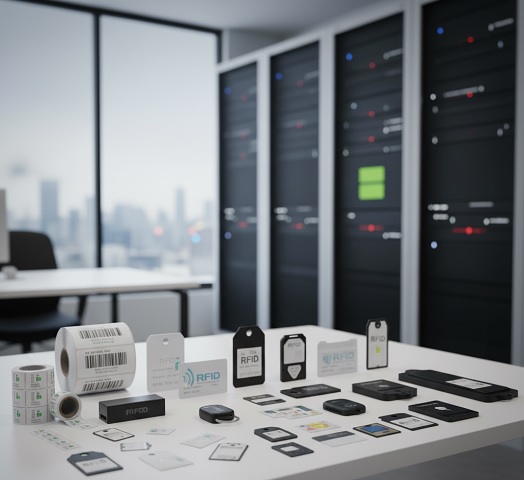
- Miniature tags. Sized from 6×4 mm (Impinj Monza R6-P, Zebra TrueVUE), embedded in price tags, labels, or packaging. They are invisible to customers but contain a unique identifier (EPC), product information, and movement history.
- Smart displays and RFID antennas. Readers integrated into display fixtures record every item removal and return, alerting to potential theft in real time.
- RFID gates at entrances/exits. Installed at store or warehouse doors, they automatically detect unauthorized removal of tagged items and integrate with alarm systems.
- Mobile scanners. Honeywell or Alien Technology terminals allow inventorying hundreds of items in seconds without removing them from displays.
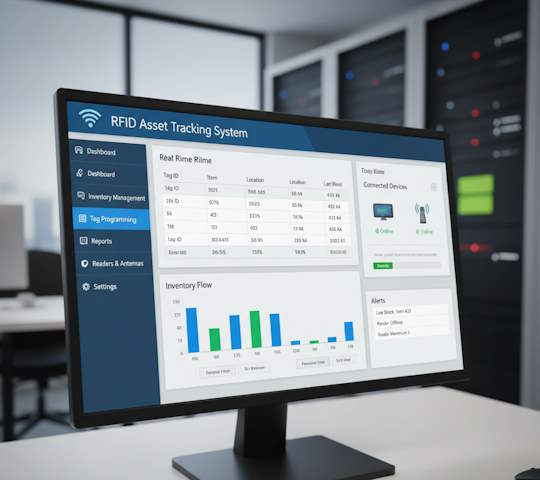
- Software platform. Software aggregates security, stock, and sales data, providing management with a unified real-time analytics dashboard.
The EPCglobal Gen2v2 standard ensures global compatibility and data security, while integration with POS and ERP (e.g., SAP Retail) forms a comprehensive digital ecosystem.
International Case Studies: Transformation Results
Case Study 1: Premium Jewelry Boutique Network in Western Europe
Challenge: Reduce growing theft losses (up to 2.1% of turnover) and cut daily inventory time from 3 hours to minutes.
Solution: Implemented smart displays with Impinj RFID antennas in 25 stores. Miniature tags applied to all 45,000 items. Installed Zebra RFID gates. Integrated with inventory management system.
Results after 16 months:
- Reduction in theft and shrinkage losses: by 94%.
- Inventory tracking accuracy: 99.95%.
- Daily full assortment inventory: in 12 minutes (previously 3 hours).
- Sales growth due to better product availability: by 18%.
- ROI: 13 months.
Case Study 2: Asian Diamond Manufacturer and Distributor
Challenge: Ensure end-to-end traceability of 10,000+ diamonds from cutting to sale, eliminate substitutions and certificate errors.
Solution: Each diamond and its GIA/HRD certificate received a paired Honeywell RFID tag. Readers deployed at all stages: production, grading, safe storage, shipping.
Results after 24 months:
- Elimination of identification and substitution errors: 100%.
- Reduction in order search and fulfillment time: by 75%.
- Increase in customer trust and sales conversion: by 22%.
- Reduction in insurance premiums due to enhanced security: by 30%.
- ROI: 15 months.
Financial Justification: Calculation for a 10-Store Network
To assess investment attractiveness, consider a model for a 10-store network with total revenue of $20 million and an average stock of 40,000 items.
| Item | Amount (USD) | Comment |
|---|---|---|
| CAPEX (One-time costs) | 340,000 | Tags (40,000 units), smart displays, RFID gates, software, integration, training. |
| Annual savings from reduced theft (2% → 0.1% of turnover) | 380,000 | Savings of 1.9% on $20 million turnover. |
| Annual savings from optimized logistics and inventory | 150,000 | Freeing up 4 FTE, lower insurance premiums. |
| Additional revenue from sales growth (15%) | 450,000 | Margin profit from additional sales (at 15% margin rate). |
| Total Annual Savings & Additional Profit | 980,000 |
Note: The calculated payback period (CAPEX / Annual Savings) is approximately 4 months. In practice, considering indirect costs and phased implementation, a target ROI range of 12–18 months is advisable for strategic planning.
Limitations and Key Considerations
Despite high effectiveness, implementing UHF RFID in the jewelry sector has nuances:
- Tag cost for very small items. For diamonds under 0.1 carats, tag cost may be comparable to the item's value, requiring careful ROI calculation.
- Aesthetic requirements. The tag must not be visible or disrupt the design of high-artistic-value pieces, necessitating custom integration.
- Need for organizational change. The technology alters workflows for staff (sales, security, warehouse), requiring change management and training.
- Dependence on implementation quality. Incorrect antenna setup in metallized display conditions can reduce read efficiency.
It is recommended to start with a pilot project in one store or for a specific product category (e.g., watches or wedding rings) to refine processes and demonstrate the effect.
Phased Implementation Strategy
- Phase 1: Pilot and Justification (2–3 months). Select a pilot location, tag 1,000–2,000 items, test equipment and processes, calculate precise ROI for the entire network.
- Phase 2: Security and Basic Tracking (4–6 months). Equip all stores with RFID gates and smart displays for theft prevention. Tag the entire current inventory. Train staff.
- Phase 3: Full Integration and Analytics (6–8 months). Integrate RFID data with CRM, ERP, and analytics systems. Implement data-driven inventory management tools based on real-time insights (demand, stock levels, seasonality).
A key factor is appointing a Project Champion from senior management responsible for achieving business goals, not just technical implementation.
Frequently Asked Questions (FAQ)
What is the typical payback period (ROI) for an RFID system in jewelry retail?
With comprehensive implementation, ROI is typically achieved within 12–18 months. Key drivers include reduced losses from theft and inventory discrepancies (up to 95%), increased product turnover (by 15–20%), and reduced manual operation costs (by 70%).
How do RFID tags work on small jewelry items?
Miniature tags (such as Impinj Monza R6-P or Zebra TrueVUE) sized from 6×4 mm are used, integrated into labels, tags, or packaging. They provide read ranges of up to 3–5 meters without damaging the product or compromising aesthetics.
Is an RFID system compatible with existing EAS security systems?
Yes, modern UHF RFID systems can operate in parallel with traditional EAS (acoustomagnetic or RF) systems. In addition to preventing unauthorized removal, RFID enables precise identification of each item, creating a dual layer of protection.
Sources & References
- GS1 EPCglobal Standards — global standards for RFID in retail.
- Impinj Retail Solutions — RFID solutions for retail.
- Zebra RFID for Jewelry — specialized solutions for the jewelry industry.
- Honeywell Security Solutions — security systems for retail.
© RFID UKRAINE, 2025. All rights reserved.