



UHF RFID in Construction: Tracking Materials, Tools and Equipment on Sites
Authors: Material prepared by experts from RFID UKRAINE, with over ten years of experience implementing international projects.
Last updated:
For top management of construction companies, control over material resources on sites is a strategic issue that directly affects schedule adherence, budget performance, and business reputation. Using UHF RFID technology transforms fragmented processes of inventory, equipment, and consumables accounting into a transparent automated ecosystem. This article provides an overview of global practices, return on investment calculations, and practical aspects of implementing RFID systems in the construction industry.
Critical Challenges in Construction Logistics
Traditional approaches to construction accounting, relying on visual inspection and paper documentation, carry serious financial and operational threats:
- Material losses: Approximately 15-20% of resources (such as reinforcement, cable products, or plumbing equipment) are lost during storage or not recorded during consumption. For a project with a $50 million budget, this results in direct losses of $7.5-10 million.
- Inefficient time use: Searching for necessary tools or equipment can take up to a quarter of a workday for line personnel. At the same time, one hour of specialized equipment downtime is valued at $150-300.
- Planning errors: Lack of operational data on actual site inventories triggers supply disruptions, work stage shifts, and penalty charges for delays.
- Theft and uncontrolled removal: The open nature of construction sites makes them extremely vulnerable. Annual damage from theft ranges from 3% to 5% of total equipment value.
- Reputational costs: Insufficient transparency in resource allocation complicates reporting to investors and reduces trust from clients.
Technological Architecture for Construction Sites
A comprehensive RFID monitoring system at a construction site is based on three components designed for operation in harsh environments:
Specialized RFID Identifiers
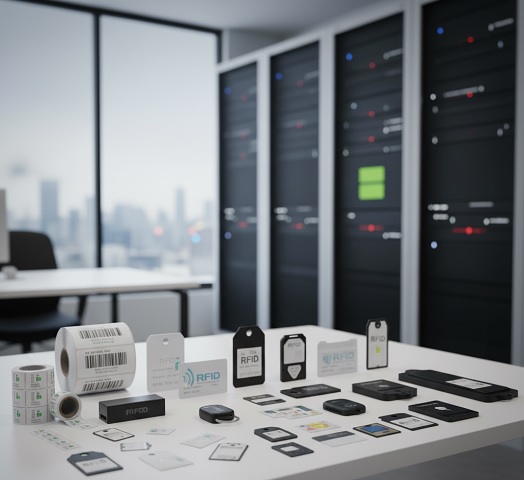
- For machinery and metal structures: Impinj H47 tags, providing read ranges up to 10 meters on metal surfaces. Approximate price: $4-6 per unit.
- Universal solutions: NXP UCODE 9 tags with IP68 protection class (resistant to impact, moisture, and dust). Cost: $2-3.5.
- For extreme temperatures: Alien Technology Higgs-EC, maintaining functionality from -40°C to +85°C.
- Package marking: Disposable adhesive Zebra TrueSens tags costing $0.8-1.2 each.
Reading Infrastructure
- Fixed terminals: Zebra FX9600 models placed at entry points and cargo reception areas.
- Portable devices: Protected Honeywell CT60 terminals (IP65) for field inventories.
- Aerial monitoring: Drones equipped with readers for inventory at height and in hard-to-reach areas.
- Local antennas: Monitoring storage areas of the most valuable tooling.
Software Platform and Integration
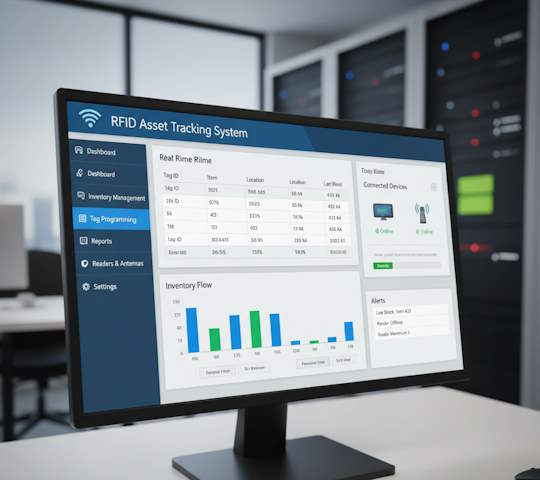
Specialized asset management software integrates with corporate ERP systems (SAP, Oracle) and industry solutions (such as Procore or Autodesk BIM 360). The system enables automated material write-offs as work stages are completed, tracks equipment logistics, and schedules maintenance.
International Implementation Case Studies and Financial Results
Case Study 1: Transport Hub Construction in Northern Europe
Goal: Control 8,500 resource units across a 45-hectare area. Project duration — 28 months. Problem: daily tool losses worth $1,200 and downtime due to material shortages.
Implementation: Deployment of a network based on Impinj H47 tags and Zebra readers. 12 fixed stations installed, 150 Honeywell mobile terminals utilized. Synchronization with the BIM model of the facility.
Results after 18 months:
- 87% reduction in asset losses (savings reached $650,000).
- Equipment search time decreased from 45 to 4 minutes.
- 34% reduction in equipment downtime (additional revenue $280,000).
- Reporting automation freed up 120 man-hours per week.
Economic impact: Investment (CAPEX) — $420,000. Annual operational income (OPEX) — $580,000. Payback achieved in 10 months.
Case Study 2: High-Rise Building Construction in Asia
Goal: Management of logistics for 15,000 tons of construction materials on a 32-story facility. Difficulties: theft, invoice errors, disputes with subcontractors over actual balances.
Implementation: Equipping pallets with NXP UCODE 9 tags. Reader installation on each floor and at entry points. Implementation of RFID access cards for personnel.
Results after 24 months:
- Complete elimination of thefts ($950,000 saved).
- 95% reduction in logistics errors.
- 9 times faster cargo acceptance (from 3 hours to 20 minutes).
- 40% increase in procurement planning accuracy.
Economic impact: CAPEX — $310,000. Annual savings — $720,000. ROI recorded after 7 months.
Typical Financial Calculation for a Construction Project
Parameters: Facility with $25 million budget, 18-month duration, 5,000 tracked items.
| Metric | Value (USD) | Comment |
|---|---|---|
| Capital Expenditure (CAPEX) | ||
| • RFID tag kit (5,000 units) | $15,000 | Average $3 per unit |
| • Reading equipment and software | $85,000 | Zebra, Honeywell |
| • Implementation process and staff training | $50,000 | |
| Total CAPEX | $150,000 | |
| Savings over entire project period (18 months, OPEX) | ||
| • Prevention of material losses (15%) | $562,500 | From $25 million material budget |
| • Reduction in resource search time | $135,000 | |
| • Reduction in costs due to equipment downtime | $180,000 | |
| • Elimination of penalties for schedule violations | $75,000 | Thanks to precise planning |
| Total project savings | $952,500 | |
ROI analysis: Net benefit upon project completion will be $802,500. Payback period is approximately 11.4 months. Thus, the system pays for itself entirely during the construction process.
Strategic Benefits for Management
- Budget monitoring: Up-to-date data on material consumption and equipment operation helps avoid unjustified expenses.
- Schedule adherence: Operational resource management minimizes the risk of forced work pauses.
- Risk minimization: Reduction in theft cases and elimination of conflict situations with partners and subcontractors.
- Reputational growth: Use of innovative technologies increases the company's investment attractiveness.
- Replicability: The developed model can easily be transferred to other developer facilities.
- Analytical foundation: The obtained data serves as a basis for optimizing future estimates and standards.
Limitations and Factors of Impracticality
RFID implementation requires consideration of construction industry specifics and possible limitations:
- Entry threshold: For small facilities (with budget under $5 million), equipment costs may be economically unjustified.
- Operating conditions: High metal concentration and dustiness require selection of more expensive protected tags, which can increase estimates by 30-50%.
- Infrastructure mobility: Need for equipment dismantling and transportation after project completion.
- Organizational aspect: Requires staff training and overcoming internal resistance to change.
- When implementation is not recommended:
- Facilities with implementation period under six months.
- Work primarily with bulk materials (sand, gravel) without packaging.
- Lack of stable power supply and communication on site.
- One-off projects without plans for further business automation.
Recommendation: The optimal starting point would be launching a pilot zone at one facility or focusing on the most valuable assets (heavy machinery, scarce equipment).
Frequently Asked Questions (FAQ)
What are the payback periods (ROI) for RFID in construction?
On average, investments are returned within 8-14 months. This is influenced by the scale of construction, the value of tracked assets, and the current loss percentage. On large infrastructure projects, ROI reaches target values within 6-8 months.
Which types of tags are best suited for construction sites?
Protected identifiers (IP67/IP68) are used: Impinj H47 for mounting on metal, Alien Technology Higgs-EC for operation in freezing or hot conditions, NXP UCODE 9 for general tasks. For temporary pallet marking, adhesive Zebra TrueSens tags are suitable.
In which cases would RFID implementation be unjustified?
If the project is short-term (up to 6 months), if material costs are extremely low, or if the company is not ready for digital transformation of its management processes. Also, implementation will not have a noticeable effect if the initial loss level is very low (less than 3%).
Sources and References
The following sources were used in preparing this material:
- GS1 EPC/RFID Standards for Construction – industry recommendations.
- Impinj Solutions for Construction – technical descriptions and project examples.
- Zebra Technologies for Construction Industry – equipment specifications.
- ISO 18738-1:2022 – international standard for RFID logistics in construction.
© 2025 RFID UKRAINE. Copying is protected. Information is provided for educational purposes. For expert support, contact our specialists.