



UHF RFID in Oil and Gas Industry: Management of Pipes, Equipment and Consumables
Authors: Material prepared by experts from RFID UKRAINE, with over ten years of experience implementing international projects.
Last updated:
For oil and gas company executives, control over material inventories is a priority area that determines capital investment levels, overall productivity, and production safety. Implementing UHF RFID technology enables transitioning pipe, equipment, and consumable component monitoring to automated real-time accounting. This material examines global practices, provides financial metrics, and describes implementation stages of RFID solutions in the extraction sector.
Critical Asset Management Problems in Oil and Gas
Traditional control mechanisms in the energy sector, relying on paper documentation and manual inspections, carry serious financial and operational threats:
- Loss of valuable inventory: On average, 8% to 12% of tubular products, fittings, and tooling disappears during logistics operations. If an organization's assets are valued at $100 million, direct losses reach $8-12 million annually.
- Delays due to item shortages: Locating specific pipes or units in storage areas often takes 3-5 days. Stopping drilling operations in such cases costs between $150,000 and $300,000 per day.
- Documentation failures and compliance issues: Discrepancies between registries and actual availability cause audit difficulties, result in sanctions, and hinder certification according to API and ISO regulations.
- Uncontrolled operation and maintenance: Lack of accurate data on equipment mileage and service history provokes sudden breakdowns and increases the likelihood of industrial incidents.
- Logistics barriers in remote areas: Coordinating deliveries to offshore platforms and remote regions requires extreme precision and complete process transparency.
Technological Architecture for Oil and Gas Facilities
A competent RFID monitoring infrastructure at oil and gas facilities is based on three main elements adapted to harsh environments:
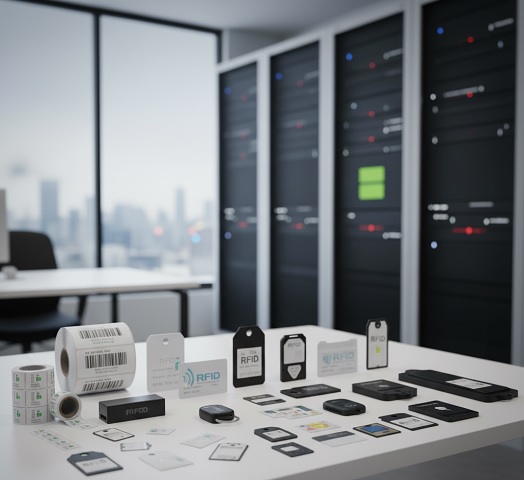
Specialized RFID Tags for Extreme Conditions
- For pipes and metal structures: Impinj H47 model, providing read ranges up to 12 meters on metal surfaces, protected against impacts. Price: $8-15 per unit.
- Explosion-proof design: NXP UCODE 9 Ex, certified according to ATEX/IECEx standards for operation in high-risk zones. Cost: $25-40.
- For temperature anomalies: Alien Technology Higgs-EC, maintaining functionality from -50°C to +150°C.
- Chemical resistance: Variants with special coating resistant to hydrogen sulfide, acids, and alkalis.
Reading Infrastructure
- Fixed control zones: Zebra FX9600 equipment for monitoring at checkpoints, helicopter terminals, and docking walls.
- Protected handheld scanners: Honeywell CT60 devices in explosion-proof housings (ATEX Zone 1 category).
- Aerial scanning: Drones with readers for inspecting pipe stacks and equipment at large open storage yards.
- Marine-grade equipment: Hardware for offshore rigs with protection against salt corrosion.
Software Platform and Integration
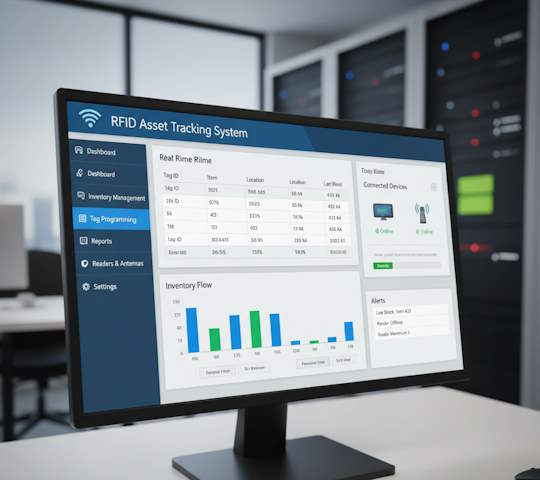
Digital asset monitoring environment synchronized with corporate systems (SAP, Oracle) and asset management databases (IBM Maximo, SAP PM). Key features include: pipe usage tracking, maintenance scheduling, certificate storage, and reporting generation according to API and ISO requirements.
International Implementation Case Studies and Financial Results
Case Study 1: Major Oilfield Service Provider in North America
Goal: Control over 250,000 pipes and 45,000 equipment units across 12 warehouses and 56 drilling sites. Initial challenges: $18 million annual losses, search for required items taking up to three days.
Implementation: Use of Impinj H47 tags combined with protected Zebra readers. Marking of entire equipment inventory, installation of control portals at logistics hubs.
Results (after 2 years):
- 76% reduction in shortages (annual benefit $13.7 million).
- Asset search time reduced from 72 hours to 2 hours.
- 45% reduction in drilling rig non-productive time (saving $6.5 million annually).
- Digitalization of customer reporting — freeing up 8,000 work hours per year.
- 60% increase in pipe procurement planning accuracy.
Financial outcome: CAPEX — $4.2 million. OPEX reduction — $24.5 million annually. Return on investment (ROI) in 10 months.
Case Study 2: Offshore Field Operator in the North Sea
Goal: Inventory control of 85,000 items across 7 platforms. Initial challenges: cargo losses during air and sea deliveries, difficulties conducting audits in confined spaces, compliance with SOLAS and MARPOL regulations.
Implementation: Marking containers and units with explosion-proof NXP UCODE 9 Ex tags. Scanner placement at loading and helicopter platforms. Integration with internal facility management system.
Results (after 1.5 years):
- Complete elimination of transportation losses ($3.8 million saved).
- Platform inventory time reduced from two weeks to 8 hours.
- Achieved 100% compliance with international regulations.
- 22% reduction in insurance costs due to risk transparency.
- 35% reduction in excess consumable inventory.
Financial outcome: Investment — $2.8 million. Annual benefit — $9.2 million. ROI: 14 months.
Typical Financial Calculation for an Oil and Gas Company
Example for a mid-tier enterprise ($50 million in assets, 5 operational sites, $200 million annual revenue).
| Metric | Value (USD) | Comment |
|---|---|---|
| Capital Investment (CAPEX) | ||
| • RFID tags (20,000 units) | $400,000 | At average $20 per protected tag |
| • Equipment and software | $600,000 | Solutions from Zebra, Honeywell, Alien Technology |
| • Implementation and training | $200,000 | |
| Total CAPEX | $1,200,000 | |
| Annual Savings (OPEX) | ||
| • Asset retention (from 10% to 3% losses) | $3,500,000 | 7% of total $50 million asset value |
| • Downtime reduction (by 30%) | $4,200,000 | 30% of current $14 million annual costs |
| • Inventory optimization | $800,000 | 80% reduction in labor costs |
| • Insurance and penalty reduction | $500,000 | |
| Total Annual Benefit | $9,000,000 | |
ROI assessment: The typical payback period for RFID in the oil and gas industry, considering conservative scenarios and phased implementation, is 10–18 months.
Strategic Benefits for Management
- Absolute fixed asset control: Precise information on location and wear of every pipe or unit.
- Operational risk mitigation: Reduced risk of emergency shutdowns through proper service and accounting.
- Financial health improvement: Minimization of insurance costs, penalty payments, and expenses for lost inventory replacement.
- Safety guarantees: Monitoring of verified and certified component usage only.
- Transparency in contractor work: Clear picture of material deliveries and targeted consumption by subcontractors.
- ESG agenda implementation: Systematic resource accounting helps reduce overall environmental impact.
Limitations and Factors of Impracticality
Using RFID in the oil extraction sector involves specific barriers that should be considered:
- Specialized chip prices: Tags with chemical and explosion protection cost $20-40 each, requiring substantial initial investments for mass marking.
- Extreme environmental exposure: Temperatures beyond -50°C...+150°C, contact with chemicals, and strong vibration necessitate custom solutions.
- Offshore extraction specifics: Space limitations, salt corrosion, and strict electronics requirements in hazardous zones.
- Regulatory norms: Mandatory explosion protection certificates (ATEX, IECEx) for all infrastructure.
- When a project may be unjustified:
- Small enterprises with equipment fleets under 1,000 units.
- Static assets that rarely change location.
- Production sites to be mothballed within 1-1.5 years.
- Lack of basic IT infrastructure for RFID data integration.
Recommendation: Start with a pilot project at one storage base or for controlling most critical assets (e.g., drill pipes or explosion-proof equipment). Conduct thorough TCO analysis over 5 years including ownership costs.
Frequently Asked Questions (FAQ)
What is the actual ROI of RFID implementation in oil and gas?
Typically, investments are returned within 10-18 months. The timeframe depends on asset volume, current level of mismanagement, tag prices, and environmental conditions. For large structures with high loss percentages, payback can be achieved in as little as 6-9 months.
Which RFID tags can withstand drilling conditions?
Specialized solutions are used: Impinj H47 for metal surfaces, Alien Technology Higgs-EC for operation in heat and freezing conditions, NXP UCODE 9 with chemical resistance and explosion protection. Encapsulated tags that dampen shocks and vibration are also in demand.
In which cases is RFID economically unprofitable in this industry?
For small sites with minimal inventory, if marking costs are comparable to the object's value, or when equipment is static. Implementation is also excessive if losses are already minimized and there are no strict regulatory requirements.
Sources and References
The following sources were used in preparing this material:
- API Standards for Oil and Gas Equipment – industry regulations.
- Impinj Solutions for Oil and Gas Industry – technical specifications.
- Zebra Technologies for Oil and Gas – equipment and implementation examples.
- ISO 18186:2022 - RFID in petroleum and natural gas industries – international standards.
© 2025 RFID UKRAINE. All rights reserved.