



RFID Implementation in Distribution Centers: Revolutionizing Transparency and Operational Efficiency
Modern distribution centers face unprecedented challenges: explosive e-commerce growth, next-day delivery expectations, and the complexity of managing millions of SKUs. Under these conditions, traditional inventory management systems based on barcodes and manual data entry have reached their limits. Radio Frequency Identification (RFID) technology emerges as a game-changing solution, transforming warehouses from storage facilities into intelligent data hubs.
RFID is a wireless communication technology that uses electromagnetic fields to automatically identify and track tags attached to objects. Unlike barcodes, which require line-of-sight and manual scanning, RFID tags can be read at a distance, in bulk (hundreds of items per second), and even through packaging. This fundamentally changes operational logistics and opens new possibilities for warehouse automation.
Key Benefits of RFID in Distribution Centers
RFID system implementation delivers tangible benefits across all warehouse operations. According to Forrester Research, companies that have deployed RFID report return on investment within the first 18-24 months. Let's examine the most significant advantages.
Instant receiving and putaway. When shipments arrive at the warehouse, dock doors equipped with fixed RFID readers automatically register entire pallets. There's no need to unpack every box to scan individual barcodes. The system cross-references received data with electronic advance ship notices (EDI/ASN) in milliseconds, flagging any discrepancies. According to Aberdeen Group data, this accelerates receiving processes by 80-90% and frees personnel for value-added tasks requiring human judgment and expertise.
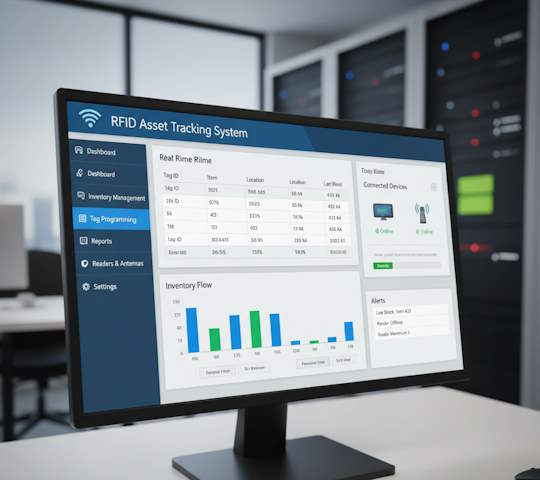
Total inventory visibility in real-time. With RFID, warehouse cycle counting transforms from a quarterly nightmare into continuous monitoring. Fixed or mobile readers positioned throughout storage zones enable the system to "see" exact location and quantity of every SKU 24/7. Inventory accuracy levels reach 99.9%, virtually eliminating stockout situations and reconciliation discrepancies. Warehouse managers gain actionable intelligence for purchasing decisions and allocation across fulfillment network locations.
Optimized picking and shipping operations. Order pickers use mobile RFID terminals from manufacturers like Zebra Technologies or Honeywell. They don't need to locate specific barcodes on cartons—simply pointing the reader at a shelf confirms correct item selection. During pallet staging for outbound shipments, readers at loading docks automatically verify complete shipment composition, eliminating mis-ships and associated financial losses and customer complaints. According to Gartner research, picking errors decrease by 95%.
Loss prevention and shrinkage reduction. RFID tags, particularly protected UHF tags, function as Electronic Article Surveillance (EAS) systems. Exit points from storage zones or high-risk areas are equipped with portal antennas. Any attempt to remove unprocessed merchandise triggers immediate security alerts. This proves especially valuable for high-margin categories including electronics, cosmetics, and spirits.
Technology Foundation and Global Standards
Successful RFID deployment relies on mature technologies and universal standards that ensure equipment interoperability across manufacturers.
Ultra-High Frequency (UHF) dominates logistics applications, operating at 860-960 MHz according to ISO/IEC 18000-6C standards. UHF provides read ranges up to 10-12 meters and high-speed simultaneous tag processing. Leading chip manufacturers like Impinj lead this segment, supplying RFID inlays globally.
GS1, the international standards organization, developed EPCglobal (Electronic Product Code) standards ensuring global RFID system compatibility. Each tag contains a unique EPC number, enabling product tracking throughout the entire supply chain from manufacturer to end consumer. This standardization proves critical for international trade and cross-border logistics. Detailed documentation is available at the official GS1 website.
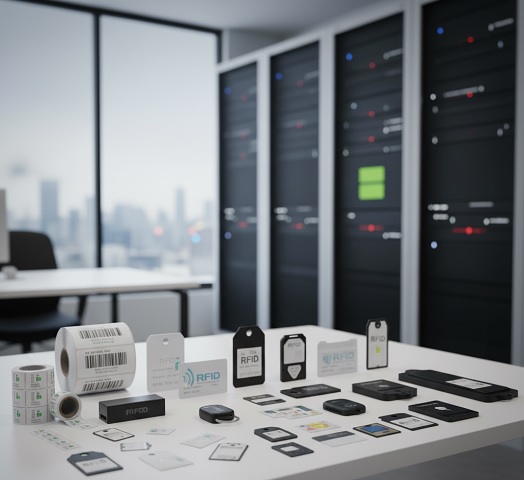
The global market offers comprehensive equipment portfolios—from passive UHF tags in various form factors to fixed and mobile readers from industry leaders including Zebra Technologies, Honeywell, Siemens, and CAEN RFID. Modern tags withstand extreme temperatures from -40°C to +85°C, making them suitable for cold storage facilities and hot climate conditions.
International Implementation Experience and Success Stories
Leading logistics operators worldwide have proven RFID effectiveness in practice, achieving measurable results.
In Europe, major retail chains like Inditex (Zara's parent company) and H&M mandate RFID for distribution center management. This enables rapid demand response and ensures highest accuracy of stock counts across thousands of stores worldwide. Inditex reports in annual statements that post-RFID implementation, cycle counting time decreased from multiple days to several hours.
In the United States, Amazon actively deploys RFID throughout fulfillment centers to automate receiving and sorting of millions of packages while combating inventory shrinkage. Retail giant Walmart has mandated RFID tagging of pallets and cases from suppliers for over a decade, standardizing processes industry-wide. According to official Walmart data, RFID utilization reduced out-of-stock situations by 16%, directly impacting sales revenue.
In Asia, particularly China and South Korea, RFID integrates with robotic sorting systems and Autonomous Guided Vehicles (AGVs). Chinese e-commerce giants like JD.com and Alibaba are creating fully automated "dark warehouses" where RFID serves as the primary sensing technology for automated systems, minimizing human intervention. Some JD.com facilities operate with just five personnel managing operations that previously required hundreds of workers.
Practical Implementation Steps for Distribution Centers
RFID deployment requires careful planning and phased approaches to minimize risks and maximize investment returns.
The first phase involves audit and planning. Conduct comprehensive analysis of current processes, define key implementation objectives (accuracy improvement, inventory turnover acceleration, shrinkage reduction), and select a pilot zone for initial testing. At this stage, engage key warehouse personnel who understand operational nuances.
The second phase encompasses technology partner and equipment selection. Match appropriate tag types to product characteristics (for example, on-metal tags for metal surfaces or liquid-resistant tags require specialized construction), select readers, and ensure RFID system integration with existing WMS (Warehouse Management System). Selecting partners with proven industry experience proves critical. Equipment selection guidance is available in the RAIN RFID Alliance technical library.
The third phase involves pilot project execution on a limited warehouse section. This validates solution effectiveness, streamlines processes, identifies potential issues, and trains personnel on new system operation. Pilots typically run two to six months, providing valuable data for approach refinement before full-scale deployment.
The fourth phase implements gradual technology scaling across the entire distribution center footprint. Phased rollout minimizes operational risks and ensures smooth transition without warehouse operation disruption. Each phase includes KPI monitoring.
The final phase focuses on continuous analytics and optimization. RFID systems generate massive datasets on product movement, operation cycle times, and zone utilization. Leveraging this data for continuous business process improvement, demand forecasting, and warehouse space optimization maximizes long-term investment returns.
Frequently Asked Questions (FAQ)
What does RFID implementation cost for a warehouse?
RFID implementation costs vary by project scale, ranging from $50,000 to $500,000 USD for medium and large distribution centers. Major cost components include: RFID tags ($0.10 to $1.50 per tag), readers ($1,000 to $5,000 per device), antennas, software, and integration with existing systems. According to IDTechEx reports, typical payback period is 18-36 months due to operational cost reduction and shrinkage mitigation.
What read range do warehouse RFID tags provide?
Passive UHF RFID tags, most popular in logistics, provide read ranges from 1 to 12 meters depending on reader power, antenna type, and environmental conditions. For warehouse operations, optimal range is 5-8 meters, ensuring reliable reads without precise product positioning. Active RFID tags with integrated power sources can be read up to 100 meters but see limited adoption due to higher costs.
Do RFID tags work with metal products and liquids?
Standard RFID tags perform poorly on metal surfaces and liquids, as metal reflects radio waves and liquids absorb them. However, manufacturers have developed specialized "on-metal" tags with integrated shielding layers and modified antenna designs that work effectively in such conditions. These tags cost more ($0.50 to $2.00 per tag) but provide reliable reads on metal containers, liquid barrels, and other challenging packaging.
Can RFID be used in cold storage facilities?
Yes, modern RFID tags are specifically engineered for extreme temperature operation from -40°C to +85°C. Cold storage and freezer facilities use tags with reinforced adhesives and condensation-resistant housings. Major food retailers including Tesco and Carrefour successfully deploy RFID in refrigerated distribution centers for perishable product tracking and temperature monitoring.
Are RFID tags safe for human health?
RFID technology uses low-power radio frequency radiation significantly weaker than mobile phones or Wi-Fi routers. The World Health Organization (WHO) and International Commission on Non-Ionizing Radiation Protection (ICNIRP) confirm that RFID systems operating within international safety standards pose no health risks. Passive UHF reader power output is regulated across countries (typically 0.5 to 2 Watts ERP), ensuring warehouse personnel safety.
How long do RFID tags last?
Passive RFID tags have virtually unlimited lifespan as they contain no batteries and have no moving parts. Tags can remain operational for 20-30 years with proper use. The primary longevity factor is physical damage to the tag or adhesive layer. For reusable applications (such as containers or pallets), rigid encased tags withstand thousands of operational cycles.
Conclusion
RFID represents not merely a barcode replacement but a fundamental paradigm shift in logistics management. The technology delivers unprecedented levels of automation, transparency, and control, transforming distribution centers into strategically vital assets capable of flexibly responding to global market challenges.
RFID investment today means investment in future competitiveness, operational efficiency, and supply chain resilience. Companies deploying this technology now gain significant competitive advantages through reduced operational costs, improved order accuracy, and ability to scale operations without proportional headcount growth.
According to MarketsandMarkets analytics, the global RFID in logistics market will grow at 12.7% CAGR, reaching $17.4 billion by 2028. This confirms RFID is not a temporary trend but a long-term strategic industry development direction.
Useful Resources and Authoritative Sources
International Organizations and Standards:
- GS1 Global — official EPCglobal standards and implementation guidelines
- RAIN RFID Alliance — technical documentation and UHF RFID best practices
- ISO — international RFID standards (ISO/IEC 18000 series)
Research and Analytics Firms:
- Gartner — reports on RFID system effectiveness and ROI
- IDTechEx — market forecasts and RFID technology trends
- Aberdeen Group — logistics technology operational efficiency research
- MarketsandMarkets — RFID in logistics market analysis
Leading Equipment Manufacturers:
- Zebra Technologies — mobile and fixed RFID solutions
- Impinj — RFID chips and developer platform
- Honeywell — industrial RFID terminals
- Avery Dennison — RFID tags and inlays