


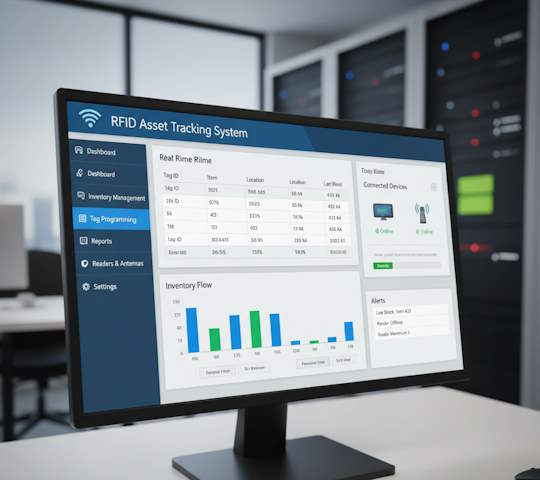


RFID Technologies in Modern Manufacturing: From Assembly Line to Final Quality Control
In the Industry 4.0 era, the core demand for manufacturing is **error-free assembly, absolute quality control, and minimal defects**. RFID technologies are becoming the nervous system of the Smart Factory, enabling real-time tracking of every component, tool, and operational step.
Author: RFID UKRAINE Experts
Date Updated: November 25, 2025
Challenges in Modern Automated Manufacturing
Large-scale manufacturing complexes, especially in automotive and electronics, face several critical challenges impacting quality and profit:
- **Component Mismatch Errors:** The risk of installing the wrong component on the conveyor (especially for highly variable models).
- **Slow Defect Isolation:** The inability to instantly determine at which stage and by whom a defect was introduced.
- **WIP (Work-in-Progress) Complexity:** Difficulty in accurately accounting for semi-finished goods and partially completed products stuck between departments.
- **Tool Accountability:** Loss of expensive specialized tools or their use past calibration/inspection deadlines.
RFID Solutions for Conveyor and Component Monitoring
Manufacturing lines utilize combinations of UHF and HF technologies, integrated into pallets, components, and workstations.
Component Tracking and Traceability
- **Tags on Pallets/Carriers:** Passive UHF tags (ISO/IEC 18000-6C) are mounted on assembly carriers. Fixed readers (Impinj, Zebra) at each station verify that the current pallet matches the required step of the technical process.
- **Product-Embedded Tags:** Miniature RFID tags can be embedded in Printed Circuit Boards (PCBs) or large assemblies (e.g., engines or chassis). This allows the history of all assembly operations to be stored directly on the product.
Tool and Fixture Control
Metallic and heat-resistant On-metal tags (e.g., Alien Technology) are attached to expensive tools. Using handheld scanners or exit readers, 100% accountability is ensured, preventing loss and misuse.
RFID's Impact on Quality Control and Waste Reduction
Implementing RFID systems directly increases the accuracy and transparency of manufacturing processes:
- **Error-Proofing (Poka-Yoke):** The system prevents an operator from starting work if the RFID tag on the component does not match the current step or if the wrong tool is used.
- **Automated Quality Log:** All actions, time stamps, components used, and the operator are automatically recorded in a database linked to the product's unique ID.
- **Rapid Defect Isolation:** Upon finding a defect, the system instantly identifies the entire batch (supplier, time, line), allowing the potentially flawed output to be stopped.
International Implementation Cases in Industry 4.0
Leading global manufacturers utilize RFID to create fully traceable and flexible lines.
Industry Examples
- **Automotive (BMW, Audi):** RFID tags embedded in the car body manage the assembly sequence, ensuring the correct options (color, engine type, interior) are installed on highly customized models. Readers (Zebra) automatically load the required program for robotic stations.
- **Electronics Manufacturing (Samsung):** Tags are used for tracking sensitive components, helping to control the soldering and assembly processes and eliminating human error.
- **Aerospace (Airbus):** Tags on tools and parts guarantee that no tool is left inside the aircraft body after final assembly, which is critical for safety.
Financial Efficiency: Calculating Manufacturing ROI
ROI from implementing RFID in manufacturing is achieved by reducing operational costs and preventing critical losses:
| Metric | RFID Impact | Financial Effect |
|---|---|---|
| Manufacturing Defect Rate | Reduction to 0.1–0.5% | Direct savings from reduced waste and rework |
| WIP Inventory Time | Reduction by 80–90% | Lower labor costs and improved reporting accuracy |
| Assembly Errors | Elimination up to 100% | Elimination of costly recalls and warranty repairs |
| Tool Loss | Reduction to 0% | Lower capital expenditures on replacement equipment |
Frequently Asked Questions
How does RFID work in metallic environments?
In manufacturing environments with high metal content, special RFID tags (On-metal Tags) are used. They feature an insulating layer that elevates the chip above the metallic surface, preventing signal absorption.
Which RFID type is best for component tracking on the conveyor?
Passive UHF (Ultra High Frequency, EPC Gen2) is most commonly used due to its high speed in reading large numbers of objects and its good reading range. HF/NFC may be used for small, very close-range control operations.
Can RFID be integrated with existing MES/ERP systems?
Yes, modern RFID systems (e.g., Impinj or Honeywell solutions) provide APIs for easy integration with existing Manufacturing Execution Systems (MES) and Enterprise Resource Planning (ERP) systems like SAP or Oracle.
Sources and References
© 2025 RFID UKRAINE. All rights reserved. Go to Blog: https://rfid.org.ua/blog