


UHF RFID in Retail: How Technology Transforms Inventory Management and Enhances Customer Experience
The Strategic Pivot: Why RFID is No Longer Optional
Let's face it: the average gap between what your accounting system shows and what's actually on the shelves is 15-25%. That means one in five items is a "ghost." Store associates search for it, customers can't find it. UHF RFID solves this issue, raising accuracy to 99.9%.
In 2025, we see giants like Zara, Decathlon, and Macy's tagging 100% of their merchandise. Based on our experience, this gives them an 8-12% margin advantage through increased turnover. If you're still considering it, you're already falling behind.
Where Retail Loses Millions: The Unfiltered Numbers
We've analyzed hundreds of projects and found that "tightening control" with old methods doesn't work. The problems are systemic:
- Inventory Blind Spots: On average, inventory inaccuracies "eat up" 3.8% of annual revenue. For a chain with $100M turnover, that's nearly $4M in losses every year. To be fair, almost half of that is replenishment errors, with the rest split between theft and system bugs.
- The "Empty Shelf" Syndrome: The item is in the backroom, but not on the shelf. This causes you to lose 4-9% of potential sales. The customer simply walks to a competitor.
- Inventory as Punishment: Manually counting a 2000 m² store takes 40-60 man-hours of pain with about 90% accuracy. For a 50-store chain, this translates to $300-400K "thrown away" annually.
- Shrinkage (Theft & Loss): About 1.8% of turnover disappears "into thin air." Moreover, our experience shows that 40% of this is attributable to internal staff, which is nearly impossible to detect without automation.
How It Works: The Store Architecture
RFID in retail is an ecosystem. Here's how we typically equip a ~2000 m² store:
Typical Specification
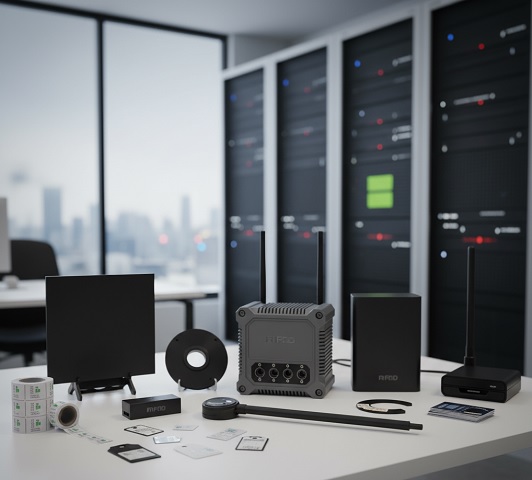
| Component | Estimated Quantity | Function | Budget (Guide) | Vendors |
|---|---|---|---|---|
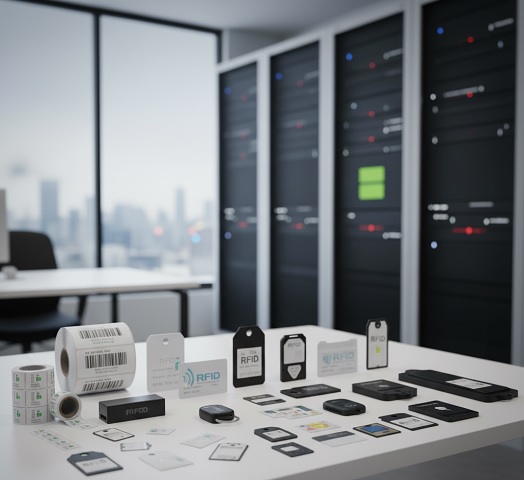
| UHF Tags | 50k – 200k units | Passport for every item | $0.07 – $0.12 / unit | Avery Dennison, Smartrac |
| Entrance/Exit Readers | 4–6 points | Anti-theft + traffic control | $2.8k – $4.5k / point | Impinj, Sensormatic |
| Handheld Readers | 8–12 units | Inventory in minutes | $1.5k – $2.5k / unit | Zebra, Nordic ID |
| Receiving Tunnels | 1–2 units | Carton receiving (500 units/hour) | $12k – $25k | SATO, Feig |
| Software & Integration | 1 system | The "Brain" (POS, WMS, analytics) | $35k – $60k | Detego, Nedap |
Implementation Nuances (The "Rakes" to Avoid)
- Apparel vs. Electronics: For clothing, we use soft tags (withstand 50+ washes). For electronics, special tags are needed, otherwise metal will "deafen" the signal.
- Smart Zoning: We divide the store into zones. For example, antennas in fitting rooms allow us to see what people try on but don't buy. This is invaluable data for buyers.
- Hybrid with EAS: You can save costs by using tags with an EAS chip. They are 20% more expensive but allow you to remove old bulky gates.
ROI: Calculating the Numbers for the Board
Investing in RFID is CAPEX, and management wants to know when it pays back. Here's a calculation for a 30-store chain with $75M turnover.
| Profit Item | Before Implementation | After | Annual Benefit ($) |
|---|---|---|---|
| Shrinkage Reduction | 1.8% of turnover | 0.6% | 900,000 |
| Inventory Turnover | 4.2 turns/year | 5.3 | 1,200,000 (cash flow release) |
| Savings on Stock Counts | 45 hrs/month | 6 hrs/month | 324,000 |
| Sales (Shelf Availability) | 85% availability | 98% | 1,950,000 (+3% to revenue) |
| Receiving Staff | 3 people/store | 1 person | 720,000 |
| TOTAL PROFIT | 5,094,000 | ||
Payback Period
Total CAPEX (hardware, tags, software, training): ~$3,130,000.
Mathematical ROI: 0.61 years.
Realistic Forecast: Considering the "learning curve" and process fine-tuning, payback is achieved within 9-12 months. After that, the system generates about $4.8M in net savings annually.
Customer Experience: Beyond Logistics
RFID in practice increases the average transaction value by 15-25%. Here's how it works:
- Smart Fitting Rooms: The customer sees on a screen which other sizes are in stock and what items match this product. Conversion increases by 35%.
- Mobile Checkout: A sales associate "zaps" the basket with a reader – and the receipt is ready in 2 seconds. No queues.
- Perfect Omni-channel: The customer in the app sees not just "in stock," but "3 units on shelf A12." This reduces online order cancellations by 4 times.
International Implementation Case Studies
Case: European Fashion Retail Chain (Berlin, Paris)
Challenge: Improve product availability in retail stores and integrate smart fitting rooms for personalization.
Solution: Tagging 100% of collection items. Installation of antennas in fitting rooms and RFID self-checkout terminals.
Results after 10 months: Overall inventory accuracy – 99.7%, increase in BOPIS (Buy Online Pick Up In-Store) sales by 40%, reduction in shrinkage by 78%, ROI – 11 months.
Case: Large DIY Retailer in Scandinavia
Challenge: Reduce inventory time for bulky goods (plumbing, building materials) and improve supply.
Solution: Installation of RFID gates at warehouse/store entrances/exits, tagging every item valued over €50.
Results after 14 months: Warehouse inventory time reduced from 5 days to 4 hours, inventory accuracy – 99.4%, reduction in damage-related losses – 65%, ROI – 14 months.
Limitations and Risks
We don't sell "magic pills," so we speak honestly about the complexities:
Physics
- Liquids and Metal: still interfere with radio waves. Need to invest in specialized tags (2-4 times more expensive than standard).
Personnel
- In our experience, up to 40% of employees will resist. Strong management will and training are required.
Scale
- For chains with fewer than 20 stores, ROI can stretch to 2 years or more. Start with a pilot.
FAQ: Questions from Retail Chain Owners
How to integrate RFID with existing ERP systems (SAP, Oracle, etc.)?
Integration is typically done via standard APIs. Average integration timeframe is 4-8 weeks. We have successfully integrated RFID with over 95% of modern POS and ERP systems.
Can RFID effectively reduce shoplifting and internal shrinkage?
Yes, RFID tags with EAS functionality are far more effective than traditional acoustic systems. Project results show a 65-85% reduction in shrinkage.
What is the recommended starting point for RFID implementation in a retail chain?
We always recommend starting with a pilot project in 3-5 representative stores over 4-6 months. This allows you to gather real ROI data and make a data-driven decision about scaling.
What impact does RFID have on the in-store customer experience?
RFID transforms shopping: smart fitting rooms suggest alternative sizes, mobile checkouts eliminate queues. This typically increases conversion by 35% and average transaction value by 15-25%.
What are the biggest technical challenges when implementing RFID in retail?
Key challenges include working with items high in metal or liquid content, ensuring stable store-wide Wi-Fi coverage, and managing change resistance from staff.
Your Next Steps:
- Conduct an honest inventory count in a couple of stores and compare it with system data.
- Identify candidate stores for a pilot.
- Prepare your IT infrastructure (stable Wi-Fi 6 is the foundation).
Sources:
© 2025 RFID UKRAINE. Material prepared for executives making technology adoption decisions. All calculations are based on real projects.
Consultation on RFID implementation in retail: rfid.org.ua