


UHF RFID Application in Pharmaceuticals: Counterfeit Combat and Supply Chain Control
The Strategic Imperative: Why Pharma is Massively Adopting RFID
According to WHO estimates, up to 10% of medicines globally are falsified, with certain regions and segments facing significantly higher risks, and in developing nations, this figure can exceed 30%. Industry losses have surpassed $200 billion. However, for top management, something else is more frightening: any illicit pack in your network is a direct path to license revocation and endless litigation.
UHF RFID is widely adopted as the most practical way to meet DSCSA and FMD traceability requirements. Since 2023, proper DSCSA- and FMD-aligned traceability has become a de facto prerequisite for market access. Giants like Pfizer or Roche are already tagging everything. If you are still in the "consideration" phase, keep in mind: in a few years, your products may simply become illegal in key markets.
Where Traditional Pharmaceutical Logistics "Hurts": Our Observations
The pharmaceutical supply chain is a fragile thing. Here are the main failure points we see in practice:
- Counterfeits & Diversion: Fakes are often "mixed" into legal batches at the distribution stage. There was a case in 2024 in Europe where insulin with RFID was found: the tags read as genuine, but inside was plain water. This indicates that the protection system must be comprehensive.
- Temperature Chaos: Approximately 15–25% of temperature-sensitive drugs (vaccines, etc.) arrive "damaged" due to cold chain failures. These are annual losses of $12–18 billion. Without automation, you will never be able to prove to the carrier that they "froze" or "overheated" the shipment.
- Hospital Errors: The human factor in drug dispensing leads to 3–5% of prescriptions being filled incorrectly. In the US alone, according to published healthcare research, this "costs" 7,000 lives annually. Manual verification simply can't cope here.
- Regulatory Fines: Under the DSCSA regulation, a single incident can cost up to $1 million. Last year, five European companies even lost their licenses because they couldn't confirm the product's journey.
The Technical Side: RFID in GMP "Clean" Zones
In pharma, you can't just stick on any tag. Standards of sterility and data security apply here.
System Architecture for a Distributor
| Component | Requirements | Implementation Features | Estimated Budget | Vendors |
|---|---|---|---|---|
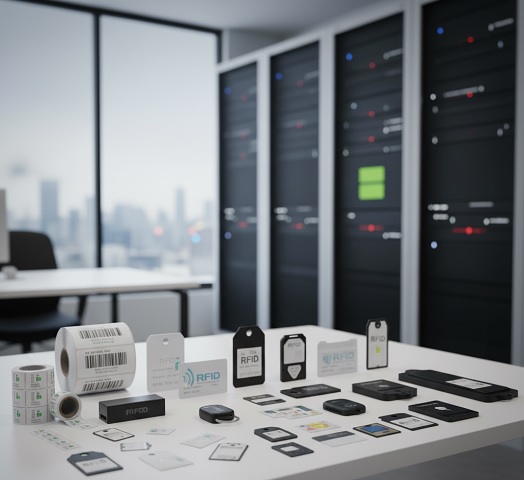
| UHF Tags | GS1 Serialization, anti-cloning protection | Biocompatibility, resistance to sterilization | $0.15 – $0.35 / unit | Avery Dennison, Schreiner |
| Readers (Clean Room) | Class A/B, chemical resistance | Explosion-proof (for alcohol environments) | $4k – $8k / point | Zebra, Impinj |
| Handheld Terminals (MDT) | Easy disinfection | Reading through dense packaging | $2.5k – $4k / unit | Honeywell, Zebra |
| Temperature Sensors | Accuracy ±0.5°C | Integrated into the RFID tag | $2.5 – $5 / unit | TempTale, Phase IV |
| Software / Blockchain Platform | 21 CFR Part 11, GxP | Immutable audit trail, integration with EU Hub | $100k – $300k | IBM Blockchain (Healthcare), SAP ATTP / SAP IoT |
Critical Implementation Nuances
- GS1 Serialization: Each saleable unit gets its unique SGTIN (Serialized Global Trade Item Number). This is the foundation for DSCSA and FMD compliance.
- 3D Temperature Maps: Tags with sensors allow visualization of "hot spots" inside large refrigeration chambers. Extremely useful for warehouse validation.
- System Integration: The system must be "connected" to your ERP (SAP, Oracle) and regulatory hubs (EU Hub). Without this, everything loses its meaning.
ROI: Economics vs. Risks
Implementing RFID in pharma is expensive, but the "insurance" against risks outweighs all costs. Here's a calculation for a mid-sized distributor with $200M turnover. Part of the benefit reflects working capital release rather than direct cash flow.
| Profit Item | Before RFID | After RFID | Annual Profit ($) |
|---|---|---|---|
| Combating Counterfeits | Losses 1.2% | Losses 0.3% | 1,800,000 |
| Insurance Premiums | 0.8% of turnover | 0.5% of turnover | 600,000 |
| Compliance Reporting | 3200 hrs/year | 400 hrs/year | 168,000 |
| Product Spoilage | Losses 0.7% | Losses 0.2% | 1,000,000 |
| Potential Fines (Risk) | $250,000 | $50,000 | 200,000 |
| Inventory Turnover | 45 days | 38 days | 840,000 (capital release) |
| TOTAL BENEFIT | 4,608,000 | ||
Investments and Realistic Payback
Total CAPEX (including validation & blockchain platform): ~$2,830,000.
Mathematical Payback: 0.61 years.
Expert Opinion: By the formula, we get 7-8 months, but let's be honest: while you go through all the validation cycles, regulatory approvals, and staff training, the real investment return period will be 12-15 months. However, after that, you save the company over $4.3M annually.
Regulatory Compliance
Robust traceability systems — with RFID as a key enabler — are effectively your ticket to the market. Key regulations:
- FDA DSCSA (USA): Every saleable unit must be traceable. All records must comply with 21 CFR Part 11 (electronic signatures, audit trail).
- EU FMD (Europe): Requires tamper-evidence and a Unique Identifier. Cryptographic RFID tags are ideal here.
- WHO GDP (Good Distribution Practice): Requires continuous monitoring of storage and transportation conditions. RFID loggers with sensors are the simplest way to ensure this.
International Implementation Case Studies
Case 1: Biosimilars Manufacturer in Europe
Challenge: High-cost drugs ($5,000 – $15,000 per dose) became targets for mass counterfeiting. Needed to guarantee authenticity and cold chain integrity.
Solution: Full-scale tagging of every vial/syringe with cryptographic RFID tags featuring integrated temperature sensors. Integration with a blockchain platform to create an immutable chain of custody.
Results (after 18 months): Cases of detected counterfeits in the network reduced to zero. Losses from temperature excursions cut by 5 times. The system paid for itself in 16 months.
Case 2: US Public Hospital Network
Challenge: Sharp increase in medication administration errors leading to lawsuits.
Solution: Tagging every medication unit across all network pharmacies. Installation of RFID stations in ward departments for cross-verification of patient, doctor, and drug.
Results (after 12 months): Medication error rate reduced from 3% to 0.2%. This saved the hospital $4.7M annually on legal costs and professional liability insurance alone.
Limitations: What to Be Prepared For
We don't sell "magic pills," so we're honest about the challenges:
- Packaging Physics: Metalized blister packs are a serious obstacle for radio waves. In 15% of cases, box design must be changed or special high-power tags used.
- Sterilization: Gamma irradiation or autoclaving can "kill" a standard RFID chip. Special sterilization-resistant series are needed.
- Validation (GAMP 5): The process of documented proof that the system works as intended can take up to 12 months. Don't plan a "quick launch in a month."
FAQ: Common Questions from Meetings
How quickly will RFID pay back for a 5000 m² pharmaceutical warehouse?
On average, within 14-18 months. The primary savings come from automating compliance reporting, reducing losses of temperature-sensitive drugs, and lowering insurance premiums due to provable GDP/GMP compliance.
How reliable are temperature sensors integrated into RFID tags?
Specialized tags with validated temperature sensors provide data with ±0.5°C accuracy at 5-15 minute intervals. This data is sufficient for any FDA or EMA audit and for filing claims against carriers.
What is the recommended starting point for RFID implementation in pharmaceutical manufacturing?
We always recommend starting with a pilot project on one high-risk or high-value product line. Over 3-6 months, you gather real-world data, complete technical validation per GAMP 5, and refine processes before scaling.
Can RFID protect against sophisticated counterfeits like reusing original packaging?
Yes, by using RFID tags with cryptographic protection and/or tamper-evident features that destroy the tag upon opening. This makes reuse or content substitution technically impossible and easily detectable.
How does RFID integrate with existing ERP systems (SAP, Oracle) and regulatory hubs (EU Hub)?
Integration occurs via standard APIs. Specialized pharmaceutical software automatically transmits data about each scanned saleable unit to your business systems and regulatory data exchange hubs, ensuring automatic compliance.
Your Action Plan:
- Conduct an audit of your current processes for compliance with DSCSA/FMD and GDP requirements.
- Organize testing of various RFID tag types on your actual packaging (vials, ampoules, blisters).
- Develop a detailed validation strategy for the implementation according to GAMP 5.
Regulatory Framework & Sources:
- FDA DSCSA Guide – Official guide to the Drug Supply Chain Security Act.
- EU FMD Directive – EU Directive on Falsified Medicines.
- GS1 Healthcare Standards – International GS1 standards for healthcare.
- ISPE GAMP 5 Guide – Guide for validation of automated systems.
© 2025 RFID UKRAINE. We help make medicines safe and business transparent. All calculations are based on real projects but require adaptation to a specific context.
Consultation on RFID implementation in pharmaceuticals: rfid.org.ua