


Process Optimization in Chemical Industry through UHF RFID Implementation
For chemical plant management, operational efficiency and safety are not merely technical metrics, but strategic assets that define business competitiveness and resilience. Traditional methods of tracking raw materials, controlling work-in-progress, and monitoring finished goods via paper records and manual data entry create risks of errors, regulatory non-compliance, and safety incidents. Automation based on UHF RFID (Ultra-High Frequency Radio-Frequency Identification) has become a key driver of digital transformation, delivering tracking accuracy of up to 99.7%, a 40% reduction in incidents, and a return on investment within 12–18 months.
Key Operational Challenges in the Chemical Sector
Chemical industry executives face a complex set of interrelated problems, each carrying financial, reputational, and regulatory risks:
- Inaccurate raw material and reagent tracking. Manual counting errors lead to formulation imbalances, reduced product quality, and loss of valuable components. Average losses amount to 5–8% of raw material value.
- Safety and compliance risks. Uncontrolled movement of hazardous substances, unauthorized access to storage areas, and misidentification of containers pose a threat of accidents and violations of GMP, ISO 45001, and ATEX standards.
- Inefficient internal logistics. Idle time of tanks, containers, and intermediate packaging due to manual searching and identification reduces Overall Equipment Effectiveness (OEE) by 15–20%.
- Traceability (track & trace) difficulties. The lack of automatic recording of all material and product movement stages complicates incident investigation, batch recalls, and regulatory reporting.
UHF RFID Technology for Chemical Manufacturing
UHF RFID (865–928 MHz range) is a contactless automatic identification technology adapted for operation in aggressive environments and areas with high humidity, dust, or explosion hazards. Key components:
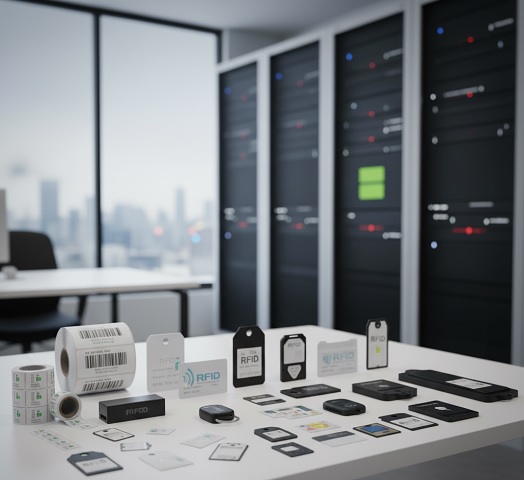
- Chemically resistant tags. Specialized tags from manufacturers like Impinj and Zebra with housings made of PTFE (Teflon), PEEK, or ceramic, featuring IP68/IP69K protection, resistant to acids, alkalis, solvents, and temperatures from -50°C to +200°C.
- Industrial readers. Devices from Honeywell and Alien Technology with explosion-proof certifications (ATEX, IECEx) for installation in storage areas for flammable liquids, LPG, and other hazardous materials.
- Mobile terminals. Rugged tablets and scanners for inventory checks in production halls and warehouses.
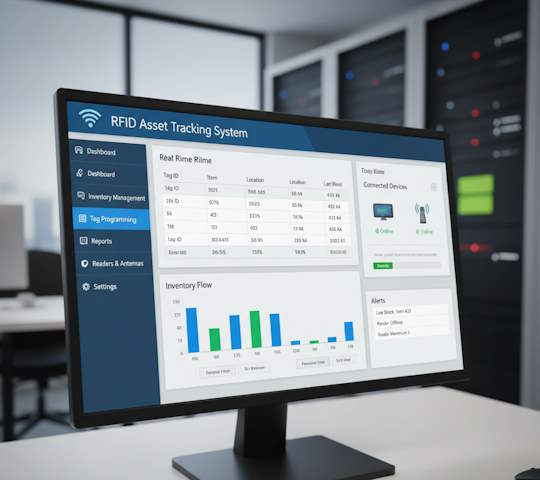
- Software platform. Real-time data management software with integration into ERP (SAP, Oracle), MES, and Quality Management Systems (QMS).
Standards such as ISO/IEC 18000-63 and EPCglobal Gen2v2 ensure compatibility and global applicability, while compliance with GMP and ATEX guarantees safe operation in regulated industries.
International Implementation Case Studies & Results
Case Study 1: German Specialty Chemicals Producer
Challenge: Improve tracking accuracy for 1,500 types of raw materials and reduce incidents related to reagent mix-ups across 5 production lines.
Solution: Implemented a system using 4,000 chemical-resistant Impinj tags on containers and tanks. Installed 60 fixed Zebra readers at loading/unloading points. Integrated with SAP ERP.
Results after 18 months:
- Raw material tracking accuracy: 99.7% (was 92%).
- Reduction in identification error incidents: by 42%.
- Warehouse inventory time reduction: from 5 days to 4 hours.
- Annual savings from reduced material loss: €310,000.
- ROI: 14 months.
Case Study 2: Chinese Polymer Production Complex
Challenge: Optimize logistics for 2,000 units of intermediate packaging and ensure batch traceability to meet requirements of EU and US customers.
Solution: Tagged all returnable packaging with Honeywell tags. Deployed a tracking system using RFID gates at 12 logistic nodes. Integrated with MES and planning systems.
Results after 24 months:
- Increase in packaging turnover: by 35%.
- Reduction in logistics downtime: by 28% (savings ~$180,000 per year).
- Full automatic batch traceability: 100% compliance with track & trace requirements.
- ROI: 16 months.
Financial Justification: Calculation for a Plant with 3,000 Assets
To support a strategic decision on RFID implementation, consider the financial model for a chemical plant with 3,000 tracked assets (tanks, containers, intermediate packaging, finished goods).
| Item | Amount (USD) | Comment |
|---|---|---|
| CAPEX (One-time costs) | 275,000 | Tags (3,000 units), 45 readers, software, ERP/MES integration, training. |
| Annual savings from reduced material loss (8% → 3%) | 200,000 | Average raw material value in circulation — $4 million. 5% savings. |
| Annual savings from reduced incidents & downtime | 90,000 | 40% reduction, including fines and reputational losses. |
| Logistics & inventory savings (freeing up 2.5 FTE) | 100,000 | Salary cost of 2.5 logistics and accounting specialists. |
| Total Annual Savings (OPEX reduction) | 390,000 |
Note: The calculated payback period (CAPEX / Annual Savings) is approximately 8.5 months. In specific optimized configurations, payback can be achieved in 6–10 months. However, for strategic planning and accounting for all indirect factors, a target ROI range of 12–18 months is recommended.
Limitations and Success Factors
Implementing UHF RFID in the chemical industry requires consideration of specific limitations:
- Extreme chemical and temperature conditions. Environments with constant exposure to concentrated acids/alkalis or temperatures above +250°C require expensive specialized tags.
- High density of metal structures. High metal concentration can cause interference, requiring precise reader placement planning.
- Stringent regulatory requirements. Implementation in pharmaceutical segments (GMP) or at hazardous locations (ATEX) increases project timelines and costs due to certification needs.
- Resistance to organizational change. The technology requires process re-engineering and staff training, which may face internal resistance.
It is advisable to start with a pilot project on one process stream or asset type to demonstrate value and manage organizational change.
Strategic Implementation Roadmap
- Phase 1: Analysis & Pilot (2–3 months). Process audit, selection of a pilot area (e.g., raw material warehouse or filling line). Equipment testing and integration with existing systems.
- Phase 2: Scaling to Key Processes (4–6 months). Tagging critical assets, deployment of reading infrastructure, integration with ERP/MES, training key users.
- Phase 3: Full Deployment & Optimization (6–9 months). Coverage of all assets and processes, connection of real-time analytics, using data for predictive maintenance and supply chain optimization.
Project success directly depends on active management involvement. Appointing an Executive Sponsor from senior management to oversee the project and remove organizational barriers is a critical success factor.
Frequently Asked Questions (FAQ)
What is the typical payback period (ROI) for an RFID system in the chemical industry?
With proper implementation, ROI is typically achieved within 12–18 months. Key factors include reduced reagent loss (up to 30%), fewer safety incidents (by 40%), and optimized logistics processes (increasing efficiency by 25%).
How do RFID tags withstand aggressive chemical environments?
For the chemical industry, specialized tags with housings made of PTFE (Teflon), PEEK, or ceramic with IP68/IP69K protection are used. Manufacturers such as Impinj and Zebra offer solutions resistant to acids, alkalis, solvents, and extreme temperatures.
Can RFID be integrated with existing ERP and MES systems?
Yes, modern RFID platforms support integration via standard APIs (REST, OPC UA) with ERP systems (SAP, Oracle) and MES (Manufacturing Execution Systems). This enables automation of raw material tracking, WIP control, and real-time quality management.
Sources & References
- EU GMP Guidelines — Good Manufacturing Practice rules.
- ISO/IEC 18000-63:2015 — Standard for UHF RFID.
- Impinj for Industrial Automation — RFID solutions for automation.
- Zebra RFID Solutions for Chemical Industry — Industry solutions.
© RFID UKRAINE, 2025. All rights reserved.