


Manufacturing Digitalization: UHF RFID Implementation for Work-in-Progress Tracking
The Production Breakthrough: Why WIP Control Has Become the New Growth Lever
Modern manufacturing is always a race against cycle time. In practice, we see that the average factory loses about 18-22% of its efficiency due to "blind spots" in Work-in-Progress (WIP). Parts can get stuck in queues, assemblies are built in the wrong sequence, and management receives reports on this with delays of days.
In 2025, industry leaders (Bosch, Siemens) view UHF RFID not as a separate "feature" but as a key enabler for lean manufacturing systems. The gap in the OEE (Overall Equipment Effectiveness) metric between companies using automatic identification and those working with paper cards already reaches 30-40%.
Hidden Losses: Where Money Gets "Buried" on the Shop Floor
Over 10+ years of work, we have identified systemic problems that are not solved in practice by simply tightening discipline:
- "Wandering" Components: Typically, 3-7% of parts on an assembly line spend up to 40% of their lifecycle simply waiting or being searched for. If $500K worth of parts are frozen in WIP, this means a monthly "immobilization" of $15-35K in working capital.
- Sequence Errors: The human factor results in 2-4% defects in complex assemblies. In our experience, each such error means 2 to 8 hours of rework and line downtime.
- APS Planning Inaccuracy: The gap between planned and actual operation times often reaches 30%. This makes the use of expensive planning systems inefficient.
- Complaint Analysis Difficulty: Searching for the root cause of a defect without a digital trail takes from 8 to 40 hours of manual archive review.
Technical Implementation: RFID in Harsh Conditions
The industrial environment means metal, oil, vibrations, and high temperatures. Consumer-grade solutions cannot be used here.
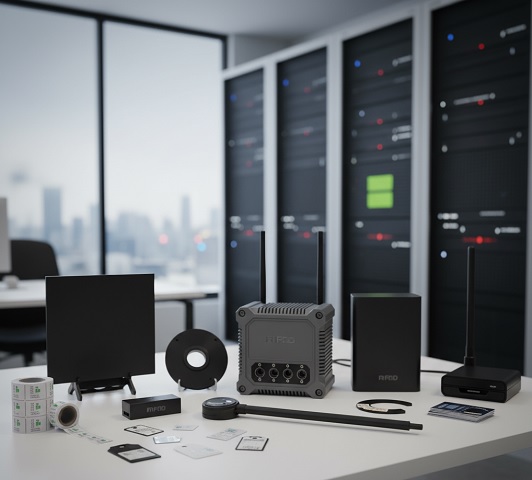
Typical Architecture for a Workshop (5000 m²)
| Component | Type / Specifications | Purpose | Estimated Budget |
|---|---|---|---|
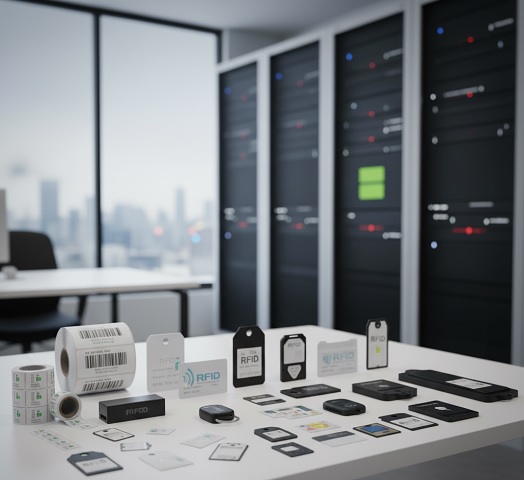
| Industrial Tags | Encapsulated (IP67), Heat-Resistant | Identification of tooling, containers, assemblies | $5 – $25 / unit |
| Fixed Readers | Protected, with Interference Filtering | Control points (Gates) on production lines | $1.5k – $3.5k / point |
| Mobile Handheld Terminals | Shockproof, Industrial Grade | Search, inventory, defect entry | $2k – $3.5k / unit |
| Directional Antennas | Narrow Beamwidth | Precise positioning on conveyors | $200 – $500 / unit |
| Industrial Gateway | 24/7 Redundancy | Data aggregation and MES/ERP communication | $10k – $25k |
Critical Success Factors
- Synchronization with Takt Time: Readers must be tightly synchronized with the conveyor's takt time. A half-second error at high speed can lead to incorrect stage identification.
- Working with Metal: Since most components are metal, the de facto standard has become the use of tags with magnetic shielding or special spacers.
- Phased Rollout: We always recommend a "non-stop" implementation — first a pilot line, then scaling.
Economic Model (ROI)
Implementing RFID in manufacturing is an investment in transparency. Here are approximate figures for an enterprise with $50M annual turnover.
| Effect Type | Item | Annual Profit ($) |
|---|---|---|
| Working Capital | Reduction in WIP (from 22 to 16 days) | 1,200,000 (cash release) |
| Direct Cash Savings | Reduction in equipment downtime | 840,000 |
| Direct Cash Savings | Reduction in assembly errors & rework | 1,125,000 |
| Direct Cash Savings | Savings on WIP inventory counting | 156,000 |
| Direct Cash Savings | OEE Increase (by 11%) | 1,100,000 (additional capacity) |
| TOTAL EFFECT | 4,421,000 | |
Investments and Payback Period
Total CAPEX (hardware, software, installation): ~$650,000.
Operational Expenses (OPEX): ~$45,000 / year.
Expert Opinion: A formal calculation shows payback within a few months, but in practice, considering staff adaptation and fine-tuning of business processes, the return on investment period is usually 10-14 months. After that, the system generates significant savings, often exceeding $4M per year.
Real-Time Tracking: What Changes?
RFID shifts management from a reactive mode ("firefighting") to a proactive one.
- Accurate Cycle Time: You see real metrics for each product, not an "average hospital temperature."
- Automatic APS: Progress data allows planning systems to dynamically reallocate resources.
- Sequence Control (Poka-yoke): The system physically prevents skipping a stage or performing it incorrectly.
- Traceability Analytics: Instant access to a digital trail for analyzing the causes of deviations or defects.
International Implementation Case Studies
Case 1: Pump Manufacturing (Germany)
Challenge: Complex assembly (800+ parts) took 12 days instead of the planned 8. High level of "wandering" components and routing errors.
Solution: Tagging each transport pallet with RFID. Installation of 35 control points with readers along the entire assembly line for automatic progress tracking.
Results (after 9 months): Average assembly cycle reduced to 7.5 days. Work-in-Progress (WIP) volume decreased by $1.2M. The system paid for itself in 11 months.
Case 2: Electronics Plant (Japan)
Challenge: Long line changeover times (4 hours) and a high percentage of component picking errors (3.8%).
Solution: Tagging all tooling and component containers. RFID stations at each workstation to confirm correct component selection.
Results (after 12 months): Changeover time reduced to 45 minutes. Defect rate decreased from 3.8% to 0.4%. The plant's production capacity increased by 22% without purchasing new equipment.
When Might RFID Not Meet Expectations?
There are objective limitations where RFID implementation is challenging:
- Extreme Heat: In foundry zones (above +250°C), special tags costing $100+ are needed. In such cases, ROI often exceeds 3 years.
- Micro-Parts: If a part is smaller than 2 cm, attaching a tag to it is impractical. We usually tag transport containers.
- Legacy Systems: Integration with systems lacking modern APIs can increase the IT part of the project cost by 50% or more.
- High-Speed Processes: For conveyors with speeds over 10 m/s, special high-frequency equipment is required, increasing the cost.
FAQ: Questions Frequently Asked by Plant Directors
Can RFID be implemented without stopping production?
Yes, this is a widely adopted practice. We recommend starting with a pilot project on one production line. After fine-tuning and obtaining initial results, scaling is carried out during non-working shifts or scheduled downtimes.
What impact does RFID have on Overall Equipment Effectiveness (OEE)?
In practice, we observe OEE growth of 15-25 percentage points due to reduced downtime, elimination of assembly errors, accurate cycle time tracking, and automated data collection for analytics.
What is the read accuracy of RFID tags on metal surfaces?
When using specialized industrial tags with magnetic shielding and properly positioned antennas, read accuracy reaches 99.8%+ even in challenging metal environments.
How does RFID integrate with existing MES/ERP systems?
Integration occurs via industrial gateways and standard protocols (OPC UA, REST API). Data about the location and status of each assembly/pallet is transmitted in real-time to the MES for schedule updates and to the ERP for accurate WIP accounting.
What are the main challenges when implementing RFID in manufacturing?
Key challenges include operating in high-temperature zones (requires expensive specialized tags), tagging very small parts (solution: tagging containers), and integration with legacy systems. Proper project planning minimizes these risks.
Your Steps Towards Industry 4.0:
- Measure the actual volume of Work-in-Progress (WIP) and the average time spent searching for parts on the shop floor.
- Select one line or area for a pilot project.
- Conduct a technical environmental audit (especially in areas with metal structures and potential interference).
Standards for Further Study:
- GS1 Standards for Manufacturing – International identification standards for manufacturing.
- ISA-95 (Enterprise-Control System Integration) – Standard for integrating enterprise and control systems.
- VDI/VDE 2185 – German guidelines for using RFID in industry.
© 2025 RFID UKRAINE. We transform manufacturing chaos into a transparent digital flow. All calculations are based on real projects.
Consultation on RFID implementation in manufacturing: rfid.org.ua