


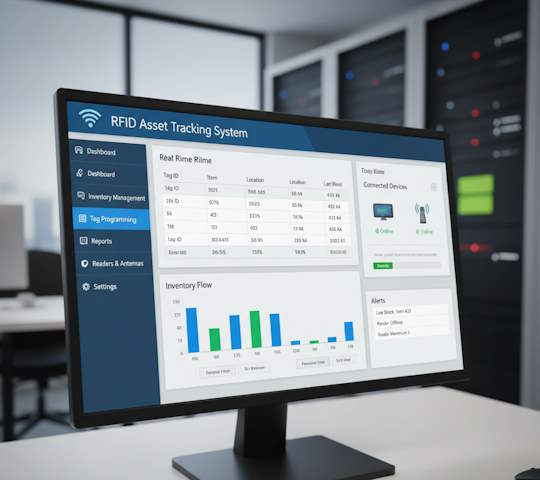


RFID Systems Fault Tolerance: Redundancy, Failover, and Autonomous Operation During Failures
In industrial RFID deployments, failure of any component leads to data loss and process stoppage. The Fault Tolerance strategy is built on three principles: hardware redundancy (N+1), failover to a hot standby middleware layer, and local event buffering in case of network connection loss (offline buffering).
Fault Tolerance is the property of a system to remain operational during partial failures of hardware or software. In the RFID context, this means continuous tag registration even if one or more readers fail, network disruptions occur, or the middleware server goes down. At critical points such as conveyor lines, logistics gateways, and access control systems, downtime is unacceptable.
Architectural Principles of Fault Tolerance
Reader Redundancy (Redundant Readers)
Over-provisioning readers at critical control points (chokepoints) compensates for the failure of a single device without stopping the process. Two or more readers are configured on the same RF channel using time division or spatial diversity.
Active-Active
All readers work in parallel. Middleware performs event deduplication using timestamps and RSSI.
Active-Standby
Standby reader activates upon primary failure. Switchover delay is 3-10 seconds.
Geo-Distributed
Readers in different locations to protect against local catastrophic failures.
Failover Middleware
The Middleware node is responsible for collecting, filtering, and forwarding events to enterprise systems. Its failure paralyzes the entire control point. Middleware clustering is implemented using "active-passive" or "active-active" schemes.
| Cluster Type | Operation Principle | RTO (Recovery Time Objective) | Data Loss |
|---|---|---|---|
| Active-Passive with Synchronous Replication | Passive node continuously synchronizes state with active via heartbeat. | 3-10 seconds | None (zero data loss) |
| Active-Passive with Asynchronous Replication | State synchronization occurs periodically. | 10-60 seconds | Last events (last-event loss) |
| Active-Active (multi-master) | All nodes process events, synchronizing with each other. | 0 seconds | None (with proper synchronization) |
⚙️ Practical Rule for Scheme Selection:
For conveyor lines and financial transactions: active-passive with synchronous replication (zero data loss).
For logistics and warehouse management: active-passive with asynchronous replication (cost/performance balance).
For security and access control systems: active-active (maximum availability).
Offline Buffering
When the network connection to the central server is lost, the edge device must store events locally until connectivity is restored. Buffer implementation requires solving several engineering tasks.
- Buffer Capacity: Calculated based on maximum downtime and event intensity. Formula: Capacity = Peak Intensity (events/sec) × Maximum Downtime (sec). Typical size ranges from 10,000 to 1,000,000 events.
- Data Integrity: Use of transactional write mechanisms (Write-Ahead Log - WAL) to prevent event loss during sudden power loss.
- Overflow Policy: When the buffer is full, the system may either stop reading (stop-on-full) or overwrite the oldest events (circular buffer). The choice depends on data criticality.
Key Metrics and Standards
The effectiveness of a fault-tolerant architecture is measured by the following key indicators, which should be defined in the SLA (Service Level Agreement).
MTBF > 50,000 hrs
Mean Time Between Failures
RTO < 10 s
Recovery Time Objective
RPO = 0
Recovery Point Objective
ISO/IEC 27031
Guidelines for IT disaster recovery and business continuity
RAID 1/10
Analogy for data redundancy (mirroring)
IEC 62443
Cybersecurity for industrial automation and control systems
Practical Implementation Algorithm
- Risk Assessment: Identify critical system components (single points of failure), assess the probability and impact of their failure on business processes.
- SLA Requirements Definition: Establish target values for MTBF, RTO, RPO based on business requirements and regulations.
- Architectural Scheme Selection: For each critical component, choose a redundancy scheme (N, N+1, 2N) and middleware clustering type.
- Buffer Capacity Calculation: Based on historical data on network downtime and peak load, calculate the required local event storage capacity.
- Monitoring Implementation: Deploy a system to monitor the status of all components (heartbeat, buffer disk space check, network metrics) with automatic alerts.
- Failure Testing: Regularly simulate failures (powering off a reader, network break, middleware server stop) to verify the correct operation of fault tolerance mechanisms.
Conclusions
Implementing a fault-tolerant RFID architecture is not an additional option but a mandatory requirement for industrial deployments. A strategy based on three-level protection (hardware redundancy, software clustering, local buffering) enables the creation of systems with predictable recovery time and guaranteed data preservation. The key to success lies not only in the correct technology selection but also in the strict definition of SLA metrics, regular failure testing, and continuous monitoring of the status of all system components.