





Principles of Engineering Design and Architectural Decisions for Industrial RFID Systems










This directory is a guide to engineering decision-making in the design of RFID systems. The focus is not on the technologies themselves, but on the methodology of architecture selection, trade-off evaluation, and building systems that solve specific business problems with given constraints of reliability, scale, and cost.
🏗️ Foundation: From Requirements to Architectural Pattern
The first and most critical stage is translating business requirements into technical specifications. The question "What needs to be tracked?" determines the choice of frequency and tag type. The question "At what speed and under what conditions?" determines the reader architecture and their placement. A typical mistake is starting with vendor selection rather than analyzing workflows.
The key decision is identifying the dominant constraint: processing speed (pallets/hour), read range (meters), data volume (number of unique identifiers), or environmental resistance (temperature, humidity, metal). An architecture optimized for one constraint often sacrifices other parameters.
⚖️ Critical Architectural-Level Trade-offs
Every architectural decision is a compromise. Understanding these trade-offs distinguishes a systems integrator from an equipment installer.
Centralized vs. Distributed Logic
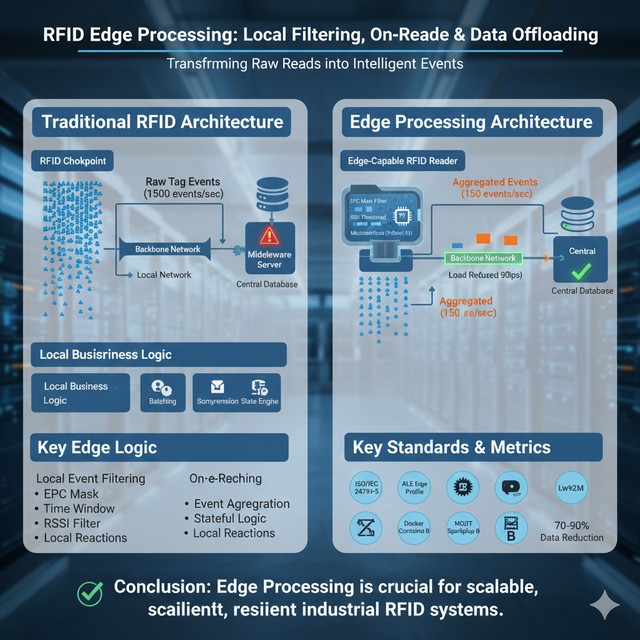
Centralized: All data flows to a server where software makes decisions. Easier to debug and update, but creates a single point of failure and requires stable network connectivity.
Distributed: Filtering and event processing logic is embedded in reader controllers. Works during connection outages but complicates scaling and changing business rules.
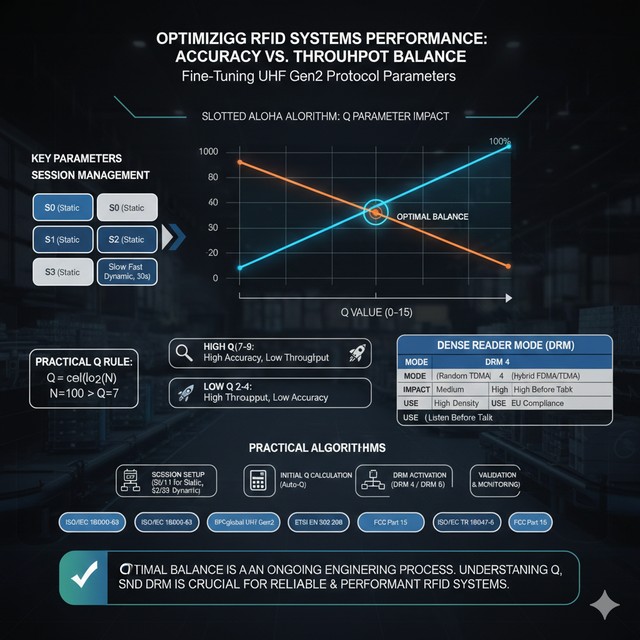
Accuracy vs. Throughput
Configuring readers for maximum sensitivity (for 99.9% accuracy) dramatically increases the number of "false" reads and collisions, reducing overall conveyor speed. Sometimes a system reliability of 95% with high throughput is more economically viable.
🔌 Integration: The Weak Link of the System
The reliability of an RFID system in industrial conditions is often determined not by tag characteristics but by the quality of integration with existing infrastructure: ERP, WMS, SCADA, mechanical systems.
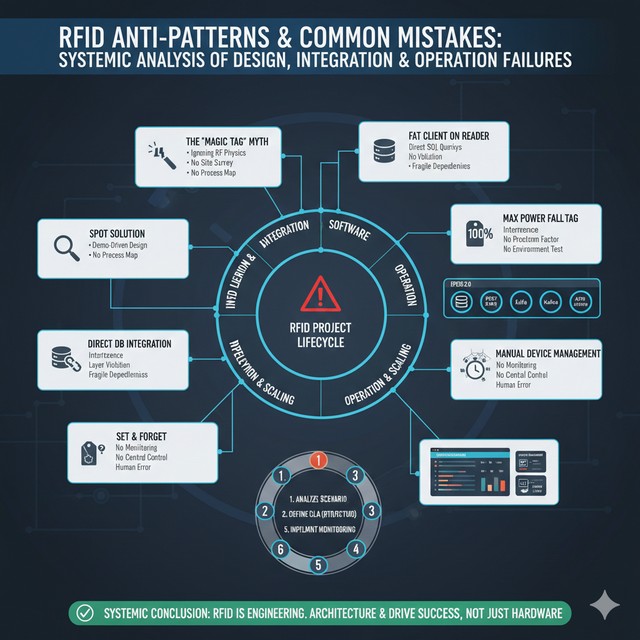
An architectural anti-pattern is creating a separate "RFID island" with manual data export. The correct approach is designing an event-driven interface, where each read event is transformed into a standard business message (e.g., via MQTT or REST webhook), which can be consumed by multiple subscriber systems. This increases fault tolerance and simplifies future modernization.
📐 Design Patterns for Typical Tasks
Reusing proven architectural patterns reduces risks. Here are two key ones:
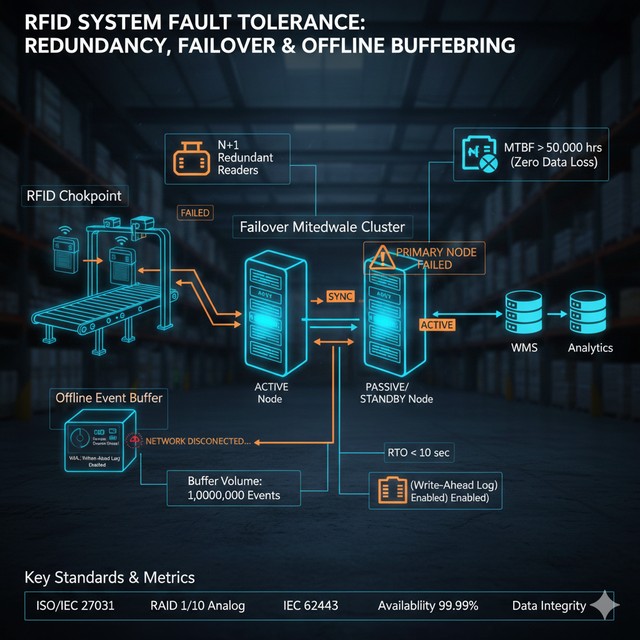
Pattern "Chokepoint": Used for guaranteed reading at a narrow point (gate, conveyor). The architecture is built around redundancy: several readers and antennas configured for mutual overlap of zones. Critical are the calculation of power echeloning and filtering of multiple reads of the same tag.
Pattern "Zone Monitoring": For tracking the presence/absence of assets within an area (storage bin, room). Requires calibration of signal level (RSSI) to determine boundaries and implementation of algorithms to eliminate "phantom" reads from adjacent zones. Here, signal stability is more important than speed.
Typical Architectural Mistake:
Using the "Zone Monitoring" pattern for "Chokepoint" tasks. This leads to "misses" at high object speeds. Conversely, applying an excessive "Chokepoint" for monitoring a large area leads to unjustified cost increases and technical complexity.
Conclusion: Architecture as an Engineering Discipline
Designing an RFID system is an engineering process driven by requirements and constraints. Success is determined not by choosing the "most advanced" equipment, but by the architect's ability to make a balanced choice, anticipate integration points, and design a system that allows for evolution. The key is to document all decisions made and their justifications, creating not just a working system, but a clear map of its structure for future modifications.