


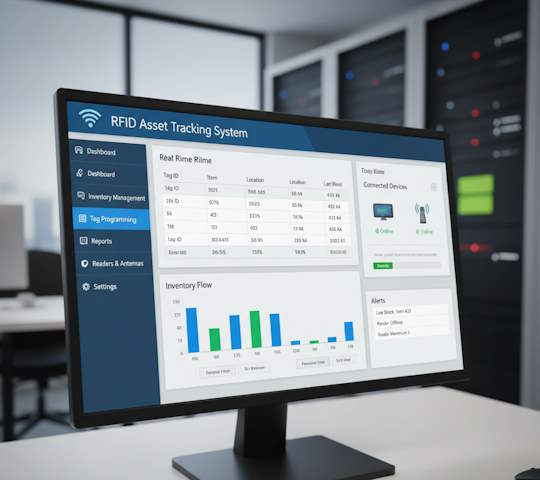


Analytical Review of GAO RFID: An Integrator of Turnkey Solutions for the Automatic Identification Market
GAO RFID positions itself as a “universal integrator” (one-stop-shop), offering a full stack of hardware and software solutions for automatic identification. Unlike vendors with deep specialization (such as NXP in chips or smart-TEC in railway tags), GAO's strategy is to cover the maximum number of typical client tasks from a single entry point, often sacrificing extreme characteristics in favor of universality and ease of implementation.
📦 An “All-in-One” Portfolio: Breadth as the Core Offering
The company's product catalog covers all levels of an RFID system: from passive and active tags, antennas, and readers of varying complexity to industrial computers, sensors, and proprietary asset management software (GAO Asset Tracking).
Key trade-off: This approach minimizes the complexity for the client of selecting and integrating components from different suppliers but creates the risk of "average" performance and functionality in each individual category. A GAO reader or tag may not show record range or speed compared to the best specialized models, but they are guaranteed to work with each other.
⚙️ Strategy Analysis: Covering Verticals with Standard Solutions
The company clearly focuses on ready-made solutions for popular industry tasks: access control, asset management, logistics, retail. This indicates an orientation towards the mass market, not a niche.
| Problem Solved (Vertical) | Typical GAO RFID Solution | Potential Limitations |
|---|---|---|
| Access Control & Time Tracking | RFID reader and card kits, accounting software | Weak protection against cloning compared to specialized systems based on NFC or chip cards. |
| Warehouse Asset Management | Tag sets, mobile/fixed readers, GAO Asset Tracking cloud software | Software capabilities may be inferior to mature WMS-class platforms or specialized IoT platforms. |
| Logistics & Tracking | Active GPS/RFID beacons, sensors, gateways | Active tag battery life and network coverage may be lower than those of top telematics vendors. |
🔍 Limitations of the "Broad-Profile Integrator" Model
1. Dependence on Third-Party Components: It is highly likely that GAO RFID does not manufacture key elements (chips, antennas) itself but procures and repackages them. This makes them vulnerable to supply chains and limits deep optimization capabilities.
2. "Middle-of-the-Road" Software: Proprietary software (e.g., GAO Asset Tracking) is often an adaptation of typical low-code solutions for managing data from RFID readers. It may lack flexibility and analytical depth for complex processes.
3. Weak Expertise in Extreme Conditions: The portfolio does not include solutions for aggressive environments, extreme temperatures, or decades-long durability. This is the territory of players like smart-TEC or Brady.
❗ Who Should Consider Other Suppliers?
- Large corporations building global, high-load systems: They need partners like Zebra, Impinj, or in-house developments based on NXP chips.
- Enterprises with unique or extreme tag requirements: Marking metal assets, operation in autoclaves, ultra-long-range reading.
- Companies with an existing developed IT infrastructure: Integrating GAO's "boxed" software with their own SAP, Oracle, or 1C systems can become a non-trivial task.
🎯 The Ideal GAO RFID Client
The target audience consists of small and medium-sized enterprises that:
- Are implementing RFID for the first time and want a ready-to-use, working kit without deep technical immersion.
- Have typical tasks: IT equipment accounting, office access control, pallet tracking in a small warehouse.
- Value a single point of responsibility (one throat to choke) and technical support from one vendor.
- Have a limited budget that does not allow hiring a system integrator to assemble a solution from best-in-class components.
📌 Final Conclusion: GAO RFID is not a technology leader but a competent supplier of standard solutions for entering the RFID market. Their value lies in reducing time and risk for a client starting digital transformation with basic scenarios. This is a choice in favor of "good enough" and "works out of the box", not in favor of maximizing performance, integration depth, or uniqueness. For 80% of standard tasks, their solutions will suffice; for the remaining 20%, more specialized partners will be required.
Analysis is based on public data from the corporate website. Relevance of the assessment is 2025. Portfolio composition and company strategy are subject to change.