

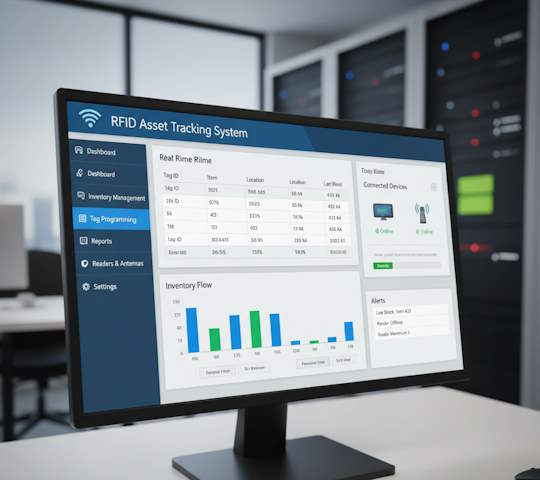


RFID and Supply Chain 4.0: Revolutionizing Pallet and Returnable Asset Tracking
Introduction: The New Era of Visibility in Logistics
In the modern global economy, supply chains have evolved into complex, multi-tiered ecosystems spanning dozens of countries and thousands of partners. Traditional tracking methods, such as barcodes and manual data entry, can no longer meet the demands for speed, accuracy, and transparency required by the e-commerce market and global trade. Stepping onto the stage is Supply Chain 4.0—a concept integrating the Internet of Things (IoT), Big Data, Artificial Intelligence, and cloud computing to create "smart," self-managing logistics networks.
At the heart of this transformation, particularly in the management of pallets and Returnable Transport Items (RTI), lies Radio Frequency Identification (RFID) technology. According to research by McKinsey & Company, companies implementing RFID for supply chain asset tracking report a reduction in operating costs of 20-30% and an increase in inventory accuracy up to 99.5%. RFID offers a fundamentally new level of asset visibility, automatically providing real-time data on the location, condition, and movement of every pallet or container.
This is not merely an evolution of existing processes, but a true revolution in logistics, paving the way for unprecedented efficiency, control, and predictive capabilities. Globally, billions of dollars are lost each year due to the inefficient management of returnable assets—a problem RFID is equipped to radically solve.
What is RFID and How Does It Work in Asset Logistics?
RFID (Radio Frequency Identification) is a wireless technology that uses electromagnetic fields for the automatic identification and tracking of tags attached to objects. Unlike barcodes, RFID tags do not require line-of-sight or precise positioning for reading, allowing dozens or even hundreds of objects to be scanned simultaneously in seconds. This foundational advantage makes RFID the ideal technology for dynamic logistics operations.
The key components of an RFID system include several interconnected elements. RFID Tags (or Transponders) are microchips with an antenna attached to pallets or containers. Passive Tags have no internal power source and are activated by energy transmitted from the reader. They are inexpensive (from $0.10 to $0.50), durable, and perfect for tracking reusable assets. Active Tags are battery-powered and can transmit a signal up to 100 meters, making them indispensable for high-value assets.
Readers are devices that generate a radio frequency field, "interrogate" the tags, and receive data. They can be stationary (installed in warehouse doorways, production lines, or terminal gates) or mobile (handheld terminals for spot checks). Antennas focus and direct the radio signal for optimal scan zone coverage.
The Software and Data Management System serves as the brain of the entire operation. This platform processes information from the readers in real-time, correlates it with data from ERP or WMS systems, and provides users with a convenient interface for asset analysis, visualization, and management.
Leading global manufacturers set the standards, including Impinj (chip technology leader), Zebra Technologies and Honeywell (readers and integrated solutions), and Siemens (full automation systems).
The Challenges of Traditional Pallet and RTI Management
Before the widespread adoption of RFID, managing fleets of pallets and RTIs was plagued by significant systemic inefficiencies and costs:
-
Asset Loss: Pallets and containers are lost, stolen, or mistakenly not returned by supply chain partners. The average annual pallet loss in the supply chain ranges from 5% to 10% of the total fleet (according to Chep research).
-
Supply Chain Blind Spots: Companies lack precise, real-time asset location data, leading to production schedule disruptions, excessive procurement of new assets, and inefficient working capital use.
-
Low Speed and High Error Rate: Manual counting and barcode scanning consumes valuable time at loading docks and is prone to human error, which can reach 5-10%.
-
Inefficient Asset Utilization: Lack of real-time data prevents optimization of routes and timely asset turnover, leading to assets sitting idle. Companies often maintain an excess fleet—sometimes 30-50% more than required—to compensate for unpredictable returns.
The Benefits of RFID for Tracking Pallets and Returnable Assets
Implementing RFID systems transforms pallets and RTIs from passive objects into "intelligent assets" that generate valuable data throughout their lifecycle.
-
Automation and Revolutionary Speed: Loading or unloading a truck with 30 RFID-tagged pallets takes 2-3 minutes, compared to 30-40 minutes for manual counting. Automated RFID tracking cuts cargo processing time by 75-85% (Aberdeen Group).
-
Data Accuracy Near 100%: Minimizing the human factor reduces counting errors to less than 0.5%, which is critical for accurate financial planning and preventing disputes.
-
Complete End-to-End Visibility: Companies gain the ability to see the location of every asset—from the manufacturing site to the distributor or third-party warehouse—at any given time.
-
Radical Reduction in Losses and Fleet Optimization: Automated tracking and notification systems significantly curb losses. Companies report reducing annual pallet loss from 8-10% to 1-2%. Accurate turnover data allows companies to optimize fleet size, often reducing it by 20-30%.
-
Improved Data Quality for Strategic Analytics: Detailed asset movement data helps analyze route efficiency, identify bottlenecks, assess partner reliability, and predict future demand with high precision.
Practical Implementation: Phased RFID Rollout
Successful RFID deployment for tracking pallets and RTIs requires a systematic, phased approach:
-
Asset Tagging: An industrial UHF RFID tag, resistant to external factors like moisture and temperature, is affixed to each pallet or container. The industry standard is EPC Gen2v2 (ISO 18000-63).
-
Infrastructure Outfitting: Warehouses, docks, production floors, and terminals are equipped with stationary RFID readers and antennas. Typical configurations include portals at entry/exit points and mobile terminals for spot checks.
-
Integration with Enterprise Systems: Real-time data from RFID readers flows into the Warehouse Management System (WMS) or Enterprise Resource Planning (ERP) system, such as SAP S/4HANA or Oracle SCM Cloud.
-
Automation of Receiving and Shipping: Upon truck entry, RFID gates automatically scan all pallets in seconds, instantly comparing the data against the Advanced Shipping Notice (ASN) and flagging discrepancies.
-
Continuous Monitoring and Proactive Management: Logisticians access interactive dashboards showing real-time asset location, turnover statistics, and key efficiency metrics. The system automatically generates notifications for critical events (e.g., exceeding asset retention time at a partner's site).
Global Case Study: A major European automotive components manufacturer tracked over 6 million returnable plastic containers using RFID. Within 18 months, they achieved a 15% reduction in their container fleet (saving €2.3 million) and a 40% reduction in annual losses, significantly optimizing asset turnover cycles.
Integrating RFID with Supply Chain 4.0 Technologies
RFID's maximum value is realized when integrated with other cutting-edge digital technologies, forming the Supply Chain 4.0 ecosystem:
-
RFID + IoT Sensors: Creates "smart" assets with enhanced monitoring capabilities, tracking temperature, humidity, shock, and tilt. This is critical for cold chain compliance in pharmaceuticals and food.
-
RFID + Blockchain: Provides an immutable and fully transparent history of every pallet's or container's movement. Each event is recorded in a distributed ledger, eliminating fraud and simplifying commercial dispute resolution.
-
RFID + Artificial Intelligence (AI): AI algorithms analyze large volumes of historical RFID data to enable predictive analytics—forecasting asset return times and suggesting optimal logistics routes.
-
Digital Twins: Creating an exact virtual replica of the entire RTI fleet, constantly synced with real-time RFID data, allows managers to simulate scenarios and test management strategies in a safe digital environment.
Frequently Asked Questions (FAQ)
How much does it cost to implement RFID for pallet and RTI tracking?
Implementation costs range from **$100,000 to $1 million USD** for medium to large companies, depending on scale. Key expenses include industrial RFID tags ($0.50 to $2 each), stationary readers/portals ($3,000 to $15,000 per point), software licenses, and integration. Typical ROI is achieved within 12–24 months through asset loss reduction and fleet optimization.
What is the reading range for RFID tags on pallets?
The read range for passive UHF RFID tags—the standard for pallet marking—is between 3 and 12 meters, depending on reader power and antenna type. For automated warehouse portals, a range of 6–10 meters is considered optimal to reliably scan all pallets within a moving truck.
Do RFID tags work on metal pallets and containers?
Standard RFID tags struggle with metal surfaces, which reflect radio waves. However, specialized "on-metal" RFID tags have been developed with shielding layers and modified antennas to work effectively on steel containers and metal pallets. These tags are more expensive ($1 to $3 each) but ensure reliable operation.
How long do RFID tags last on reusable pallets?
Passive industrial RFID tags, designed for harsh logistics environments, can maintain full functionality for 10–15 years or 500–1,000 use cycles. Since they have no batteries, their electronic part is nearly impervious to wear. Longevity is typically limited by physical damage or adhesive wear.
Can RFID be used to track pallets in international transport?
Yes. The EPC Gen2v2 (GS1) standard ensures global compatibility. However, operators must use "global" RFID tags that support the differing UHF frequency ranges used in various regions (e.g., North America: 902–928 MHz; Europe: 865–868 MHz).
Which companies have successfully implemented RFID for RTI management?
Global leaders include BMW Group (tracking 6+ million containers), Procter & Gamble (99.8% accuracy), the world's largest pallet pool operator CHEP (300+ million pallets), and Coca-Cola (25% improvement in asset turnover).
Conclusion
RFID technology has moved beyond novelty to become a critical tool for building the next generation supply chain—Supply Chain 4.0. In the context of pallet and RTI management, it provides the essential foundation of transparency, automation, and analytics required for digital transformation and operational excellence.
Investing in RFID is not merely an expense; it is a strategic commitment to business resilience, operational efficiency, and competitive advantage in the global arena. Companies that integrate RFID today are laying the robust foundation for a future where supply chains are intelligent, self-adjusting ecosystems capable of adapting to real-time changes.
📚 Resources and Authoritative Sources
🌍 International Organizations and Standards
- GS1 Global — Official EPCglobal standards and RFID implementation guides
- RAIN RFID Alliance — Technical documentation and best practices for UHF RFID
- ISO — International RFID standards (ISO/IEC 18000-63, ISO 17364, ISO 17366)
- AIM Global — International association for automatic identification and mobility
📊 Research and Analytical Agencies
- McKinsey & Company — Research on the digital transformation of supply chains
- Gartner — Reports on Supply Chain technologies and RFID ROI systems
- Aberdeen Group — Research on the operational efficiency of logistics technologies
- IDTechEx — Market forecasts and technology trends for RFID and IoT
- MarketsandMarkets — Market analysis of RFID in logistics and Supply Chain
- Zebra Technologies Research — Industry studies and reports on RFID implementation
🏭 Leading Equipment Manufacturers and Solutions
- Zebra Technologies — Mobile and stationary RFID solutions for logistics
- Impinj — RFID chips, readers, and platform for developers
- Honeywell — Industrial RFID terminals and scanners
- Siemens — Comprehensive solutions for supply chain and industrial automation
- Avery Dennison — RFID tags and inlays for various applications
- Confidex — Industrial RFID tags for harsh operating conditions